Clear Sky Science · en
Early-onset Palmijihwang-hwan treatment modulates phospholipid metabolism and gut microbiota for healthy aging: reducing adipose inflammation and oxidative stress
Why an Old Herbal Remedy Matters Today
Many people hope to age in better health, not just live longer. This study looks at Palmijihwang-hwan, a classic East Asian herbal formula used for centuries in older adults, and asks a modern question: can starting it early in life gently tune our metabolism and gut bacteria to support healthier aging, without the side effects seen with some newer drugs?
A Traditional Mixture Put to a Modern Test
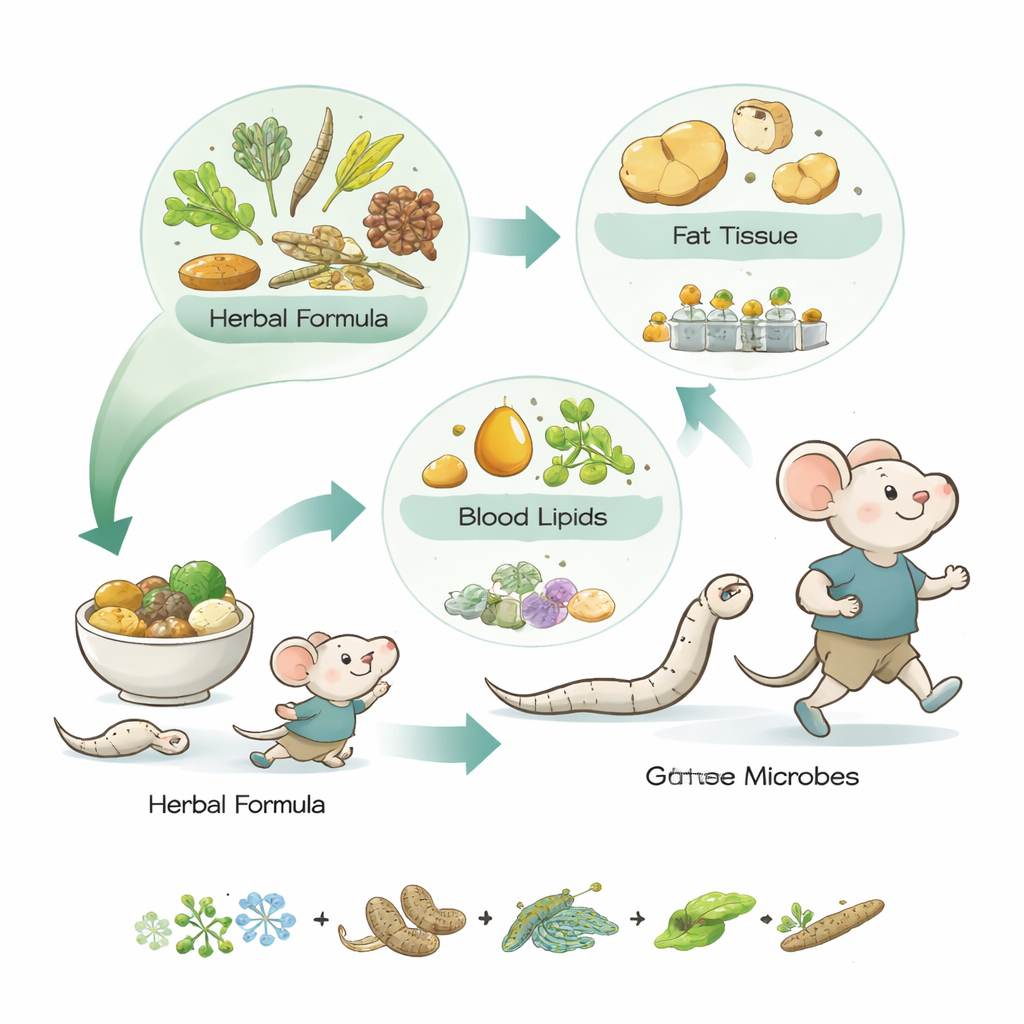
Palmijihwang-hwan is a blend of eight herbs, including roots, bark, and fungi that contain well-known plant compounds. The researchers first mapped its chemical makeup using advanced chromatography and mass spectrometry, identifying twenty main ingredients in measurable amounts. They then tested the formula as a daily supplement, starting early in life, in two very different organisms: microscopic worms (Caenorhabditis elegans) and laboratory mice. This design let them ask whether the remedy could influence basic aging traits across species rather than just treat a single symptom.
Living Longer Without Obvious Harm
When worms received the herbal mixture in their food, they lived up to about 40 percent longer than untreated worms, and showed fewer signs of cellular wear and tear, such as age-related pigment buildup and loss of movement. In mice, treatment began at two months of age—roughly early adulthood—and continued for 16 months, into old age. Mice given Palmijihwang-hwan in their drinking water had better survival than control mice, without losing weight or showing damage to major organs like the liver and kidneys. Tests of liver and kidney function in the blood also looked normal. Markers of “cellular aging” in tissues, such as a stain called SA-β-gal and proteins p16 and p21, were lower in treated animals, suggesting that the buildup of worn-out cells slowed down.
Calmer Fat Tissue and Friendlier Blood Fats
As animals age, fat stored around organs tends to become inflamed and hormone‑secreting, feeding problems like diabetes and heart disease. In the treated mice, a key fat depot in the abdomen was smaller, and blood levels of leptin, resistin, and insulin—all linked to obesity and metabolic strain—were reduced. Yet the mice did not eat less or lose overall body weight, hinting that the formula acted on how the body handles energy rather than simply cutting calories. A broad survey of blood lipids showed that aging normally shifts the balance toward “broken” membrane fats called lysophospholipids, which can promote inflammation. Palmijihwang-hwan nudged the pattern back toward intact phospholipids and lowered the activity of a fat‑cleaving enzyme, PLA2G7, at the gene level in fat tissue. This enzyme is known from human studies of calorie restriction as a driver of age‑related inflammation.
Rebalancing Gut Bugs Linked to Inflammation
The team also examined the gut microbiome, the vast community of microbes living in the intestines. Aging control mice showed a familiar pattern: more bacteria from groups tied to gut inflammation and disease. Mice given the herbal formula had a different microbial fingerprint. Harm‑associated species, including Helicobacter ganmani, Vampirovibrio chlorellavorus, and Oscillibacter valericigenes, were reduced, while potentially beneficial bacteria such as Lactobacillus johnsonii increased. Statistical links suggested that certain “bad” microbes tracked with more inflammatory lipids and higher insulin levels, while friendlier microbes tracked with healthier lipid species. Although these connections do not prove cause and effect, they fit with the idea that tweaking gut communities can calm inflammation in distant organs like fat.
Connecting the Dots for Healthy Aging
Taken together, the findings suggest that starting Palmijihwang-hwan early in life may help animals age more healthily by acting on two interconnected fronts: it steers blood fats away from inflammation‑prone forms by damping down enzymes like PLA2G7, and it reshapes gut microbes away from species linked to chronic irritation. This combination appears to keep fat tissue quieter, lower insulin and certain hormones, and support longer, healthier lives in worms and mice. While much more work is needed—especially to confirm safety, isolate active ingredients, and test in humans—the study offers a modern scientific framework for how a long‑used herbal formula might gently tune the body’s metabolism and microbiome to promote healthy aging.
Citation: Lee, S.M., Yoon, J.J., Kim, H.Y. et al. Early-onset Palmijihwang-hwan treatment modulates phospholipid metabolism and gut microbiota for healthy aging: reducing adipose inflammation and oxidative stress. npj Aging 12, 35 (2026). https://doi.org/10.1038/s41514-026-00334-4
Keywords: healthy aging, herbal medicine, gut microbiome, lipid metabolism, inflammation