Clear Sky Science · en
Behavioral and psychophysical characterization of proprioceptive impairment in healthy aging: a hyper-illusory experience of movement
Why our hidden sense of movement matters as we age
Every time you reach for a glass of water or button a shirt, your brain quietly relies on a “sixth sense” called proprioception—the internal feeling of where your limbs are and how they are moving. This study explores how that sense changes with healthy aging, revealing that older adults may actually experience movements more intensely than younger people when the body is tricked by carefully controlled illusions of motion.
Two sides of our body sense
Proprioception has two main parts: knowing where a joint is (position sense) and feeling it move (movement sense, or kinesthesia). Earlier research suggested that aging can blunt these abilities, but results were mixed, especially for the arms and hands we use for everyday tasks. The authors designed a set of experiments focusing on the wrist, a joint crucial for fine hand control, to tease apart these components. They compared 29 young adults in their mid‑20s with 26 older adults in their late 60s to see whether aging affects position and movement in the same way.
Matching hand positions: a stable skill
In the first experiment, volunteers sat with both forearms supported while the experimenter gently bent the dominant wrist to about half or three‑quarters of its maximum flexion. With eyes closed, participants then tried to match that position with the other wrist. Despite older adults having slightly stiffer wrists overall, both age groups were equally accurate in matching the target angles. This suggests that, at least under controlled conditions and when both hands are used at the same time, the basic sense of where the wrist is in space can remain surprisingly intact with age.
Illusions of motion: when older adults feel “too much” movement
To probe movement sense, the team used a classic trick: a small mechanical vibrator placed over the tendons at the back of the wrist. When it buzzes at certain frequencies, it excites muscle sensors and convinces the brain that the joint is moving, even though it stays still. In the second experiment, the dominant wrist was vibrated at seven different frequencies while the other wrist was free to move. Participants were asked to copy the illusory movement as they felt it and to rate how vivid it seemed. 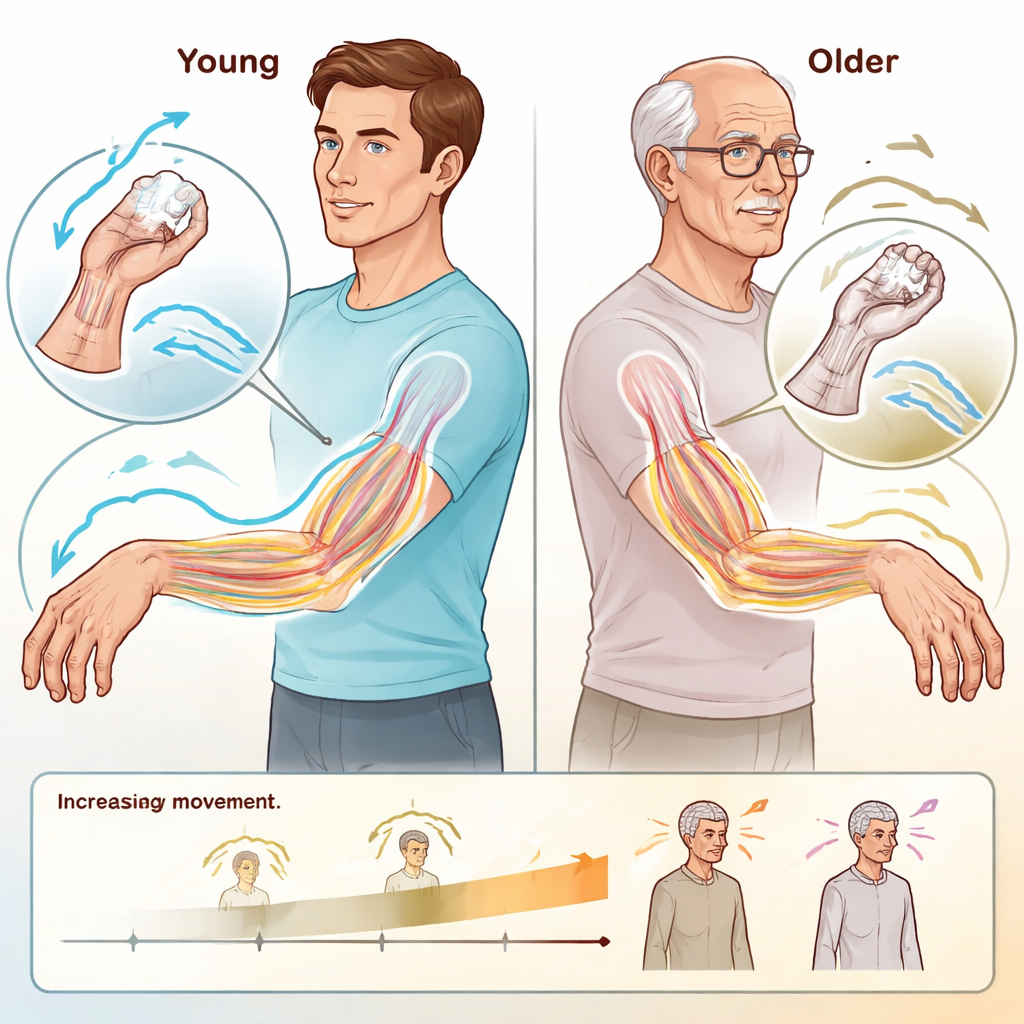
Testing fine discrimination: a blurrier internal scale
In a third experiment, the vibrator delivered two brief bursts in each trial: a standard frequency and a comparison frequency. With their eyes closed, participants simply chose which of the two produced the stronger feeling of motion. From many such choices, the researchers built a “psychometric curve” and estimated the smallest change in frequency people could reliably detect. Younger adults required only small differences to tell one stimulus from another, whereas older adults needed larger gaps. This means that, even though older participants felt strong illusory movements, their internal scale for grading those sensations was coarser and less precise.
What lies behind a stronger illusion
How can older adults feel more movement yet distinguish it less well? The authors discuss changes both in the sensors inside muscles and in the brain’s processing hubs. Specialized nerve endings called muscle spindles provide rapid information about motion; animal work suggests their fastest fibers slow and change behavior with age. At the same time, brain regions that integrate body signals and control posture show structural and connectivity changes in later life. Together, these shifts may make the nervous system less “critical” in evaluating incoming signals, accepting even artificial stimulation as strong, genuine movement and reducing its ability to compare sensations precisely.
What this means for everyday life
Overall, the study paints a nuanced picture: in healthy aging, the sense of joint position can remain relatively stable, while the sense of movement becomes exaggerated yet less finely tuned. For older adults, this could mean that certain body signals feel stronger or more confusing, even though static positioning feels normal. Understanding this “hyper‑illusory” experience of motion may help clinicians design better balance and movement training, targeting the specific parts of proprioception that change with age rather than assuming a general decline. 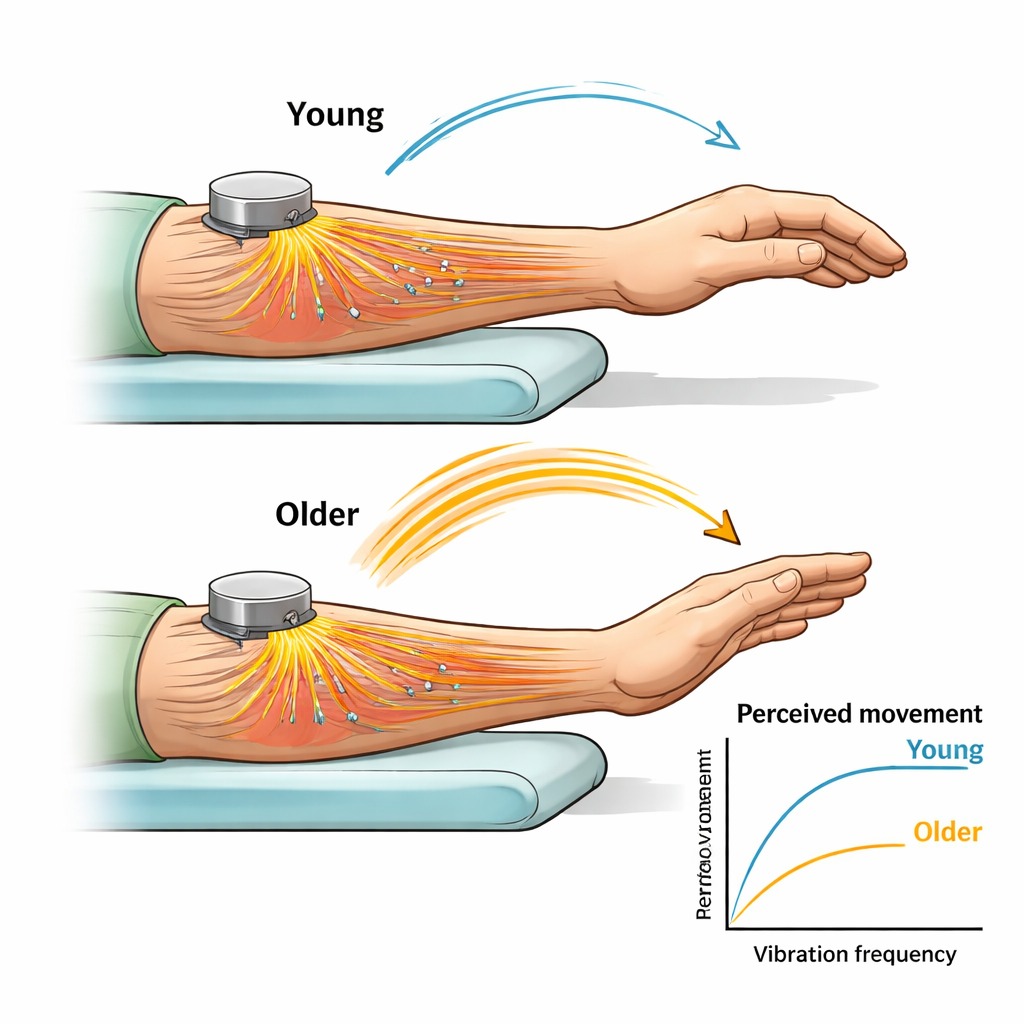
Citation: Mirabelli, F., Albergoni, A., Avanzino, L. et al. Behavioral and psychophysical characterization of proprioceptive impairment in healthy aging: a hyper-illusory experience of movement. npj Aging 12, 34 (2026). https://doi.org/10.1038/s41514-026-00333-5
Keywords: proprioception, healthy aging, kinesthetic illusion, muscle spindles, sensorimotor control