Clear Sky Science · en
High-frequency biparental inheritance of plant mitochondria upon chilling stress and loss of a genome-degrading nuclease
Why plant parents matter
In most biology textbooks, we learn that plants and animals inherit their tiny power stations—mitochondria—almost exclusively from their mothers. This rule helps keep energy systems stable across generations. But what if fathers sometimes sneak a few mitochondria into the next generation, changing how plants grow, reproduce and evolve? This study in tobacco plants uncovers when and how paternal mitochondria can break through the usual barriers, and shows that this rare event can actually rescue sick plants and restore their fertility.
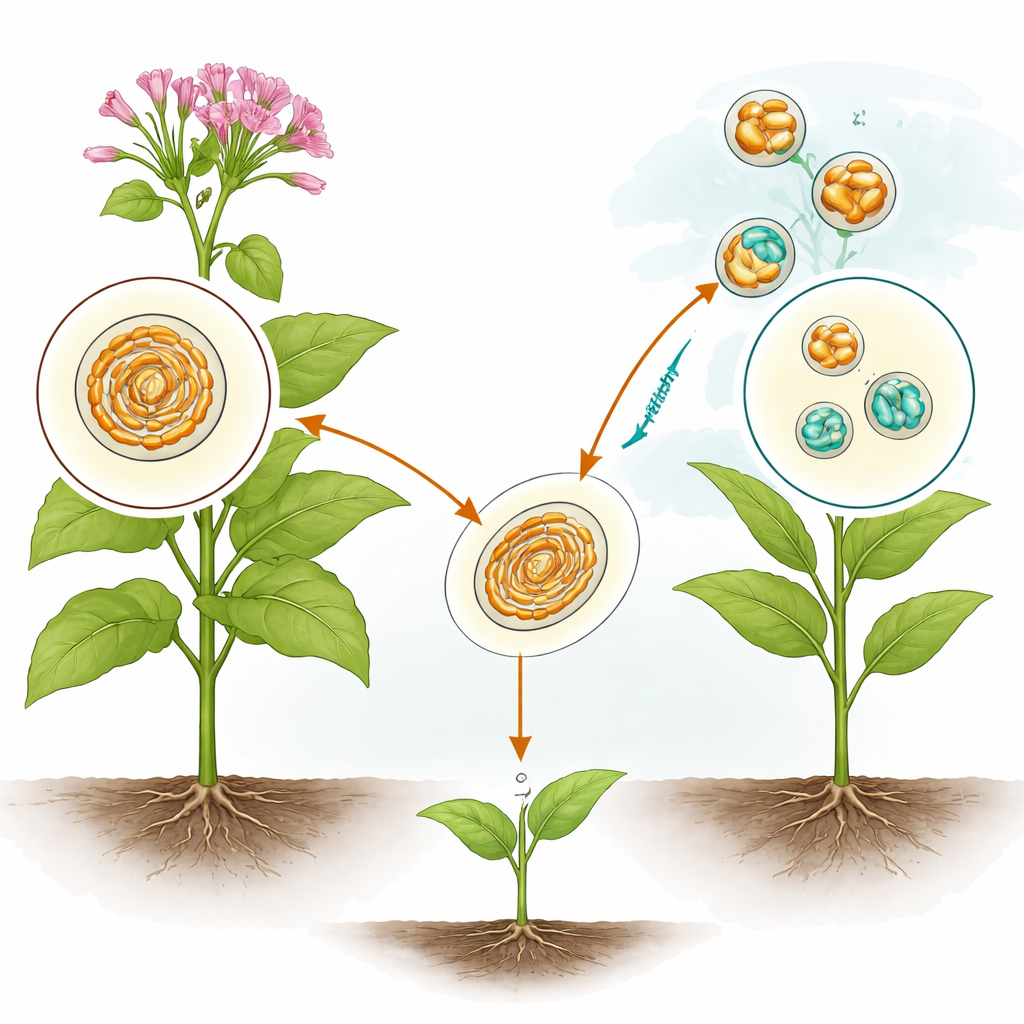
A hidden second parent in plant power cells
Every plant cell carries three sets of genetic instructions: in the nucleus, in chloroplasts (for photosynthesis) and in mitochondria (for respiration). While nuclear DNA comes from both parents, the DNA in chloroplasts and mitochondria usually travels only through the mother. The authors wanted to know how strict this maternal rule really is for mitochondria, and which cellular gatekeepers enforce it. To tackle this, they used tobacco plants with a damaged mitochondrial gene called nad9. Plants missing this gene germinate slowly, grow poorly and are male-sterile because their mitochondria cannot fuel development properly.
Using sick seeds as a natural sensor
The researchers turned this mitochondrial defect into a sensitive biological "sensor" for paternal mitochondria. They used the slow-germinating, male-sterile plants as mothers and crossed them with fathers that carried healthy mitochondria. Any offspring that suddenly germinated quickly and looked vigorous were likely to have received working mitochondria from the father. With this approach, they found that paternal mitochondria do slip through more often than expected—even under normal greenhouse conditions, about 0.18 percent of offspring carried paternal mitochondrial contributions. When the team combined two conditions in the pollen donor—growth at low temperature and loss of a DNA-degrading enzyme called DPD1—that rate jumped dramatically to over 7 percent.
How cold and a missing enzyme open the gate
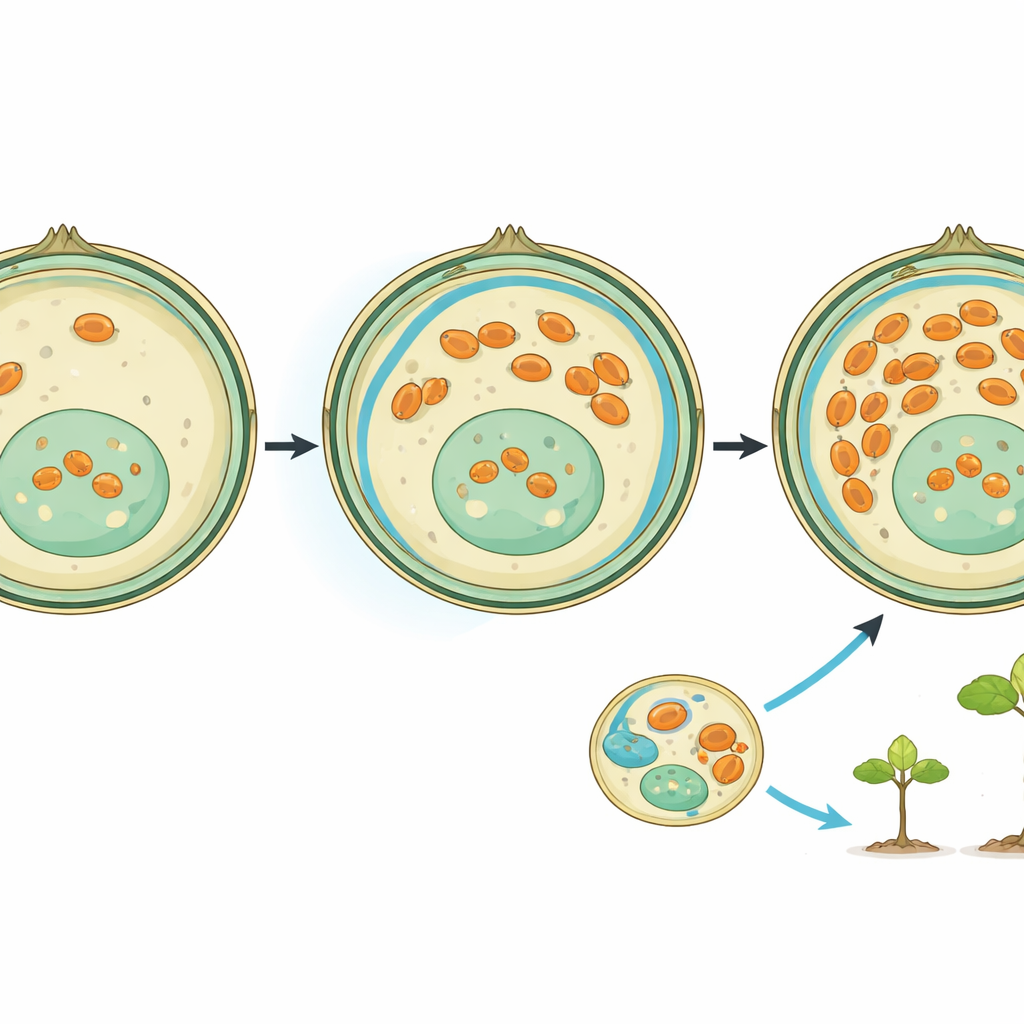
To see what was changing inside pollen, the authors used high-resolution electron microscopy and fluorescent dyes. In pollen formed at a chilly 10 °C, the inner reproductive cell (the generative cell) contained more mitochondria than at warmer temperatures. At the same time, in plants lacking the DPD1 exonuclease, the DNA inside those mitochondria was no longer efficiently destroyed during pollen maturation. Staining experiments showed bright DNA signals co-localizing with mitochondria only in the mutant pollen. Together, more mitochondria entering the male germ cell and reduced DNA breakdown meant that many DNA-containing mitochondria could now be carried by sperm into the egg and pass their genomes to the next generation.
Rescuing growth and reversing male sterility
When paternal mitochondria successfully entered the offspring, their impact was striking. Some progeny carried a mix of maternal and paternal mitochondrial genomes, a state known as heterochondriomy. In these plants, paternal mitochondria supplying the intact nad9 gene restored normal seed germination, healthy growth and, in most cases, male fertility. The once-sterile line could now produce viable pollen and full seed capsules. By following seeds into the next generation, the team showed that either maternal, paternal or mixed mitochondrial populations could be passed on, demonstrating that these "rescued" mitochondria can become part of the long-term family line.
What this means for crops and evolution
These findings overturn the notion that paternal mitochondrial inheritance in plants is almost nonexistent. Instead, it appears that environmental conditions such as chilling, together with specific DNA-destroying enzymes, actively shape which parent’s mitochondria survive in the next generation. This has practical consequences: traits like cytoplasmic male sterility, widely used in hybrid seed production, arise from mitochondrial mutations that normally cannot be fixed by crossing to a healthy line because mitochondria are assumed to be strictly maternal. Allowing paternal mitochondria through offers a new way to restore fertility without detailed knowledge of the underlying mutations. On an evolutionary scale, occasional biparental inheritance creates opportunities for mixing and matching mitochondrial genomes, boosting diversity and potentially helping plants adapt to changing environments.
Citation: Gonzalez-Duran, E., Liang, Z., Forner, J. et al. High-frequency biparental inheritance of plant mitochondria upon chilling stress and loss of a genome-degrading nuclease. Nat. Plants 12, 571–582 (2026). https://doi.org/10.1038/s41477-026-02242-7
Keywords: plant mitochondria, paternal inheritance, cytoplasmic male sterility, tobacco genetics, organellar DNA