Clear Sky Science · en
ZmMYB127 controls maize endosperm filling via dual-transcriptional regulation to improve grain yield and quality
Why better corn kernels matter
Maize, or corn, feeds people and livestock around the globe, and most of its calories and nutrients sit in a tissue called the endosperm inside each kernel. Farmers and breeders usually face a trade-off: pushing kernels to yield more often dilutes their protein, vitamins and minerals. This study uncovers a molecular switch in maize grain called ZmMYB127 that helps fill kernels more completely while also packing in more nutrients, pointing to a new way to grow corn that is both higher yielding and more nutritious.
A control hub inside the seed
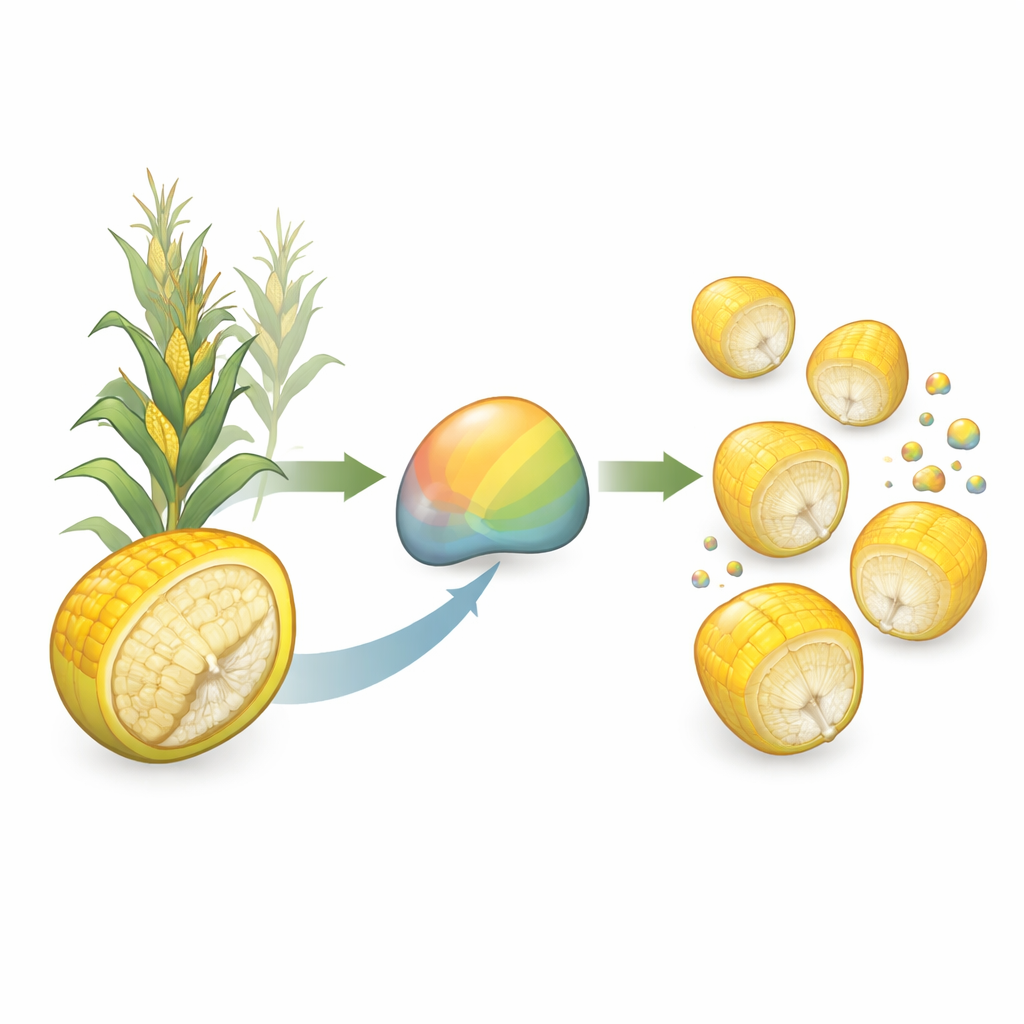
Inside a developing maize kernel, different cell layers cooperate to stockpile starch, protein, vitamins and minerals. The authors focused on a thin outer layer called the aleurone and the starchy interior, because both are crucial for yield and nutrition. By scanning gene activity across many maize tissues and stages, they found one control gene, ZmMYB127, that switches on almost exclusively during the filling phase of the endosperm. When they used gene editing to knock this gene out, kernels became lighter, softer and more opaque, with less starch and protein. Microscopy revealed that the once neat, brick-like aleurone cells turned irregular as the kernel filled, and chemical analyses showed sharp drops in vitamins B6 and B9 and in key minerals such as iron and zinc. Together, these defects showed that ZmMYB127 is essential for building well-structured, nutrient-rich kernels.
Two opposite jobs for one regulator
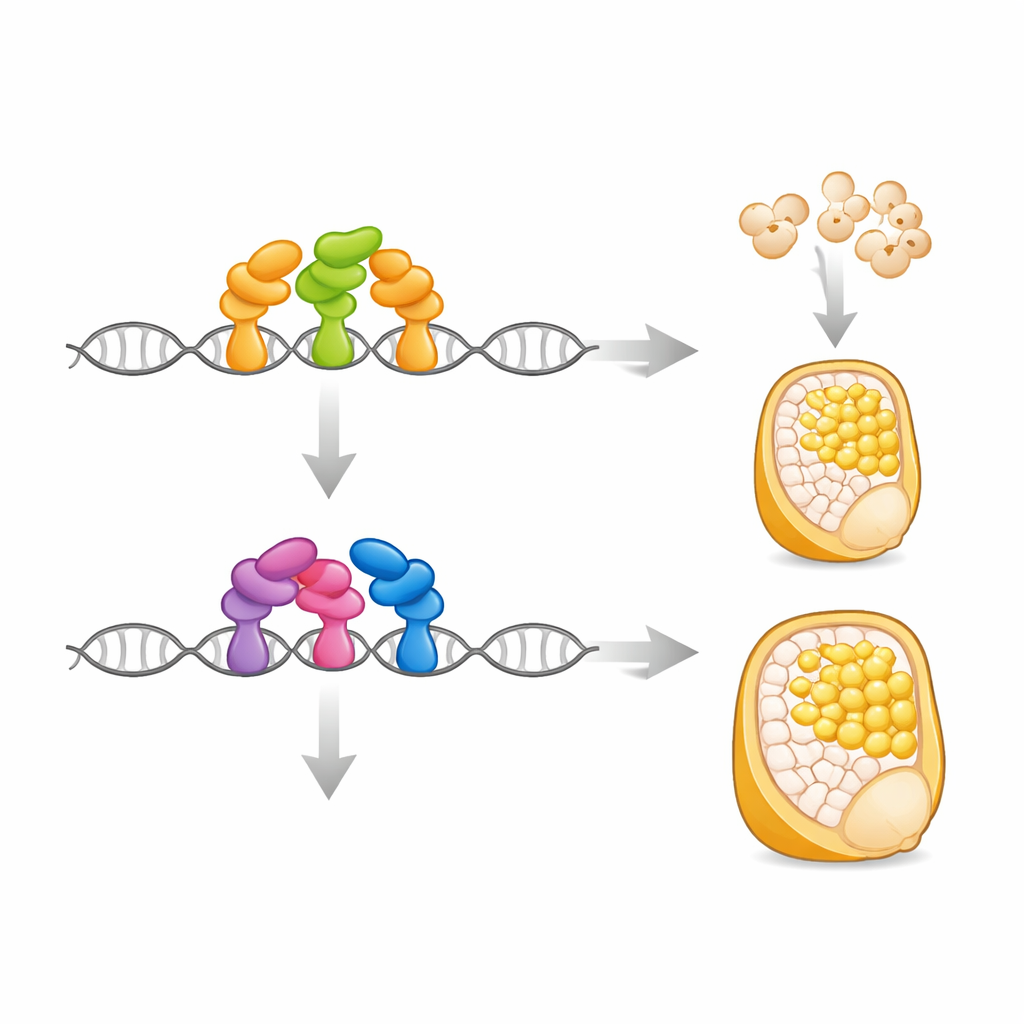
Digging deeper, the team asked how a single factor could have such wide influence. They mapped where ZmMYB127 binds along the DNA in developing endosperm and found that it sits on regulatory regions of several master grain-filling genes. Intriguingly, it performs a dual role. In one mode, ZmMYB127 teams up with another protein, Opaque2, to strongly activate genes that drive endosperm filling and proper aleurone structure, such as NKD1 and NKD2. In a second mode, it helps shut down genes like CR4 and Opaque2 itself by forming a larger complex with two other proteins, ZmLUG3 and ZmABI4. Which mode it adopts depends on the nearby DNA “docking sites” and which partners are present. This push-and-pull control lets ZmMYB127 fine-tune how much storage material is produced and how the outer cell layer develops, rather than simply turning processes fully on or off.
From molecular wiring to heavier, healthier grain
Armed with this mechanistic picture, the researchers tested whether boosting ZmMYB127 only in the filling endosperm could improve real-world crops. They engineered maize plants to overproduce ZmMYB127 under a promoter that is active just during this stage, and grew them in multi-year, multi-location field trials. Kernels from these lines had more hard, glassy endosperm, were up to about 15% heavier, and showed sizable gains in starch and especially protein content, all without changing plant height, ear size or kernel number. Microscopy showed the aleurone layer nearly doubled in thickness, and nutrient profiling revealed large increases in vitamins B6 and B9 and in phosphorus, iron and zinc. Importantly, the same genetic tweak introduced into a widely grown hybrid, Zhengdan958, delivered similar improvements in kernel weight, hardness and nutritional value while leaving overall plant performance unchanged.
A shared strategy across cereal crops
The study also looked beyond maize. A closely related gene in rice, OsMYB20, turns on during grain filling in a similar pattern. Rice plants lacking this gene produced chalkier, lighter grains with disorganized outer layers, while rice lines overproducing it made slightly larger, heavier grains and thicker aleurone in specific regions. These parallels suggest that the molecular design discovered in maize—using a dual-function regulator to orchestrate endosperm filling—may be conserved across major cereals such as rice and possibly wheat and sorghum. That raises the prospect of a common breeding strategy to improve grain quality in multiple staple crops.
What this means for future food security
To a non-specialist, the key message is that the authors have found a way to encourage kernels to act like better “grain factories” from the inside out. By precisely boosting ZmMYB127 in the part of the seed that fills with nutrients, they could grow corn that is simultaneously heavier, richer in protein and micronutrients, and better suited for processing, without the usual penalties to plant vigor or yield components. Because the same type of regulator works in rice, and can in principle be tuned further with modern gene-editing tools, this work offers a blueprint for designing cereal varieties that help close protein and micronutrient gaps while maintaining high productivity.
Citation: Shi, J., Li, Z., Wang, Z. et al. ZmMYB127 controls maize endosperm filling via dual-transcriptional regulation to improve grain yield and quality. Nat. Plants 12, 617–634 (2026). https://doi.org/10.1038/s41477-026-02238-3
Keywords: maize endosperm, grain filling, transcriptional regulation, crop biofortification, precision breeding