Clear Sky Science · en
Photorespiration is linked to DNA methylation by formate as a one-carbon source
How Leaves Turn Air and Light into Lasting Memories
Plants do more than just convert sunlight into sugar. They also record hints of the environment in their DNA, leaving chemical marks that can influence growth, stress resistance and even future generations. This study reveals a surprising bridge between these two worlds: a wasteful side reaction of photosynthesis called photorespiration turns out to feed the chemical machinery that writes and maintains DNA “memory” marks. As rising carbon dioxide and shifting climates change photorespiration, they may also quietly reshape plant genomes over time.
A Costly Detour in Plant Photosynthesis
When plants harvest light, the key enzyme that captures carbon dioxide sometimes grabs oxygen instead. This mistake launches photorespiration, a repair loop that recovers some carbon but spends energy and releases CO2. Traditionally viewed as an unfortunate drain on crop yields, photorespiration is now recognized as deeply intertwined with other metabolic routes. One by-product of this repair loop is formate, a tiny one‑carbon molecule made in plant mitochondria. The authors asked whether this humble by-product might do more than just get burned off—could it help fuel the chemical reactions that place methyl groups, small carbon‑containing tags, onto DNA?
The Hidden Pipeline from Formate to DNA Marks
Inside plant cells, a network called one‑carbon metabolism shuttles single carbon units between different molecules. These units eventually supply the methyl groups that are added to DNA, helping keep jumping genes silent and maintaining stable gene activity. Working in the model plant Arabidopsis, the researchers focused on two key enzymes, THFS and MTHFD1, that convert formate into the active one‑carbon forms needed for DNA and amino acid chemistry. Using mutants with weakened or missing MTHFD1, they found that plants accumulated inhibitory by‑products, lost DNA methylation across large regions of the genome, and began to unlock normally silent transposable elements. Strikingly, knocking out THFS in these mutants restored normal growth and most DNA methylation patterns, revealing that the formate‑processing route and a parallel serine‑based route normally balance one another to keep one‑carbon supply steady. 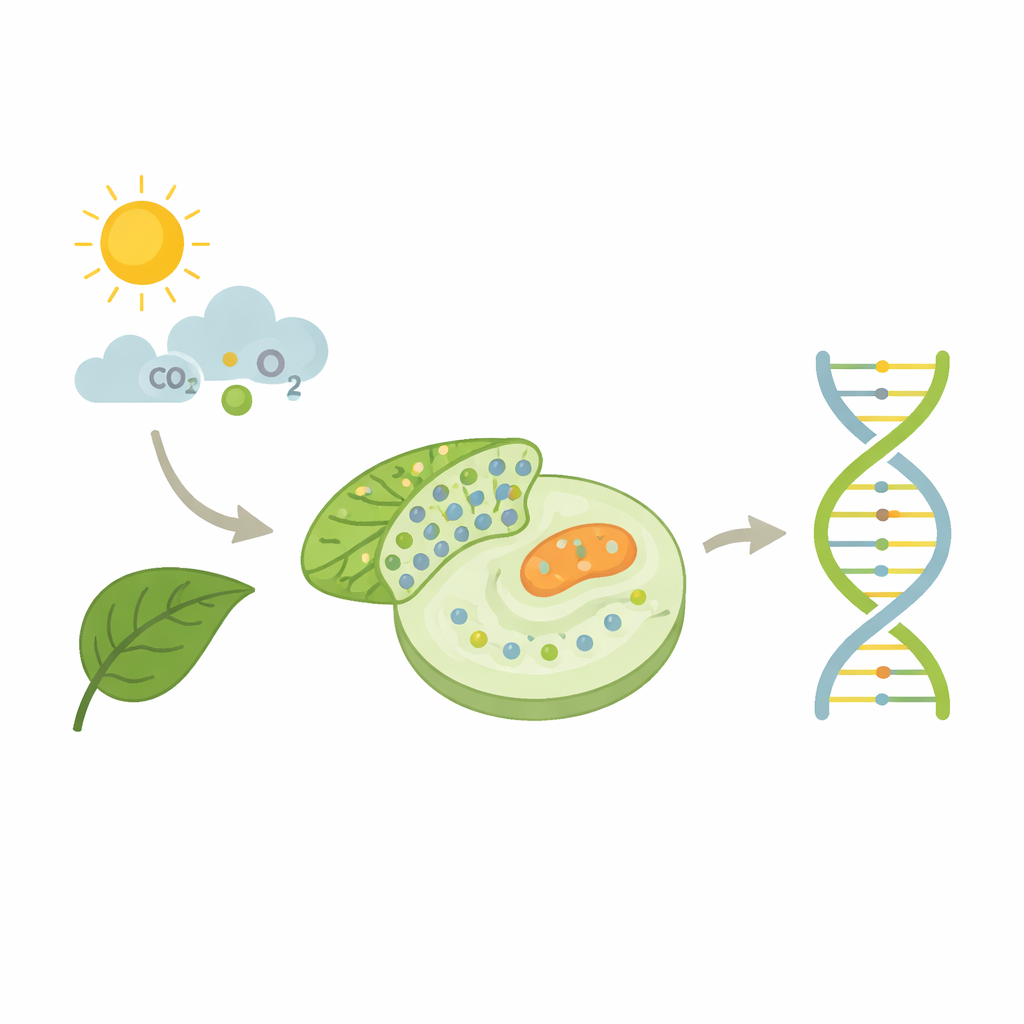
Tracking Carbon Atoms from Breath to Genome
To show directly that formate feeds DNA methylation, the team supplied plants with formate labeled with a heavy version of carbon and followed where those atoms went. Using sensitive mass spectrometry, they detected the label in methionine, the amino acid precursor of the universal methyl donor, and in methylated cytosine bases within DNA. This labeling depended on THFS and MTHFD1 and was strongest during the day, when photorespiration is active, but not at night. They also observed labeled thymine bases, linking formate to the building blocks of DNA itself. By contrast, the purine base adenine did not depend on this cytosolic pathway, matching previous evidence that its synthesis occurs elsewhere in the cell. Together, these experiments map a clear route: photorespiratory formate is recycled into the one‑carbon network and ends up as chemical tags on the genome.
Day Length, Carbon Dioxide and the Epigenetic Balance
The strength of this link shifted with light cycles and air composition, tying DNA chemistry to the outside world. Under long summer‑like days, MTHFD1 mutants showed strong build‑up of one‑carbon intermediates, accumulation of a natural inhibitor molecule, loss of DNA methylation and widespread activation of transposable elements. Shorter days greatly softened these problems, suggesting that when light is limited plants rely more on a serine‑based route for one‑carbon supply, easing the demand on the formate pathway. The team then grew plants under very high carbon dioxide, which suppresses photorespiration. In normal plants, this treatment produced subtle DNA methylation changes, especially in certain gene regions. In MTHFD1 mutants, however, high CO2 partly restored DNA methylation and reined in rogue genetic elements, consistent with a reduced flow of formate into a faulty pathway. This shows that shifts in photorespiration—driven by day length, CO2 levels, temperature or drought—can ripple through one‑carbon metabolism and reshape patterns of DNA marking.
Why This Matters for Crops and Climate
The work recasts photorespiration from a mere energy drain into a gatekeeper of epigenetic stability. By demonstrating that carbon atoms from photorespiratory formate end up in DNA methylation marks, the authors provide a concrete mechanism by which the environment can influence the plant epigenome through core metabolism. As atmospheric CO2 rises and heat and water stress intensify, the balance between formate‑ and serine‑derived one‑carbon supply is likely to shift, changing how faithfully DNA methylation is maintained. Over many generations, such shifts could alter the activity of genes and mobile elements in ways that affect adaptation, yield and resilience. Understanding this metabolic bridge may therefore help breeders and biotechnologists predict and perhaps steer how crops respond, at the level of their genomes, to the climate of the future. 
Citation: Hankofer, V., Ghirardo, A., Obermaier, L. et al. Photorespiration is linked to DNA methylation by formate as a one-carbon source. Nat. Plants 12, 653–664 (2026). https://doi.org/10.1038/s41477-026-02222-x
Keywords: photorespiration, DNA methylation, one-carbon metabolism, plant epigenetics, climate change