Clear Sky Science · en
Long-distance transport of siRNAs with functional roles in pollen development
How plant roots quietly help make fertile pollen
Plants cannot walk, but they constantly send internal messages to coordinate growth and reproduction. This study reveals that roots of the wildflower Capsella rubella send tiny RNA "signals" all the way up to the flowers, where they help pollen mature properly. Understanding this hidden postal system inside plants may open new ways to protect crops from infertility caused by stress or climate change.
Invisible messengers on the move
Plants use many kinds of small RNA molecules to fine‑tune which genes are turned on or off. Among them are small interfering RNAs (siRNAs), snippets only about 21–24 building blocks long. They can travel between cells and even from one organ to another, acting as mobile chemical messages. Until now, scientists knew such RNAs could move through the plant body, but they did not know in detail how far they go in nature or how important they are for forming viable pollen grains that carry sperm cells.
A mutant plant that stalls pollen
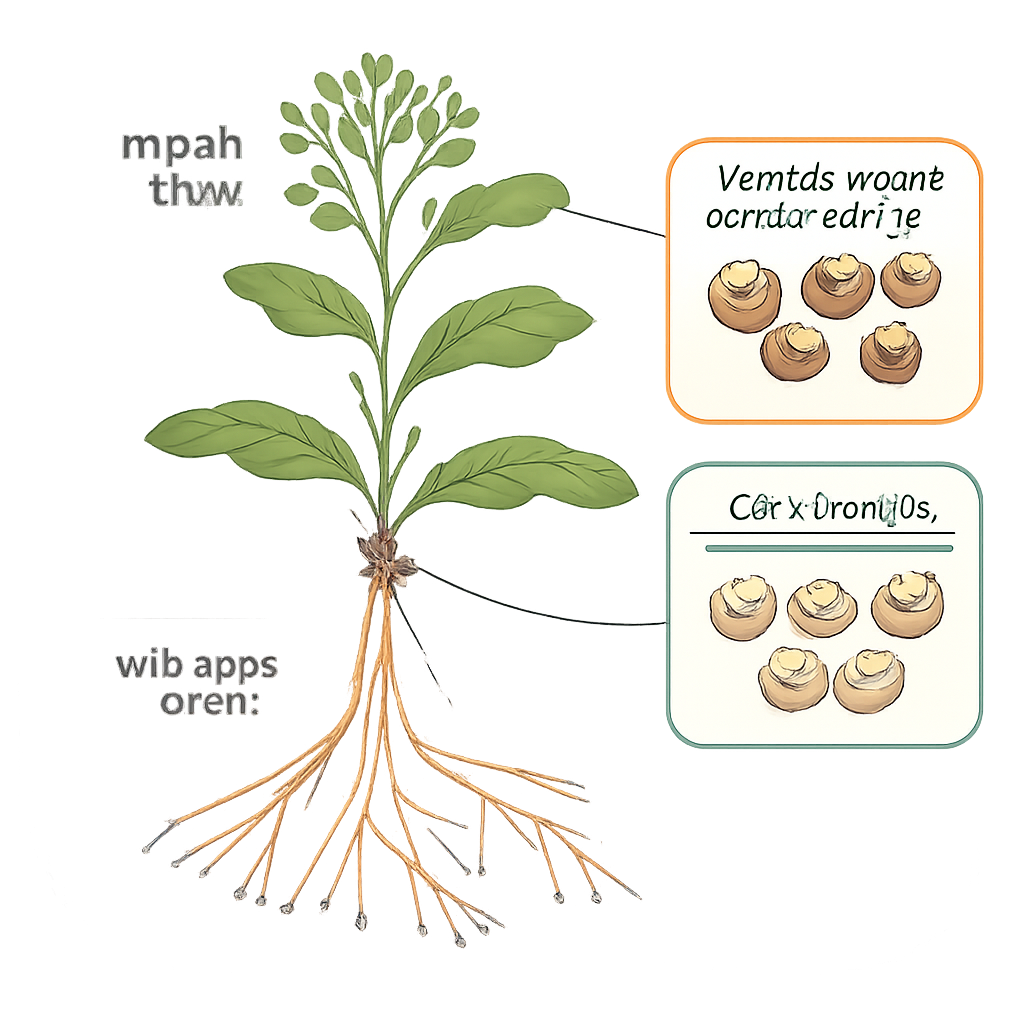
The researchers focused on plants lacking a key enzyme called RNA polymerase IV (Pol IV), which is required to make many siRNAs. In Capsella, plants missing the main Pol IV subunit, called NRPD1, produce pollen that arrests early at the microspore stage instead of maturing into functional grains. These mutants also show a dramatic loss of siRNAs in pollen. To test whether mobile siRNAs from healthy tissue could rescue this defect, the team grafted shoots of mutant plants onto roots of normal plants, creating individuals whose above‑ground parts were defective but whose roots could still make Pol IV‑dependent siRNAs.
Grafting restores pollen and mobile RNAs
After grafting, the mutant shoots produced far more mature, viable pollen and set many more seeds than ungrafted mutants, although not quite as many as fully normal plants. Microscopy showed improved pollen development and better guidance of pollen tubes toward ovules. When the scientists sequenced small RNAs from the rescued pollen, they discovered that a large set of siRNAs had been restored. Most of these came from 169 genomic regions that produced especially abundant siRNAs; the authors named these Pol IV‑dependent mobile siRNAs, or PMsiRNAs. Remarkably, these 169 regions accounted for more than half of all Pol IV‑dependent siRNA reads in pollen, implying a focused and powerful long‑distance signal.
Gene control without rewriting DNA marks
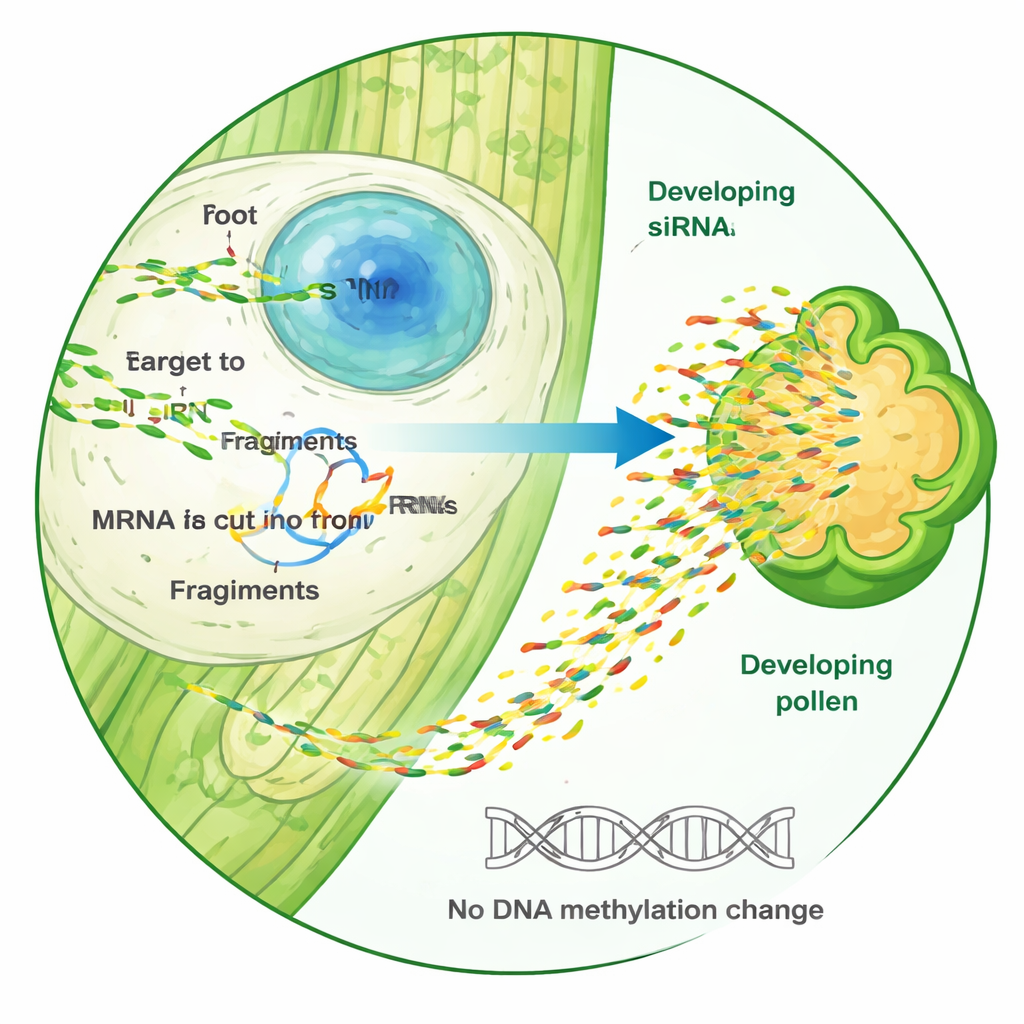
Many Pol IV‑derived siRNAs in other contexts guide chemical tags called DNA methylation, which switch genes off at the level of the DNA itself. Here, however, whole‑genome methylation profiling showed that DNA methylation remained low in mutant tissue even after grafting. In other words, PMsiRNAs did not repair the plants by restoring these DNA marks. Instead, biochemical experiments revealed that PMsiRNAs are loaded into a protein called ARGONAUTE1, which typically cuts or blocks messenger RNAs in the cell cytoplasm. PMsiRNAs accumulate mainly over the protein‑coding parts of genes, particularly ones related to pollen development and growth, and their presence correlates with a partial return to normal gene activity in developing pollen. This points to a post‑transcriptional mechanism: PMsiRNAs help shape which RNA messages are present, rather than rewriting the underlying DNA.
Roots as long‑distance partners in reproduction
Where do the triggering signals originate? By sequencing siRNAs from roots, the team found many Pol IV‑dependent siRNAs that could pair, with a few mismatches, to the PMsiRNA‑producing regions in pollen. Multiple root loci often targeted the same pollen locus, suggesting that root‑derived siRNAs travel upward, recognize matching RNA sequences in the shoot, and spark a cascade that amplifies PMsiRNAs locally in reproductive cells. Plants lacking another RNA‑processing enzyme, RDR6, also showed severe pollen defects, reinforcing the idea that small‑RNA‑based quality control is vital for male fertility, even though PMsiRNAs themselves appear to be made largely without RDR6.
Why this matters beyond one wildflower
The study reveals a long‑distance communication route in which siRNAs made in roots help steer pollen development in distant flowers, acting not by permanent DNA changes but by flexible RNA‑level regulation. These PMsiRNAs resemble reproductive small RNAs found in many other flowering plants, suggesting that similar invisible conversations between roots and flowers may be widespread. In practical terms, learning how plants use mobile RNAs to safeguard pollen could help breeders and biotechnologists design crops that maintain fertility under environmental stress, thereby stabilizing yields in a changing climate.
Citation: Zhu, J., Santos-González, J., Wang, Z. et al. Long-distance transport of siRNAs with functional roles in pollen development. Nat. Plants 12, 386–399 (2026). https://doi.org/10.1038/s41477-026-02219-6
Keywords: plant reproduction, small interfering RNA, pollen development, root-to-shoot signaling, RNA mobility