Clear Sky Science · en
Thermosensory reconfiguration of the auxin transcriptional pathway to drive root cell growth
Why warmer roots matter
As heat waves and shifting climates reshape agriculture, understanding how plant roots cope with warmth is crucial. Roots are the hidden half of plants, responsible for finding water and nutrients in increasingly dry, hot soils. This study reveals how a common lab plant, Arabidopsis, rewires a key growth hormone system so that warmer temperatures actually help roots grow longer—potentially a valuable trait for future crops facing drought and heat stress. 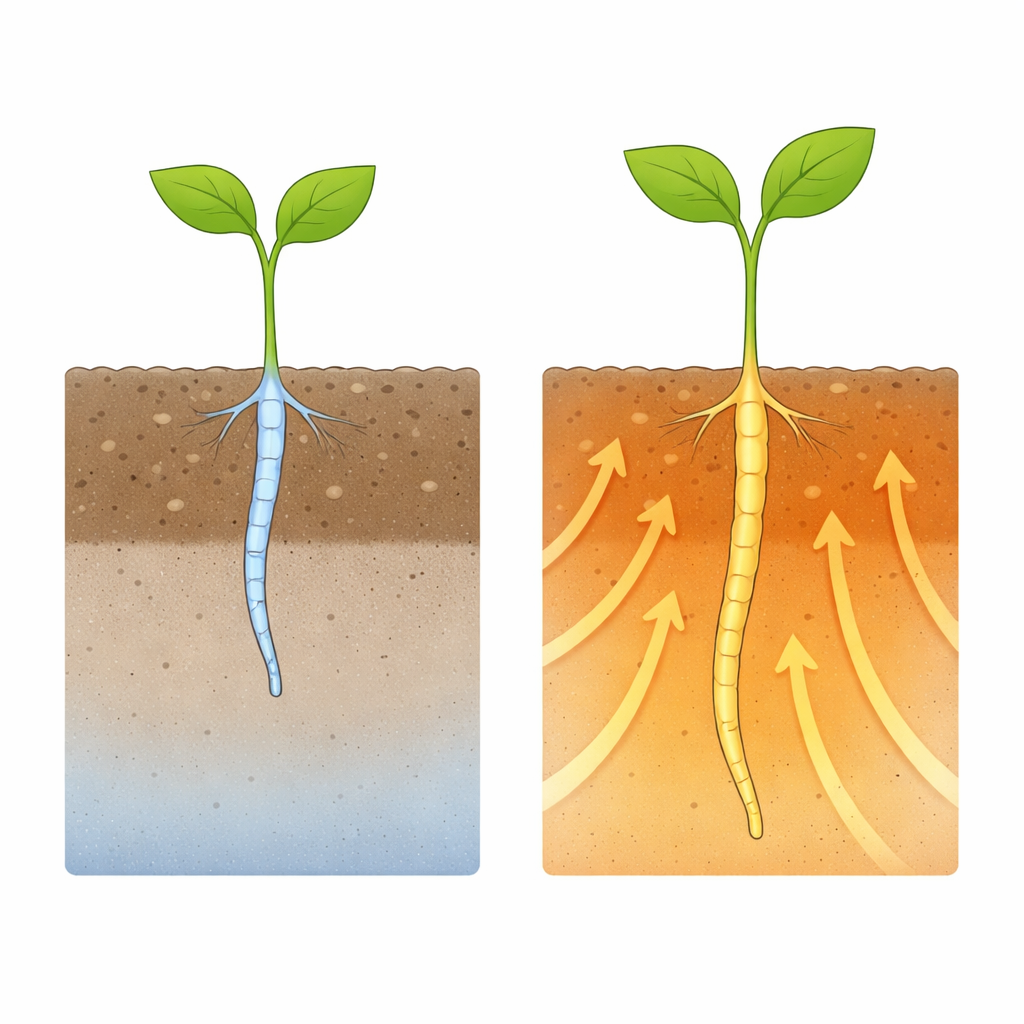
Longer roots in warmer soil
The researchers first asked a simple question: what actually changes inside roots when soil warms from a mild 20 °C to a balmy 28 °C? They found that primary roots did not just grow a little faster—they became markedly longer over several days. This extra length came from two contributions. There were more cells in the root body, and each of these cells was, on average, slightly longer. Warmer conditions shrank the pool of small, dividing cells at the root tip but sped up their journey into the zone where cells rapidly stretch out. At the same time, cell division itself happened more often. Together, faster division, faster transition into elongation, and a modest increase in final cell size combined to produce substantially longer roots.
Cells that keep stretching instead of stopping
Not all root cells responded to warmth in the same way. In the early part of the differentiation zone—where root hairs and inner tissues first become clearly visible—cell size barely changed with temperature. But further down the root, in fully differentiating cells, a striking pattern emerged. At cooler temperatures these mature cells almost stopped elongating, reaching a size limit and then remaining stable. Under warmth, however, the same class of cells kept stretching for longer, effectively raising the size threshold at which they stopped growing. This prolonged elongation of more mature cells turned out to be a major contributor to the overall boost in root length.
A growth hormone system turned on its head
Root growth is strongly guided by auxin, a plant hormone that usually curbs root cell elongation when present at high levels. That makes the warm-root response puzzling, because past work showed that higher temperatures increase auxin levels in root tips. By systematically testing more than 50 mutants in the auxin pathway, the team showed that a fully functional “nuclear” branch of the auxin system is absolutely required for warmth to promote cell elongation. Mutations that disrupted auxin production, its main receptors, key transcription factors, or downstream targets all weakened the warm-growth response. Yet when the scientists added a synthetic auxin from outside, cells became shorter instead of longer—confirming that warmth and extra auxin do not simply act in the same way. 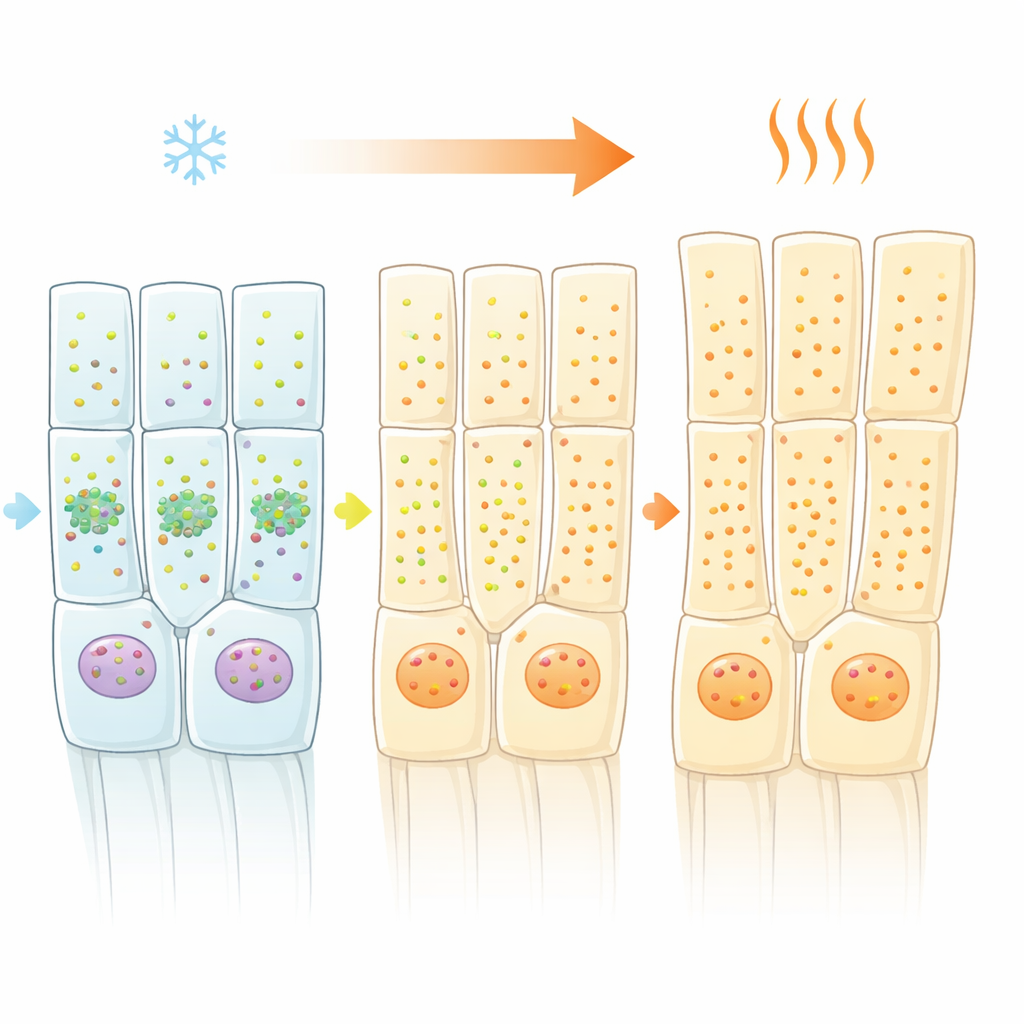
Proteins that move, cluster, and dissolve with heat
To resolve this paradox, the study zoomed in on where specific auxin-related proteins reside inside root cells and how their behavior shifts with temperature. Warmth increased the amount of auxin in elongating cells and boosted nuclear levels of several auxin receptors that normally trigger degradation of growth-blocking proteins. At the same time, however, warmth drove another receptor, AFB1, into the cell nucleus, where it helped stabilize those very growth blockers. This would normally dampen auxin signaling, yet the researchers found that activity of auxin-responsive transcription factors still rose under warmth. They traced this to two closely related proteins, ARF7 and ARF19. At cool temperatures, these factors often cluster into dense droplets in the cytoplasm, where they are inactive. As the temperature rises, these condensates dissolve, ARF7 and ARF19 become less tightly bundled together, and more of them accumulate in the nucleus. There, in a warm-specific configuration of the pathway, they promote cell elongation rather than inhibit it.
How this reconfiguration helps plants
By following cell behavior, hormone levels, and protein movements, the work shows that warmer temperatures effectively rewire a familiar hormone circuit to achieve a different outcome. Instead of letting higher auxin simply shut down root cell growth, plants use AFB1, ARF7, and ARF19 to reshape where key components sit inside the cell and how strongly they interact. The result is a longer root built from cells that keep elongating for longer, helping the plant explore deeper, potentially moister soil. Understanding this built-in flexibility could guide strategies to breed or engineer crops with roots better suited to the hotter, drier conditions expected in the coming decades.
Citation: Borniego, M.B., Pereyra, M.E., Sageman-Furnas, K. et al. Thermosensory reconfiguration of the auxin transcriptional pathway to drive root cell growth. Nat Commun 17, 2884 (2026). https://doi.org/10.1038/s41467-026-71011-z
Keywords: root growth, temperature response, auxin signaling, plant thermomorphogenesis, Arabidopsis