Clear Sky Science · en
Helicity-selective and spectrally tunable chiral thermal emissions
Twisting Heat Light on Demand
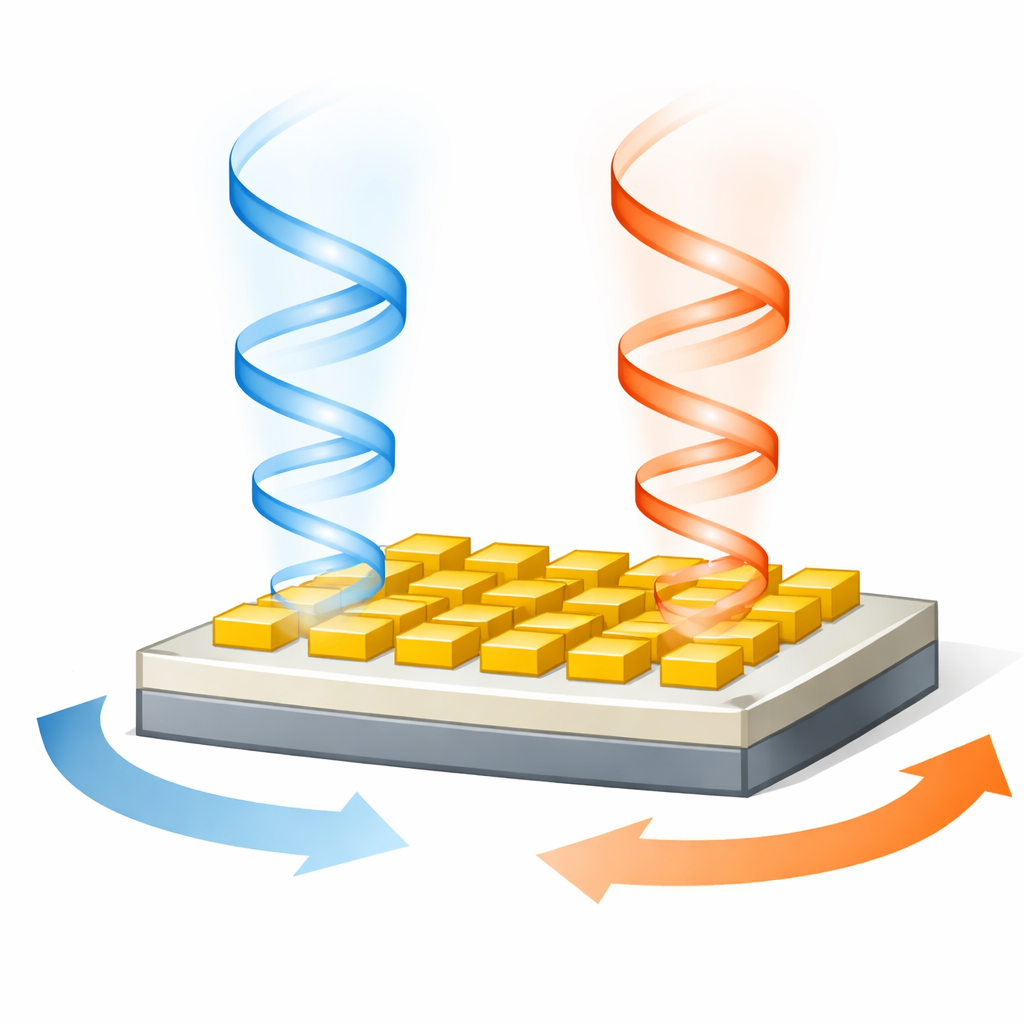
When objects get hot, they glow—stovetops turn red, electric heaters shine orange. But what if that glow could be shaped into a highly organized, spiral form of light whose color and “twist” you can dial in just by changing temperature? This study shows how a fingertip-sized surface can turn ordinary thermal glow into a sharp, controllable, corkscrew-like beam of mid‑infrared light, opening doors for chemical sensing, secure communication, and advanced imaging.
From Chaotic Glow to Tailored Heat Light
Normal thermal radiation, like that from a hot stove or the human body, is messy: it spans many colors, comes out in all directions, and is not polarized. That limits its usefulness in precision technologies such as infrared camouflage, heat‑powered solar cells, and high‑resolution thermal cameras. Over the last decade, ultrathin patterned structures called metasurfaces have changed this picture by sculpting heat‑driven light at scales smaller than its wavelength. By carefully arranging nanostructures, researchers have already made thermal emitters that shine in narrow color bands and specific directions, much like tiny antennas for heat.
Why Twisted Light Matters
Beyond color and direction, the “handedness” of light—whether its electric field rotates left or right as it travels—has become a powerful tool. This circular polarization is crucial for reading the subtle asymmetry of many molecules, including biological “left‑handed” and “right‑handed” forms (enantiomers) that can differ dramatically in behavior, such as in drugs or fragrances. Devices that emit circularly polarized thermal light could simplify such measurements and enable polarization‑encoded signals in infrared links. Yet most existing designs are static: they emit only one fixed handedness at one preset color. Changing either usually requires swapping devices or physically reconfiguring them, which is bulky and impractical.
A Heat‑Tuned Meta‑Emitter
The authors introduce a single, compact metasurface that overcomes this rigidity. It is built from three stacked layers: a thick gold film at the bottom that blocks transmission, a thin transparent spacer in the middle, and on top, a patterned layer of germanium bricks arranged in a slightly asymmetric lattice. This arrangement supports special resonances—quasi‑guided modes—that trap and re‑radiate thermal energy as extremely sharp, coherent beams at specific mid‑infrared wavelengths. Because of the broken symmetry in the pattern, two such modes appear with opposite twist: one emits left‑handed, the other right‑handed circularly polarized light. Crucially, germanium’s refractive index shifts almost linearly with temperature without adding much loss, so heating the device smoothly slides these resonances to longer wavelengths while preserving their quality.
Switching the Twist with Temperature
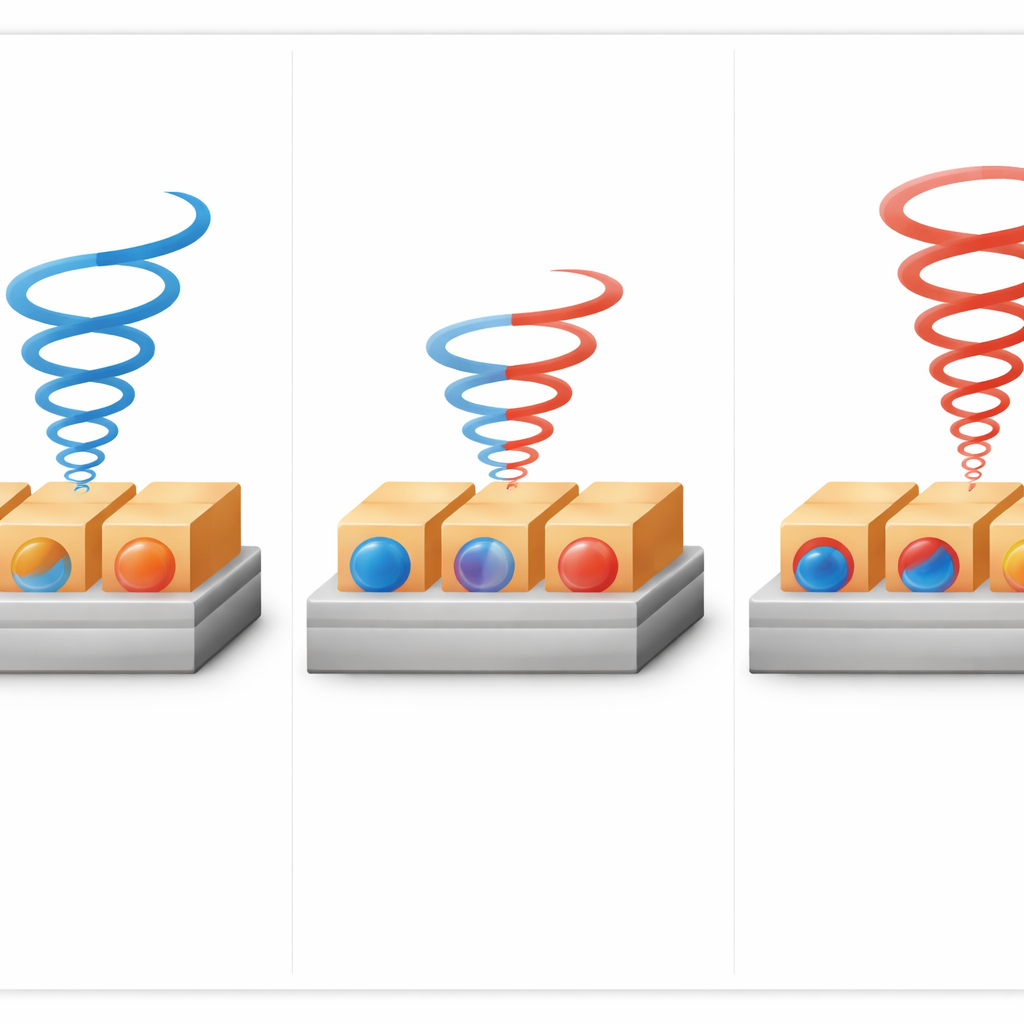
By designing the geometry so that the left‑ and right‑handed modes sit close together in color, the team exploits this thermal shift in a clever way. At a lower operating temperature, the device emits strongly left‑handed light at one target wavelength while the right‑handed mode lies slightly offset. As the temperature rises, both modes slide to longer wavelengths. At a certain point, the right‑handed mode drifts away and the left‑handed one takes over at the original target color, effectively flipping the handedness of the emitted light without changing the device or using any electrical or mechanical control. Experiments confirm that this helicity switching is reversible, maintains very narrow linewidths (high temporal coherence), and preserves a strong preference for one handedness over the other across nearly a 100‑nanometer band in the mid‑infrared. Simulations suggest that, with a wider temperature range, the switchable band could approach half a micrometer.
Path to Practical Heat‑Based Devices
To a non‑specialist, the key message is that the authors have turned simple heating into a robust “knob” for programming how hot objects shine—not just in color and brightness, but in the twist of the light itself. Their germanium‑on‑gold metasurface achieves clean, switchable circular polarization using straightforward fabrication and no moving parts or complex wiring. With future improvements to reduce material loss and improve thermal control, such structures could become on‑chip sources for identifying chiral molecules, enhancing thermal cameras, or encoding information in the spin of mid‑infrared light—all powered by heat that has been tamed and twisted to order.
Citation: Sun, K., Qin, H., Liu, M. et al. Helicity-selective and spectrally tunable chiral thermal emissions. Nat Commun 17, 2536 (2026). https://doi.org/10.1038/s41467-026-70825-1
Keywords: thermal metasurfaces, circularly polarized infrared light, helicity switching, mid-infrared photonics, chiral sensing