Clear Sky Science · en
Many small climate change impacts presage rapid population extinction in a common iconic bird
A Familiar Backyard Bird Facing an Unexpected Threat
For many Australians, the tiny, bright‑blue superb fairy‑wren is a cheerful fixture of gardens and parks. Because these birds are still widespread and officially classed as “Least Concern,” they might seem safe from the dangers of climate change. This study reveals a far more troubling reality: decades of detailed monitoring show that a web of small climate‑related stresses is quietly pushing one well‑studied fairy‑wren population toward extinction within a few decades, offering a stark warning for other common species we take for granted.
Why Common Species Still Matter
Conservation efforts often focus on rare or spectacular animals, yet common species are the backbone of many ecosystems. They pollinate plants, eat insects, and provide food for other wildlife. History shows that even abundant species can vanish quickly once pressures mount, as happened with the passenger pigeon in North America. The authors of this study ask whether today’s rapid climate change could drive similar collapses in familiar birds. They focus on a population of superb fairy‑wrens living in the Australian National Botanic Gardens in Canberra, a place where these birds have been followed individually for more than 30 years.
Three Decades of Watching Every Bird
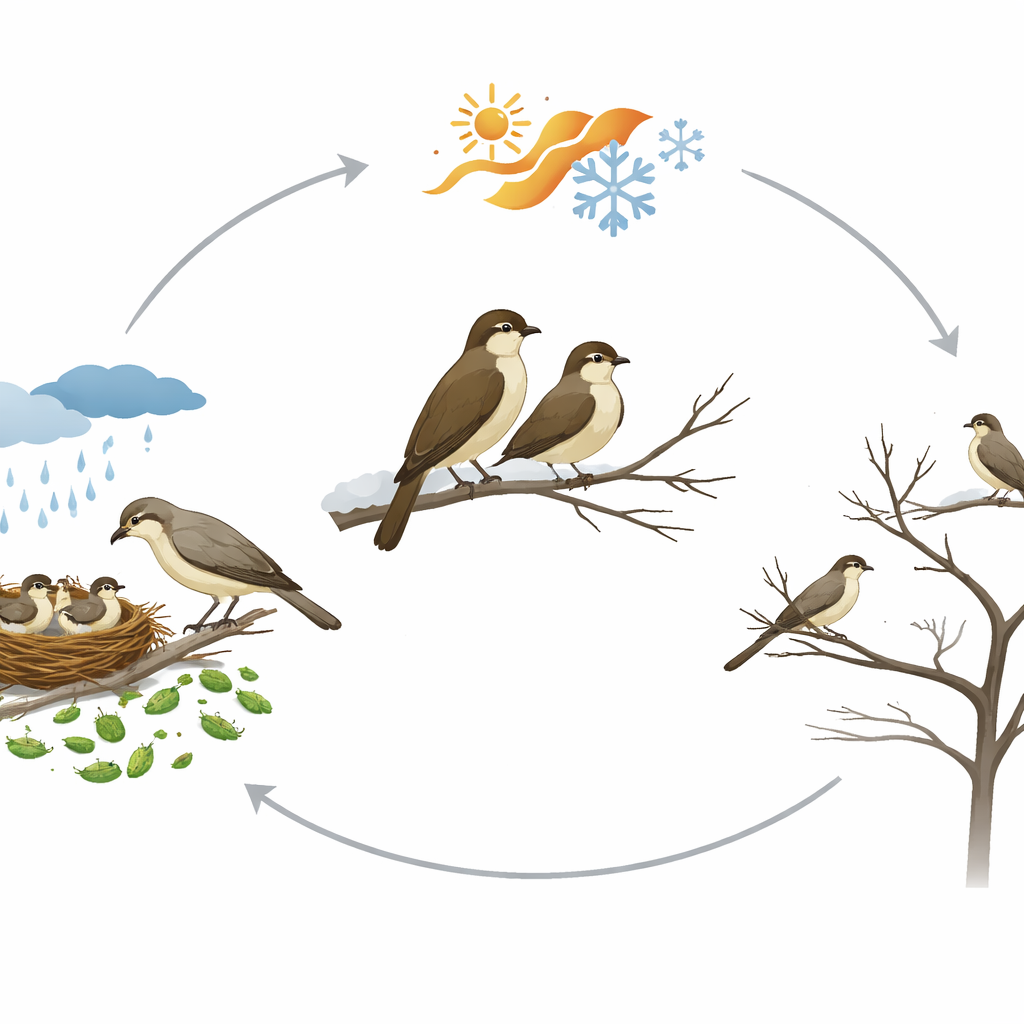
Since the early 1990s, researchers have tracked nearly every fairy‑wren in this population. By color‑banding nestlings and adults, they recorded who lived, who died, who bred, when chicks fledged, and which birds moved in or out. This intense, year‑round work allowed them to break the year into three key phases: a recruitment phase when chicks hatch and new birds arrive; a winter non‑breeding phase when survival is often hardest; and a spring “scramble” phase when females compete for scarce breeding spots. Using a powerful statistical framework called an integrated population model, the team combined all these data to estimate how many birds the population gained or lost each year and which parts of the life cycle mattered most.
Small Weather Shifts with Big Consequences
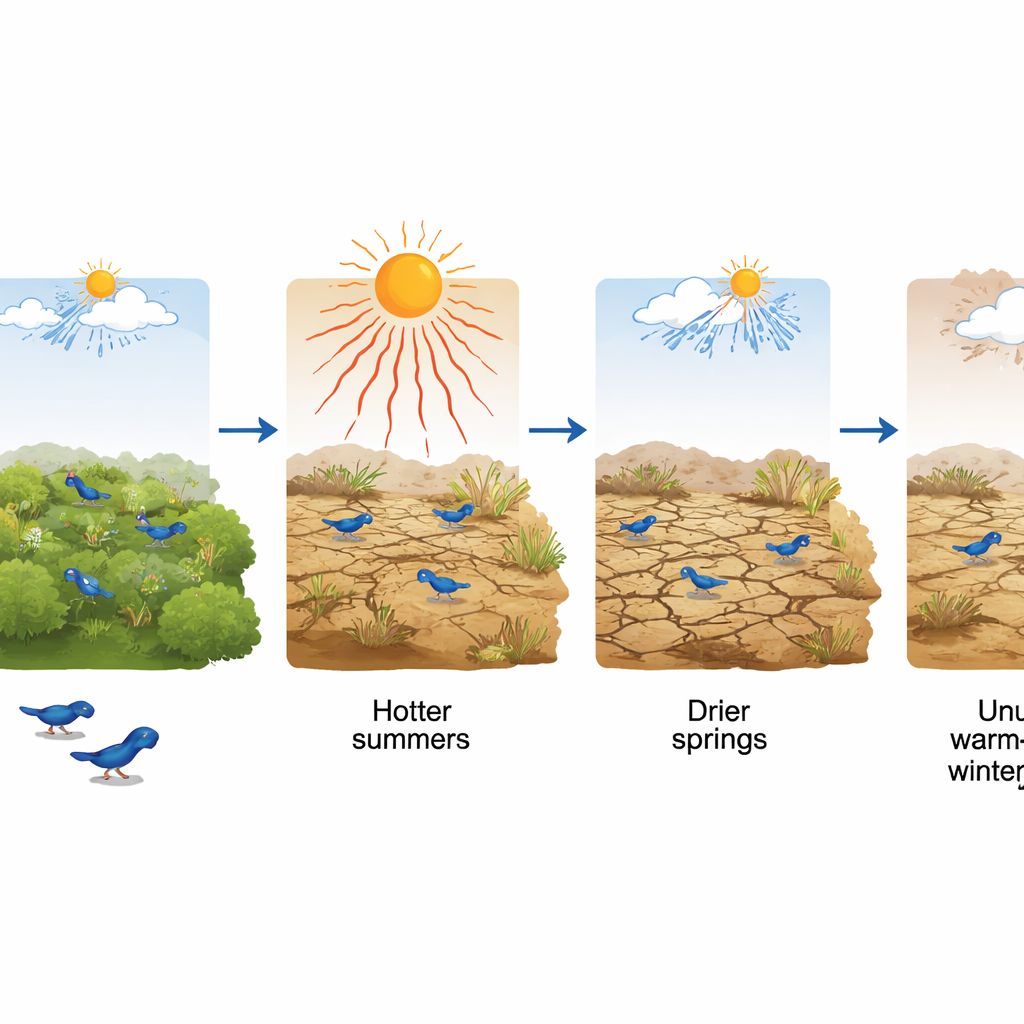
The researchers then linked these gains and losses to local weather: spring rainfall, summer heat, and winter temperatures. They found 11 distinct pathways by which climate influenced the birds. Wet springs boosted breeding, allowing females to raise more broods and increasing the number of young females that immigrated into the area. In contrast, dry springs sharply reduced the number of chicks that survived and stayed, causing gaps when breeding females died and were not replaced. Hot summers and unusually warm winters turned out to be especially harmful, lowering the survival of both adults and young birds during the non‑breeding season. Warm spells followed by cold snaps seem particularly deadly, likely disrupting insect prey and leaving birds short of food at the worst possible times.
Looking Ahead: A Race Against the Warming Clock
To test whether these many small effects could add up to something more serious, the authors used their model to project the population’s future under different greenhouse gas scenarios. When they assumed that climate stopped changing, the fairy‑wren population still fluctuated but had a relatively low chance of disappearing by 2100. Under realistic warming scenarios, however—even the most optimistic one—the population almost always crashed to zero. In the intermediate and high‑emission futures, the model predicts local extinction between about 2059 and 2062, just 30–40 years from now. The team considered possible “rescues,” such as evolution toward climate‑hardier birds, inflows of better‑adapted birds from warmer regions, or climate‑driven declines in predators. While these might delay the worst outcomes, none offers a clear or quick fix.
What This Means for Everyday Nature
The central message of this work is both sobering and subtle. The fairy‑wrens are not being wiped out by a single dramatic threat like habitat loss or overhunting. Instead, a tangle of modest changes—slightly drier springs here, slightly hotter summers there, winters that swing between warm and cold—gradually erodes survival and reproduction until the population can no longer sustain itself. Because few species are watched as closely as these birds, similar silent declines may be unfolding unnoticed in other “ordinary” animals. The superb fairy‑wren, long a symbol of Australia’s everyday birdlife, may thus serve as a genuine canary in the coal mine, warning that even common species can be pushed to extinction by the accumulating nudge of climate change.
Citation: Lv, L., Zhao, Q., Liu, Y. et al. Many small climate change impacts presage rapid population extinction in a common iconic bird. Nat Commun 17, 2711 (2026). https://doi.org/10.1038/s41467-026-70758-9
Keywords: climate change, bird population decline, superb fairy-wren, extinction risk, wildlife monitoring