Clear Sky Science · en
Global record-shattering breadbasket droughts emerge from moderately extreme regional events
A Hidden Threat to the World’s Corn Supply
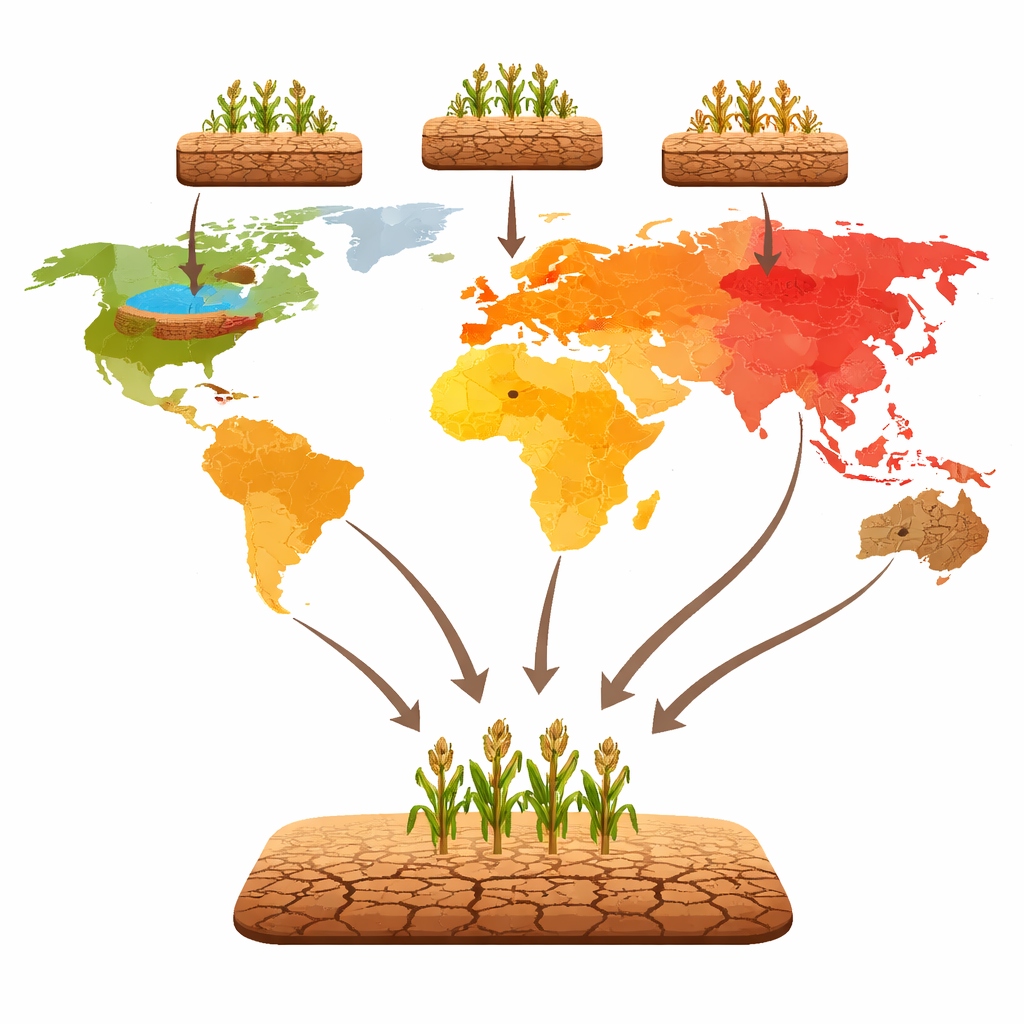
Most of us rarely think about where our corn-based foods come from, yet a handful of major “breadbasket” regions grow much of the world’s maize. This study shows that, within this century, there is a disturbingly high chance that droughts striking several of these regions at once will push the global area in drought far beyond anything seen before. Such a record-shattering event would not necessarily look like the single worst drought ever in any one country, but rather like many serious, simultaneous hits that together strain the world’s food system.
Where Our Corn Grows and Why Droughts Are Linking Up
The authors focus on six key maize-growing regions: the United States, Brazil, Argentina, Europe, China, and India. Together, these areas produce more than half of the world’s maize. Using large climate-model ensembles that simulate weather and climate from 1850 to 2099 under different greenhouse-gas pathways, they track how often these regions experience dry surface soils, a direct measure of how much water is available to crops. They then calculate, year by year, what fraction of the total maize-growing area is in drought and watch how this measure changes over time.
A Growing Share of Maize Land Under Drought
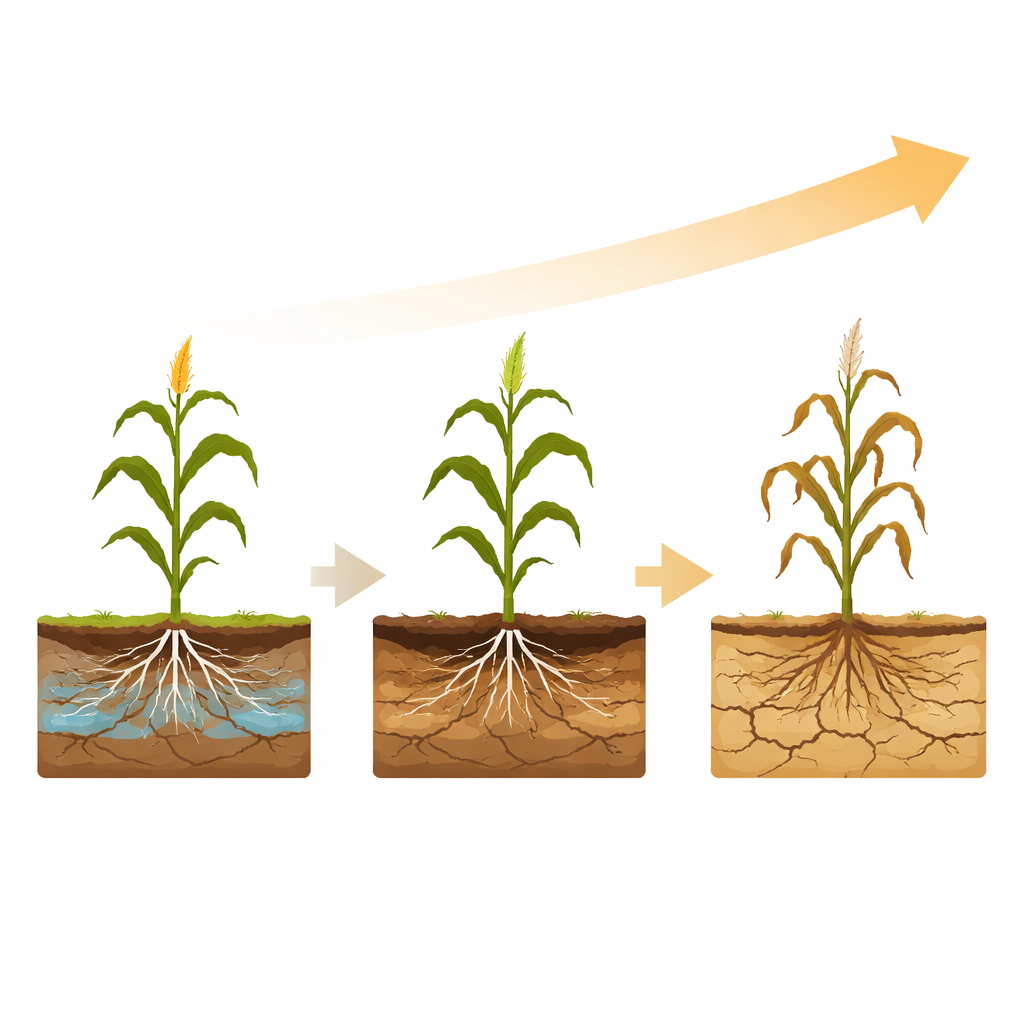
The simulations show that, before the year 2000, the global share of maize land in drought is relatively steady. Afterward, it rises strongly through the 21st century, especially under a high-emissions future. By late century in that scenario, nearly half of all maize fields worldwide are in drought in an average year. The increase is far from uniform: Brazil, Europe, and the United States see the largest rise in drought area, while Argentina, China, and India show only small changes or even slight declines, partly because extra rainfall can offset higher evaporation there. Across models, the main reason for expanding drought is a steady drying of average soil moisture, not wilder year-to-year swings.
How Records Get Shattered, Not Just Broken
To focus on truly exceptional events, the authors define a “record-shattering” global drought as a year when the fraction of maize land in drought jumps at least five percentage points above any previous record. They find that the annual chance of such an event increases rapidly early in the century, peaks around mid-century, and then levels off or falls slightly as drying trends slow. Looking over 2026–2099, there is about a one-in-two chance of at least one record-shattering global drought under a mid-range emissions pathway, and roughly a three-in-five chance under a high-emissions path—seven to eleven times higher than if soil moisture had no long-term trend. These probabilities are driven mainly by persistent drying in Brazil, Europe, and the United States.
Many Bad Years at Once, Not One Worst Year Everywhere
One might expect a global record to happen only when several regions each endure their own worst drought on record. Instead, the study finds that most global record-shattering events occur without any region hitting its individual record in that same year. Under mid-range emissions, about 73% of global record-shattering years involve no regional record-shattering drought at all. Rather, what matters is that several regions experience “moderately extreme” droughts—among the largest 20% of events in recent decades—at the same time. When added together, these overlapping but not individually unprecedented events push the global drought area into uncharted territory.
What This Means for Food Security and Planning
The findings imply that the world’s food system is vulnerable not only to headline-grabbing local disasters, but also to quieter, simultaneous shocks spread across continents. While each regional event may be manageable on its own, their combination could overwhelm trade, storage, and emergency response, threatening food prices and access. Because Brazil, Europe, and the United States contribute most to the rising risk, trends there are especially important to watch, while relatively less-affected regions like Argentina, China, and India could serve as buffers if their production and trade capacity are strengthened. Overall, the study concludes that a global, record-shattering maize drought in coming decades is more likely than many planners assume, underscoring the need to integrate climate-hazard projections with crop and trade planning to build a more resilient global food system.
Citation: Li, J., Zscheischler, J. & Bevacqua, E. Global record-shattering breadbasket droughts emerge from moderately extreme regional events. Nat Commun 17, 2577 (2026). https://doi.org/10.1038/s41467-026-70700-z
Keywords: maize drought, global breadbasket, food security, climate change risk, compound extremes