Clear Sky Science · en
Evidence from Buhais Rockshelter for human settlement in Arabia between 60,000 and 16,000 years ago
Ancient lives in an unexpected place
Today the Arabian Peninsula is often imagined as an empty stretch of dunes, but this new study shows that for tens of thousands of years it was a landscape people repeatedly called home. By carefully excavating a rocky shelter in the Emirate of Sharjah and reading the buried layers of sand, stone tools, and former lake beds, researchers reveal that southeastern Arabia was not a dead zone during the last Ice Age. Instead, it flickered between dry and greener phases, opening brief windows when people could thrive on the desert’s edge.
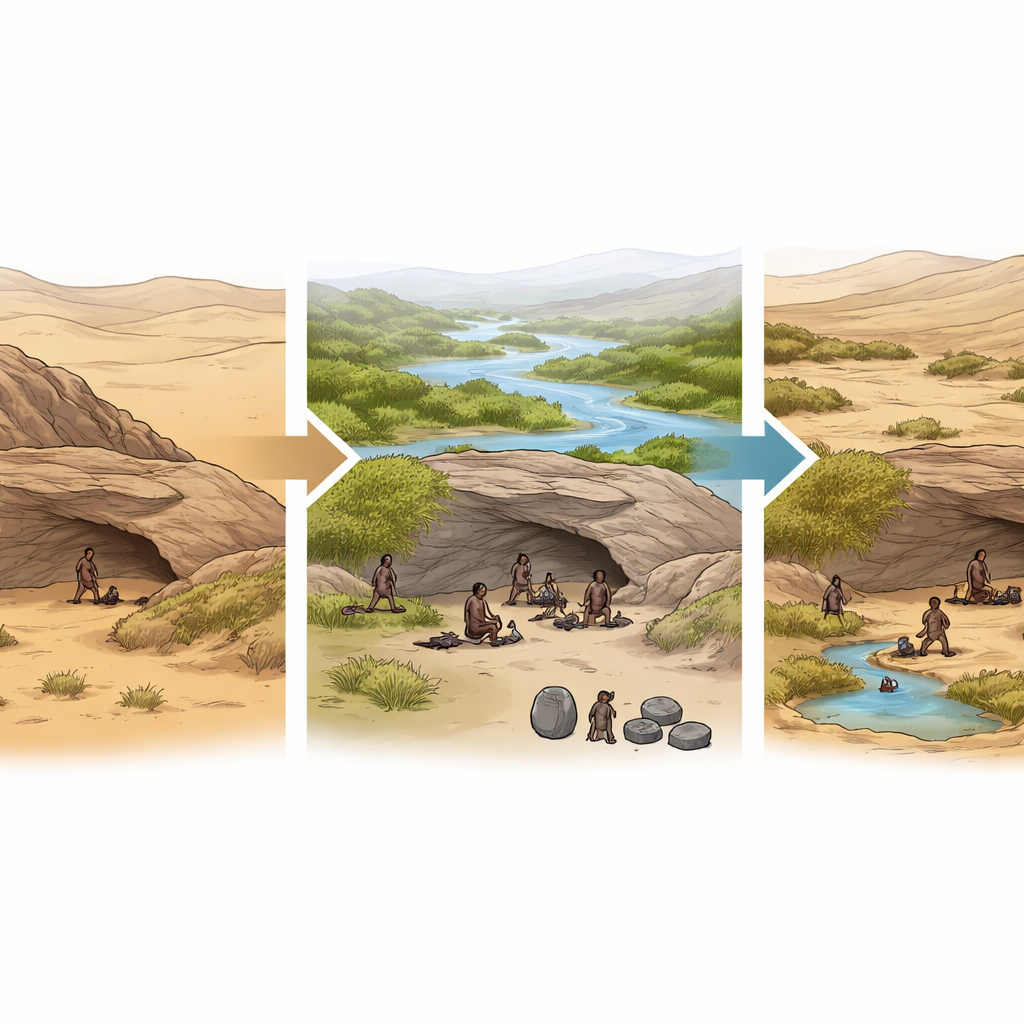
A rocky porch above the sands
At the heart of the study is Buhais Rockshelter, a shallow cave at the foot of a limestone ridge, about 60 kilometers from the modern Gulf coast. The site faces a sea of dunes and lies near ancient drainage channels that once carried water from nearby mountains. Although the place was already known for much younger burials, its deeper, older layers had never been explored. Starting in 2017, archaeologists opened a 24-square-meter trench beneath collapsed roof blocks, uncovering a 1.7-meter-deep sequence of sediments and stone artifacts. Using a dating technique that measures when sand grains were last exposed to sunlight, they built a timeline for these layers stretching back more than 100,000 years.
Four visits over 100,000 years
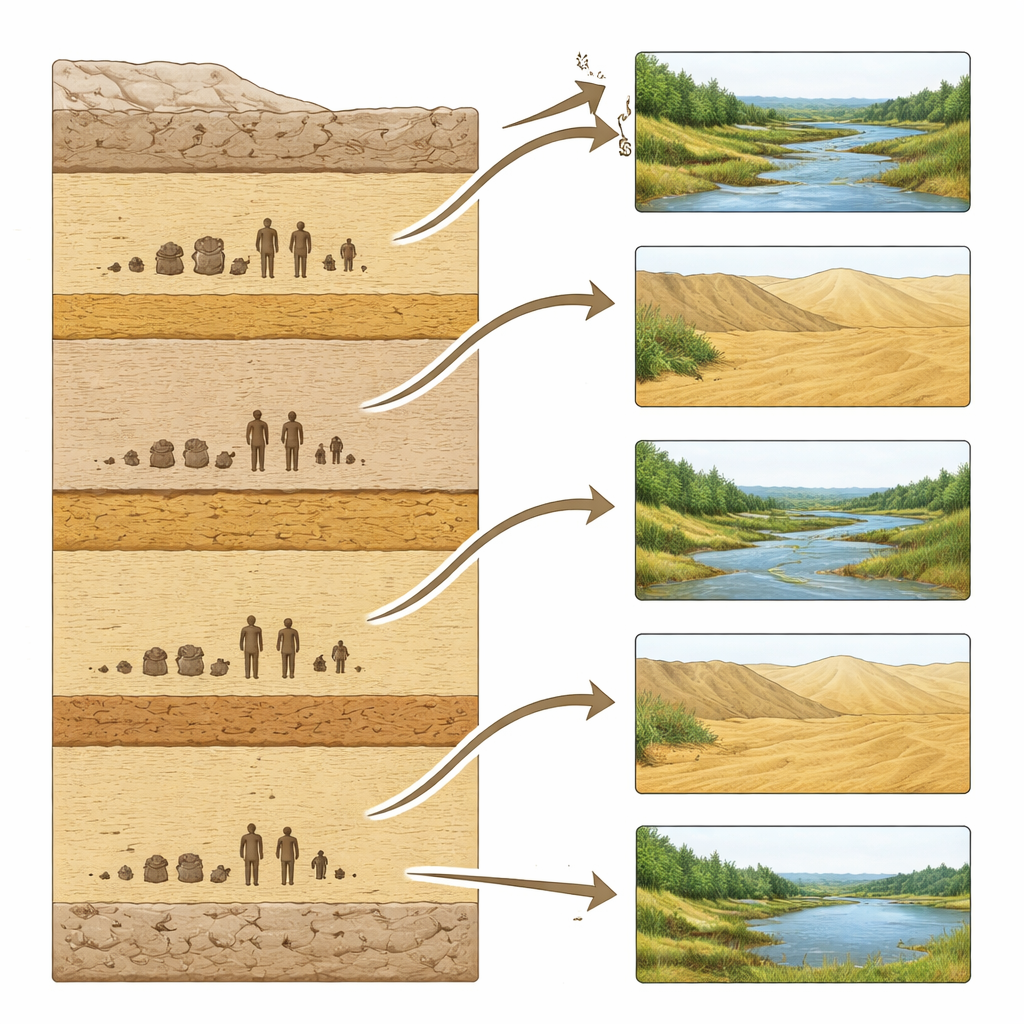
The sediment stack at Buhais preserves four main phases of human activity. The lowest horizon, formed about 125,000 years ago, holds tools typical of an earlier stone-working tradition that focused on shaping large flakes from carefully prepared cores. Above a long gap with no artifacts, a second horizon around 60,000 years ago shows a very different way of making sharp pieces of stone: instead of the classic prepared-core method known from many other regions, toolmakers favored simpler approaches to produce triangular flakes and blades. Higher still, a horizon dated to roughly 35,000 years ago reveals the earliest clear evidence in southeastern Arabia for a later stone-tool tradition centered on long blades and tiny bladelets. The youngest layer, around 16,000 years old, continues this blade-focused technology, indicating people returned yet again near the end of the last glacial period.
Following the water in a shifting desert
To understand why people arrived when they did, the team examined nearby natural deposits that record past climate. At the northern end of the same mountain range, a 4.7-meter section of sediments from an ancient lake basin shows a rhythm of river gravels, calm-water silts, and wind-blown sands. Another section from an interdune hollow captures a brief episode when a small lake formed between otherwise dry, sandy phases. By dating these natural layers, and by analyzing grain sizes and chemical fingerprints, the scientists reconstructed periods when rivers flowed, springs were active, and shallow lakes dotted the landscape. Strikingly, the times when Buhais was occupied line up with these wetter pulses: around 59,000 years ago, between about 39,000 and 30,000 years ago, and again near 17,000 to 16,000 years ago.
Changing tools, changing connections
The stone tools from Buhais also serve as clues to wider human movements. The 60,000-year-old toolkit differs sharply from older local traditions and from better-known methods in northern Arabia and the Levant, suggesting a new population or new ideas reached southeastern Arabia after a period of harsh conditions. Later, the blade-rich tools from about 35,000 years ago resemble those seen farther north in regions such as the Levant and the Zagros Mountains, where a broad family of Upper Paleolithic cultures had already taken hold. This hints that, by this time, people and ideas were flowing into Arabia from the north and northeast across an exposed Gulf plain, rather than only along southern coastal routes.
Rethinking a "blank" on the human map
Taken together, the archaeological and environmental records from Buhais Rockshelter overturn the notion that Arabia lay empty between 60,000 and 16,000 years ago. Instead, the region was visited again and again whenever climate shifts brought back water to the desert’s wadis and basins. These findings plug a major gap in the story of our species’ spread across Southwest Asia, showing that southeastern Arabia was both a refuge and a crossroads during times of global change. For non-specialists, the key message is that even today’s most forbidding deserts have histories as livable landscapes, and that human groups were flexible enough to track fleeting opportunities in some of the planet’s toughest environments.
Citation: Bretzke, K., Kim, S., Jasim, S.A. et al. Evidence from Buhais Rockshelter for human settlement in Arabia between 60,000 and 16,000 years ago. Nat Commun 17, 2502 (2026). https://doi.org/10.1038/s41467-026-70681-z
Keywords: Arabian prehistory, human dispersal, paleoclimate, stone tools, Ice Age Arabia