Clear Sky Science · en
Phanerozoic seawater Mg/Ca variations driven by supercontinent cycles
Oceans That Change With Moving Continents
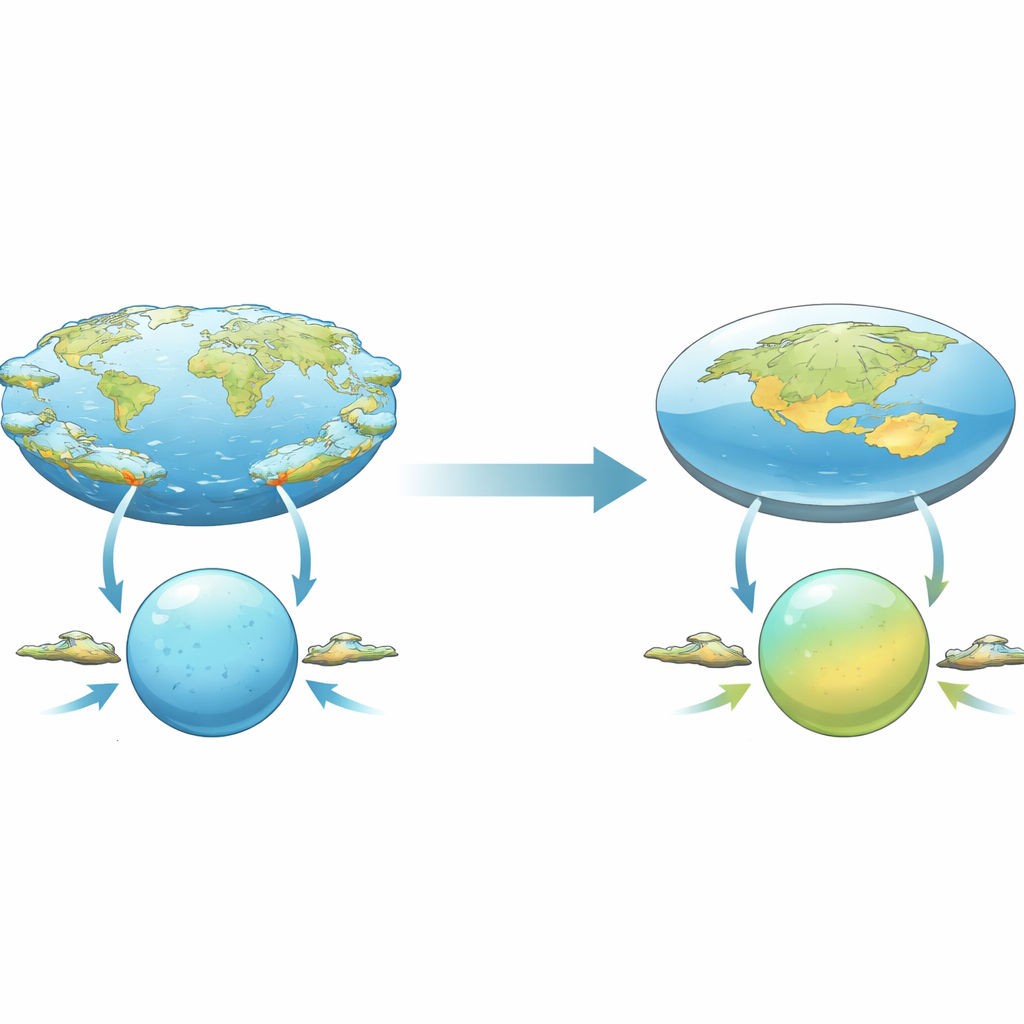
Earth’s oceans may look timeless, but their chemical makeup has shifted dramatically over the past 540 million years. This study asks a deceptively simple question with big consequences for climate and marine life: why has the balance between magnesium and calcium in seawater swung back and forth through time? The answer links the deep engine of plate tectonics, the rise and fall of ancient supercontinents, and the minerals that build seafloor rocks and marine sediments.
Why Magnesium and Calcium Matter
Magnesium and calcium are two of the most abundant positively charged elements in seawater. Their ratio controls which carbonate minerals—aragonite or calcite—tend to form in shells, reefs, and chemical sediments, and it tracks shifts between cold “icehouse” and warm “greenhouse” climates. Geological clues, such as tiny trapped seawater droplets in ancient salt crystals and the chemistry of fossil carbonates, show that seawater’s magnesium-to-calcium ratio has swung from less than 1 in some past intervals to about 5 today. These swings changed which minerals dominated ocean floors and marine skeletons, and they coincided with major climate transitions.
Reading the Oceans’ Memory With Isotopes
The difficulty has been figuring out which processes drove these long-term changes. Rivers deliver magnesium and calcium to the ocean, while reactions in the crust and seafloor sediments remove magnesium and often add calcium. Two key sinks are magnesium-bearing silicate minerals that grow within altered oceanic crust and clays, and the carbonate mineral dolomite that forms in marine sediments. The authors took advantage of a subtle clue: silicate minerals and dolomite shift magnesium isotopes in opposite directions. By combining records of total seawater magnesium concentration with magnesium isotope trends, they built an inverse model that works backward through time to estimate how strongly each sink operated during different stages of Earth history.
Tracing Fluxes Through Deep Time
Using millions of Monte Carlo simulations, the model searched for combinations of river input, silicate formation, and dolomitization that reproduce the observed elemental and isotopic histories. The results show that river input varied only modestly within plausible limits and is not the main driver. Instead, large swings in the strength of magnesium removal into silicate minerals and dolomite dominate the story. Times when seawater magnesium rose and the magnesium-to-calcium ratio increased correspond to intervals when both silicate alteration of the seafloor and dolomite formation were weakened. When those sinks intensified, magnesium was stripped more efficiently from seawater, the ratio fell, and the oceans shifted back toward calcite-rich conditions.
Supercontinents as the Master Switch
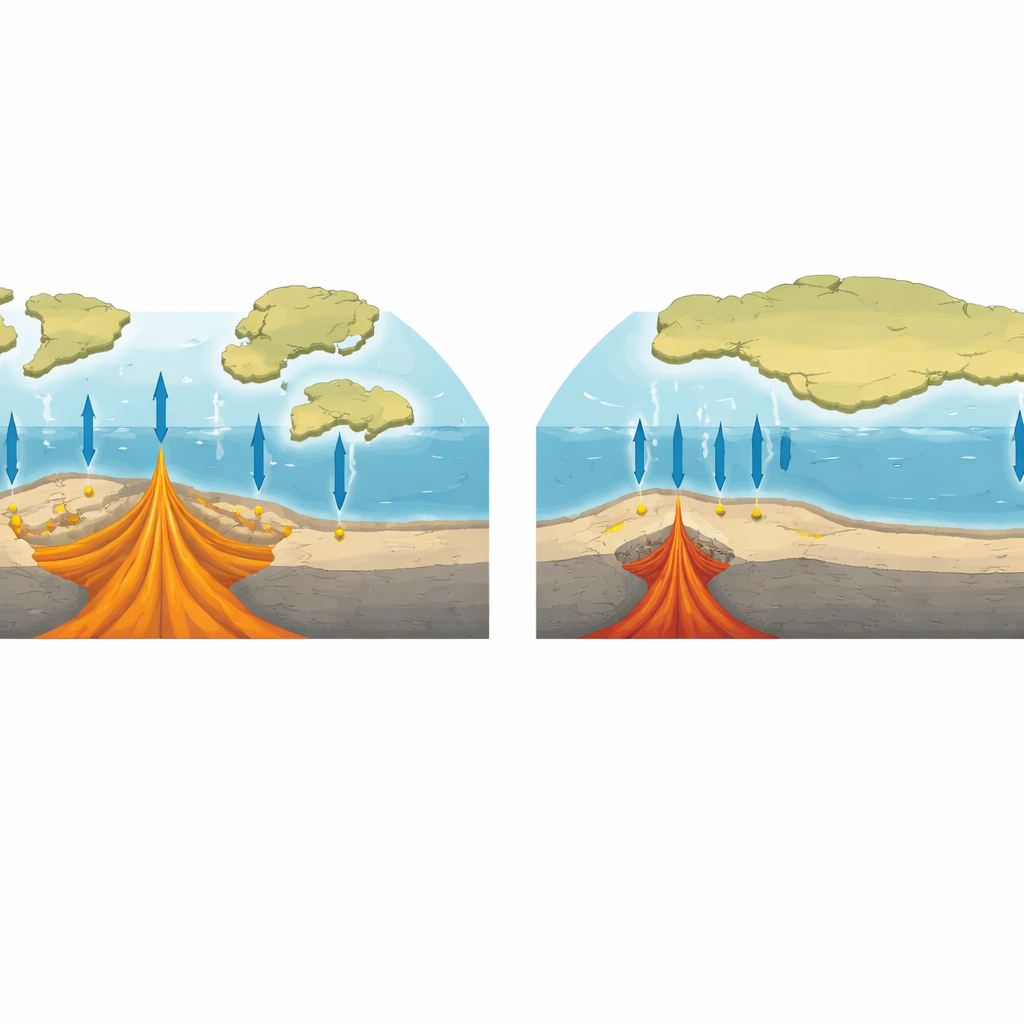
The changing strengths of these mineral sinks turn out to be closely tied to the supercontinent cycle—the slow assembly, stability, and breakup of giant landmasses such as Pangea. During assembly and major continent–continent collisions, seafloor spreading slows and climates tend to cool, which reduces hydrothermal alteration of the seafloor and limits conditions favorable for dolomite formation. Magnesium therefore accumulates in the oceans and the magnesium-to-calcium ratio rises. During early breakup, faster seafloor spreading and warmer, higher-sea-level climates enhance both seafloor alteration and dolomitization, ramping up magnesium removal and lowering the ratio. During long periods of tectonic stasis and broad continental dispersal, inputs and outputs nearly balance, keeping magnesium-to-calcium values relatively low and stable.
What This Means for Earth’s Past Oceans
In plain terms, this work argues that the slow dance of the continents acts as a master control knob on seawater chemistry. By changing how quickly fresh ocean crust is created and how often warm, shallow seas and restricted basins develop, the supercontinent cycle governs how much magnesium gets locked into seafloor rocks and dolomite. That, in turn, helps set which carbonate minerals flourish, how evaporite deposits evolve, and how ocean chemistry couples to long-term climate. The study provides a quantitative framework linking deep Earth processes to the chemistry of the surface ocean, showing that today’s magnesium-rich seas are just one phase in a repeating tectonic rhythm.
Citation: Zhang, P., Kendrick, M.A., Han, Y. et al. Phanerozoic seawater Mg/Ca variations driven by supercontinent cycles. Nat Commun 17, 2656 (2026). https://doi.org/10.1038/s41467-026-70649-z
Keywords: seawater chemistry, supercontinent cycle, magnesium calcium ratio, plate tectonics, dolomite formation