Clear Sky Science · en
Role of the primate ventral striatum as a neural hub bridging option valuation and action selection
How the Brain Turns Wanting into Doing
Everyday choices, from grabbing a snack to checking your phone, involve more than simple impulse. Deep inside the brain, circuits quietly weigh potential rewards and then push us toward one action or another. This study in macaque monkeys uncovers how a small region called the ventral striatum helps convert an internal sense of “how good is this option?” into a concrete action, revealing a key link between motivation and movement that may be relevant for habits, addiction, and psychiatric disorders.
A Small Hub with a Big Job
The ventral striatum sits at the crossroads of brain systems that process emotion, reward, and movement. Earlier work suggested it mainly stores and updates the expected value of different options, guided by the teaching signals of dopamine neurons. The authors asked a deeper question: does this region merely keep score, or does it also help decide which action to take? Because the ventral striatum connects strongly to areas that plan and control movement, it was a prime candidate to serve as a hub that links “how much is this worth?” with “what should I do?”
Watching Choices Unfold in Real Time
To probe this, three monkeys performed a simple gambling-like task. On each trial, one picture appeared first and promised a specific amount of liquid reward; the monkey had to decide whether to release a button to accept it or keep holding the button and wait for a second picture that might be better or worse. This design separated three steps that normally blur together: evaluating the first option, deciding whether to act, and actually moving the hand. By recording electrical activity from individual ventral striatum neurons during this sequence, the researchers could see how signals evolved as the monkeys made up their minds. 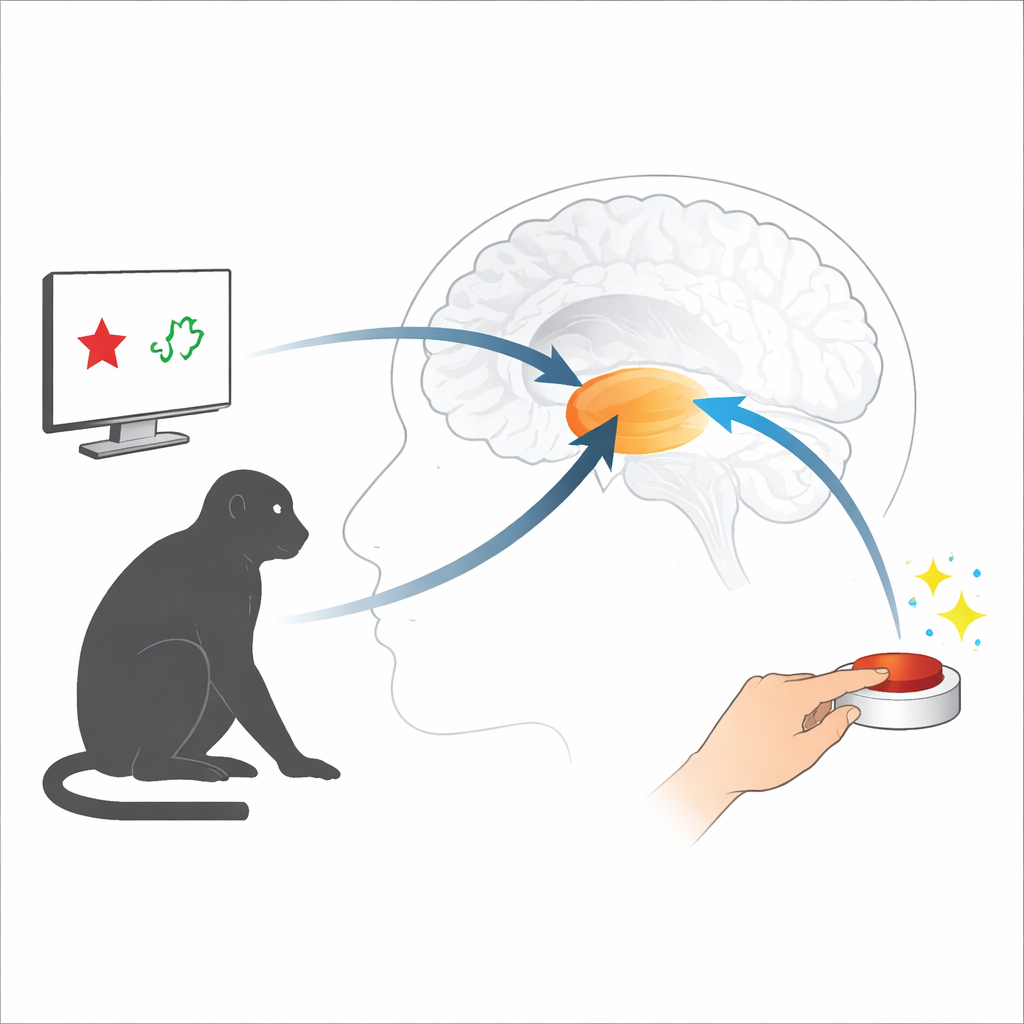
From Measuring Value to Committing to an Action
The neural recordings revealed a striking shift over time. Right after the first picture appeared, many neurons fired in proportion to how large the potential reward was, regardless of what the monkey eventually did, reflecting a pure value signal. As the decision point approached, activity patterns changed: some neurons now fired differently depending on whether the monkey would release the button or keep holding it, even before the movement occurred. Statistical modeling showed three types of signals—value-related, choice-related, and intermediate mixtures—and these tended to emerge in sequence, matching the mental path from evaluation to commitment. Crucially, the “choice” signals could not be explained by simple movement control, because the same neurons responded much more weakly in a separate task where monkeys released the button without making a decision.
Pushing the Circuit and Watching Behavior Shift
Observing correlations is one thing; proving cause and effect is another. The team therefore perturbed the system in two ways while the monkeys were deciding about the first option. In one set of experiments, they delivered tiny electrical pulses directly into the ventral striatum. In another, they used optogenetics—a light-based technique—to boost dopamine input fibers that run from the midbrain into this region. Both interventions had a similar, nuanced impact: they nudged the likelihood that the monkey would choose the first option, but mainly when that option was of medium value—situations in which the animal was naturally most unsure. At some sites, stimulation made choices more likely; at others, it made them less likely, consistent with the presence of different neural sub-circuits that promote approach or avoidance. Importantly, these manipulations barely affected the speed of button releases in a simple motor task, arguing that they biased decision-making itself rather than just hand movements. 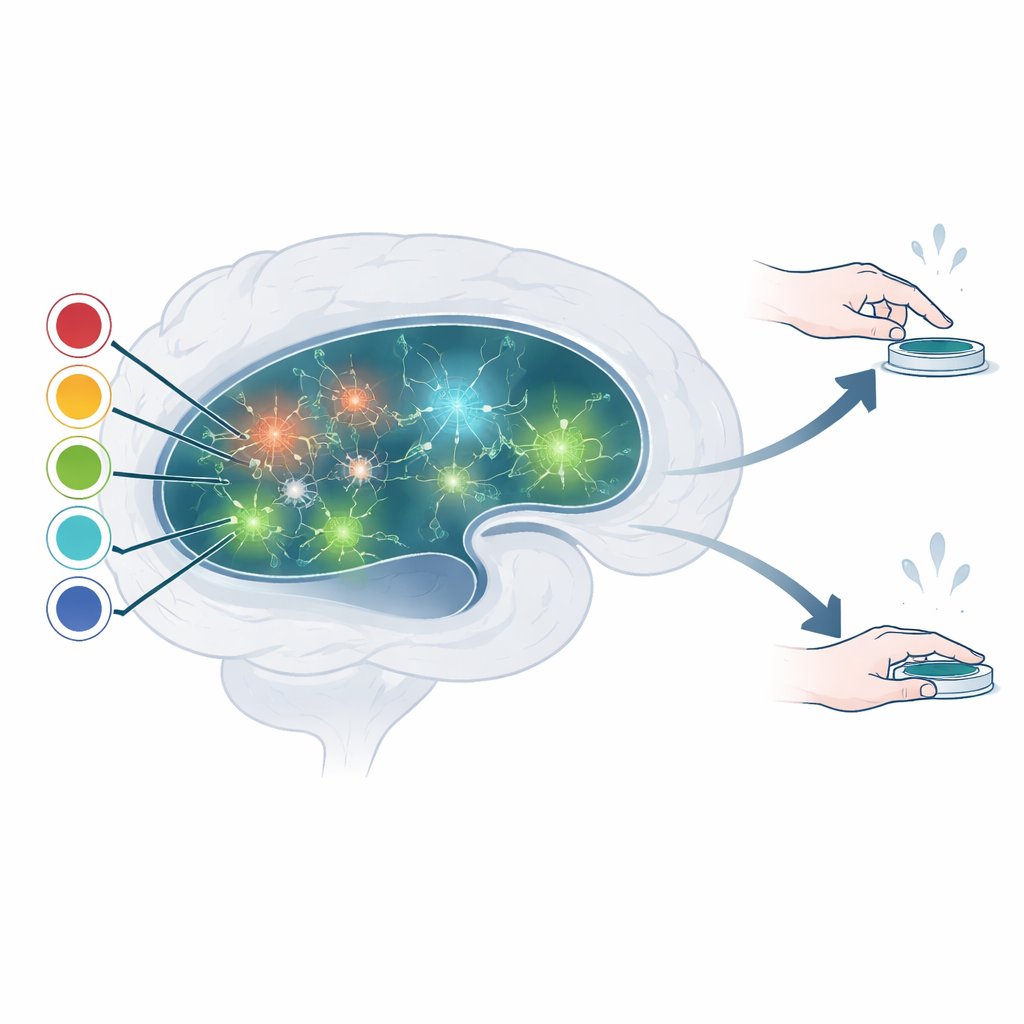
Why This Matters for Everyday Decisions
Taken together, the findings support the idea that the ventral striatum is not just a passive scorekeeper for rewards. Instead, it acts as a neural hub where information about how good an option is gets gradually transformed into a specific choice about whether to act. Dopamine inputs help shape this transformation, especially when the decision is uncertain. For a layperson, this means that a compact, chemically sensitive circuit deep in the brain helps tip the scales when we hover between “go for it” and “wait and see.” Understanding this bridge between valuation and action could eventually shed light on conditions in which that bridge is distorted, such as addictive behaviors or disorders of motivation, and may guide future interventions aimed at restoring balanced decision-making.
Citation: Nejime, M., Yun, M., Wang, Y. et al. Role of the primate ventral striatum as a neural hub bridging option valuation and action selection. Nat Commun 17, 2501 (2026). https://doi.org/10.1038/s41467-026-70634-6
Keywords: decision making, ventral striatum, dopamine, reward, action selection