Clear Sky Science · en
Predator-mediated local convergence fosters global microbial community divergence
Why tiny hunters in soil matter to us
Soil is home to a vast hidden world of microbes that help grow our food, store carbon, and recycle nutrients. This study asks a deceptively simple question: who really organizes these microscopic societies? The authors focus on single‑celled hunters called protists that eat bacteria. By combining global surveys, field experiments, and lab tests, they show that these predators quietly steer how bacterial communities take shape—sometimes making nearby soils more alike, while at the same time driving soils in different parts of the world further apart.
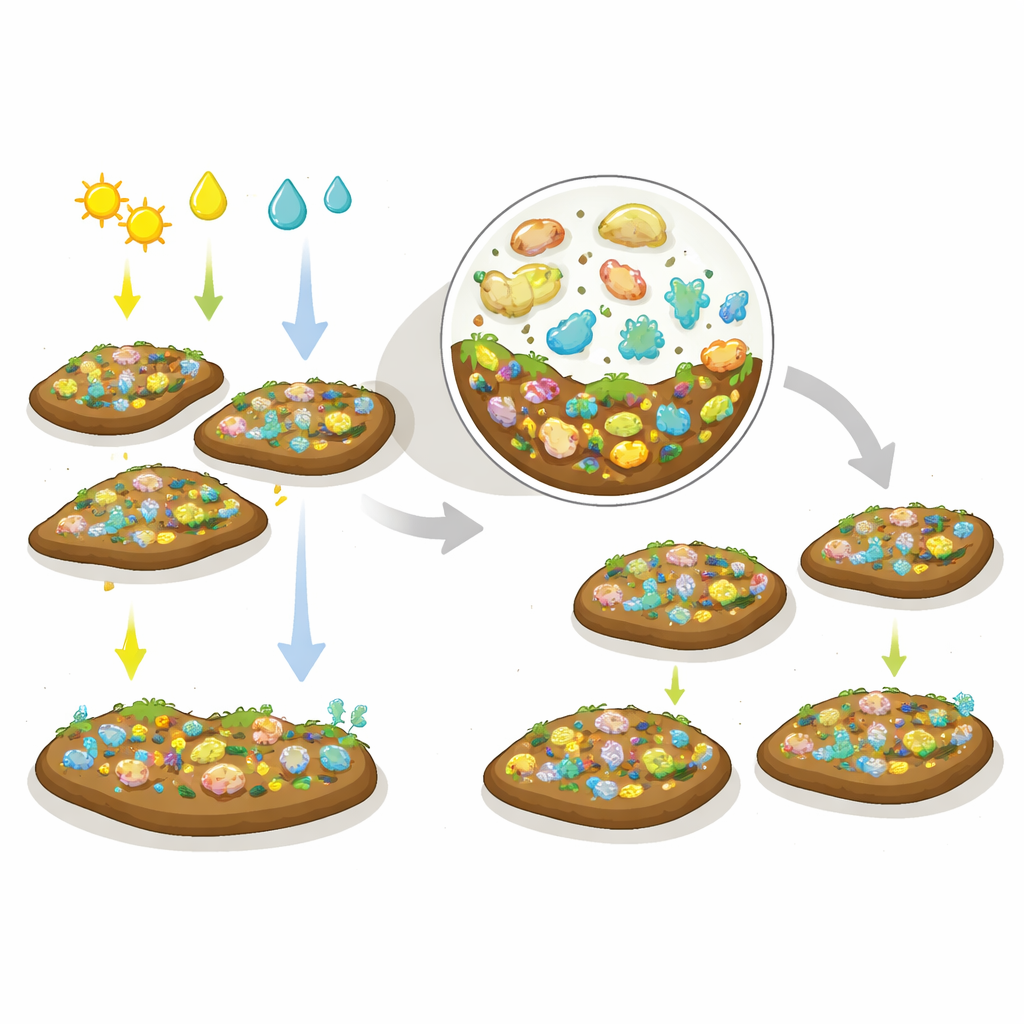
Local neighborhoods becoming more alike
The researchers first analyzed DNA data from soils collected at 138 sites across six continents. They looked at which bacteria and protists were present and how similar or different the communities were from place to place. A key pattern emerged: where certain common predator protists were abundant, local soil samples tended to share more of the same successful bacterial types. These protists consistently nibbled away at the most dominant bacteria in each soil, preventing any single type from taking over. As a result, neighboring communities ended up with a broader mix of well‑represented species and became more similar to one another.
Global differences growing larger
At the same time, the study found that differences in which predator species lived in different regions helped make bacterial communities across the globe more distinct. Rare, locally restricted predators and changes in predator communities from one ecosystem to another were strongly linked to how different bacterial communities became over long distances. In other words, while common predators push nearby soils toward a shared balance of bacteria, unique predator lineups in different climates and habitats pull distant soils in different directions, increasing global variety.
Field tests on a tropical island
To move beyond correlations, the team set up a controlled field experiment in sugarcane farms on a small tropical island in Japan. They deliberately pushed bacterial communities apart by changing soil nutrients and acidity with different fertilizers and lime. Despite these strong environmental nudges, plots that hosted higher levels of common predator protists showed bacterial communities that were less “spread out” from each other. The predators again appeared to trim back overly successful bacterial types and boost the number of different dominant species, counteracting some of the divergence caused by fertilizer and pH changes.
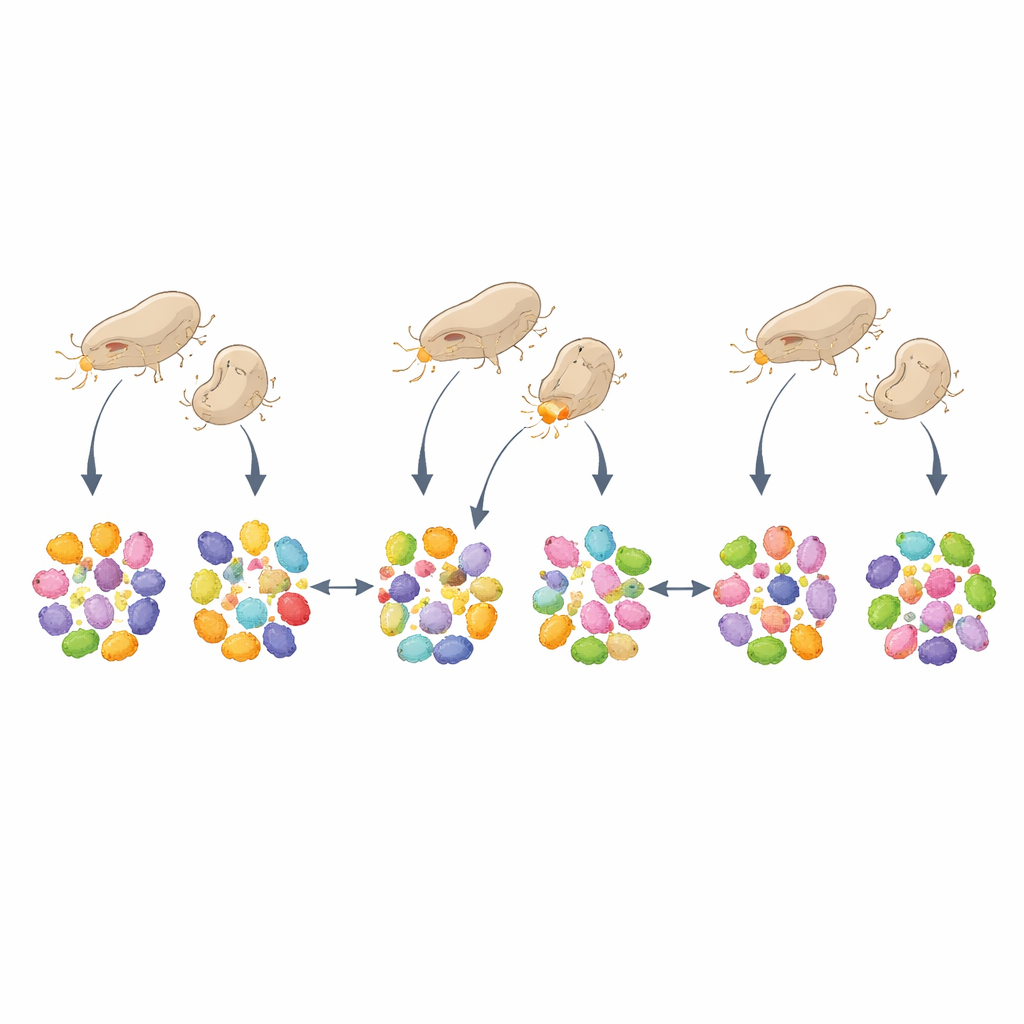
Zooming into lab worlds and synthetic mini‑ecosystems
In lab microcosms, the authors took bacteria from five very different soils and grew them in a standardized artificial soil, with and without added predators. When predators were present, bacterial communities from these different origins became more alike; without predators, they remained more distinct. The predators mostly reduced a few formerly abundant bacterial strains and allowed several strong competitors to coexist. The researchers then built simple “synthetic” communities from only six known bacterial species—three that resist being eaten and three that are easy prey—and exposed them to different protist hunters. When predator‑vulnerable bacteria started out dominant, predator feeding pulled communities toward a common structure. But when predator‑resistant bacteria dominated, communities changed less, and convergence weakened. This showed that both the identity of the predator and the traits of the prey shape the final outcome.
What this means for managing soils
Putting all lines of evidence together, the authors propose that microbial predators are key, context‑dependent organizers of soil life. Common predators make nearby communities more similar by cutting down runaway winners and supporting a richer set of co‑dominant bacteria. Yet because different ecosystems host different sets of predators and prey, their selective feeding drives communities around the world to diverge. For non‑specialists, the main takeaway is that protecting and perhaps deliberately using these tiny hunters could help guide soil microbiomes toward configurations that improve crop health, nutrient cycling, and resilience to environmental stress—using the food web itself as a subtle tool for microbiome engineering.
Citation: Asiloglu, R., Kuno, H., Fujino, M. et al. Predator-mediated local convergence fosters global microbial community divergence. Nat Commun 17, 2499 (2026). https://doi.org/10.1038/s41467-026-70605-x
Keywords: soil microbiome, microbial predators, protists and bacteria, ecosystem resilience, microbiome engineering