Clear Sky Science · en
Shear properties and stable wrinkle resistance in 2D Ti3C2Tx MXene monolayers
Flat Films for Flexible Futures
From bendable phones to tiny sensors woven into clothing, tomorrow’s gadgets will rely on ultra-thin films that can flex and twist without failing. This study explores a promising class of sheet-like materials called MXenes, focusing on a titanium-based version known as Ti3C2Tx. The researchers discover that, unlike many other atomically thin materials which crumple into wrinkles under sideways forces, Ti3C2Tx stays remarkably flat and strong, making it an appealing building block for robust, flexible electronics.
Why Sideways Forces Matter
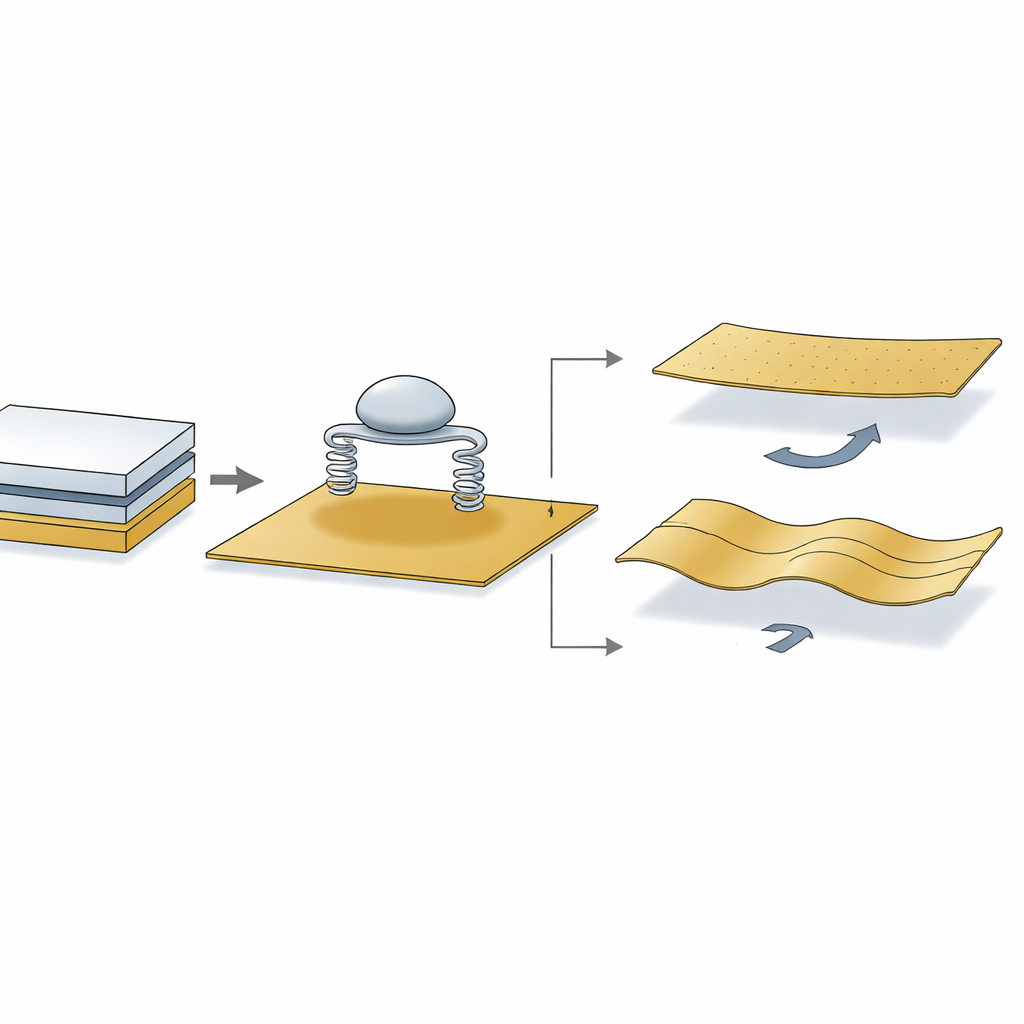
In real devices, ultra-thin films do not just get pulled like a rubber band; they are also pushed and dragged sideways by everyday mechanical stresses. These sideways pushes, or shear loads, often cause common 2D materials such as graphene to buckle into tiny ripples. Those wrinkles may sound harmless, but they can disrupt the flow of electrons and heat, undermining performance and shortening a device’s life. Until now, however, it has been very difficult to directly measure how a single atomic sheet responds to this type of loading, especially for solution-made MXenes like Ti3C2Tx. Existing lab techniques mostly probe how layers slide over each other or how a membrane interacts with a surface, rather than how a single layer itself resists shear.
A New Way to Push an Atom-Thin Sheet
To tackle this challenge, the team developed a careful way to handle delicate Ti3C2Tx monolayers and a specialized “push-to-shear” test device. First, they produced large, high-quality single layers of Ti3C2Tx in solution and suspended them on tiny copper meshes. Using a micromanipulator and focused ion beam cuts, they trimmed and lifted individual sheets, then fixed them across a small gap on a nanomechanical testing chip. Platinum deposited at the sheet’s edges ensured a firm grip without tearing. In the test instrument, a rounded tip pushes on a movable plate connected by springs so that one side of the sheet is gently shifted sideways while the other side is held still. Microscopy confirms that the gap width does not change, meaning the sheet experiences almost pure shear rather than stretching or compression.
Measuring Strength Without Destroying Quality
Once the test setup was established, the researchers combined imaging and force measurements to quantify how the Ti3C2Tx monolayer behaved. High-resolution electron microscopy before and after the transfer showed that the crystal structure remained intact and single-crystalline, both at the edges and in the central test area. They also carefully determined the effective thickness of a single layer (about one nanometer) using cross-sectional imaging and theoretical modeling, rather than relying on rougher surface measurements that can be distorted by contamination or trapped water. With the sheet dimensions and device stiffness in hand, they turned the recorded force and sideways displacement into a three-dimensional shear modulus—a measure of how stiffly the sheet resists being sheared—as well as the maximum shear strain and strength before breaking.
Surprisingly Stiff and Wrinkle-Resistant
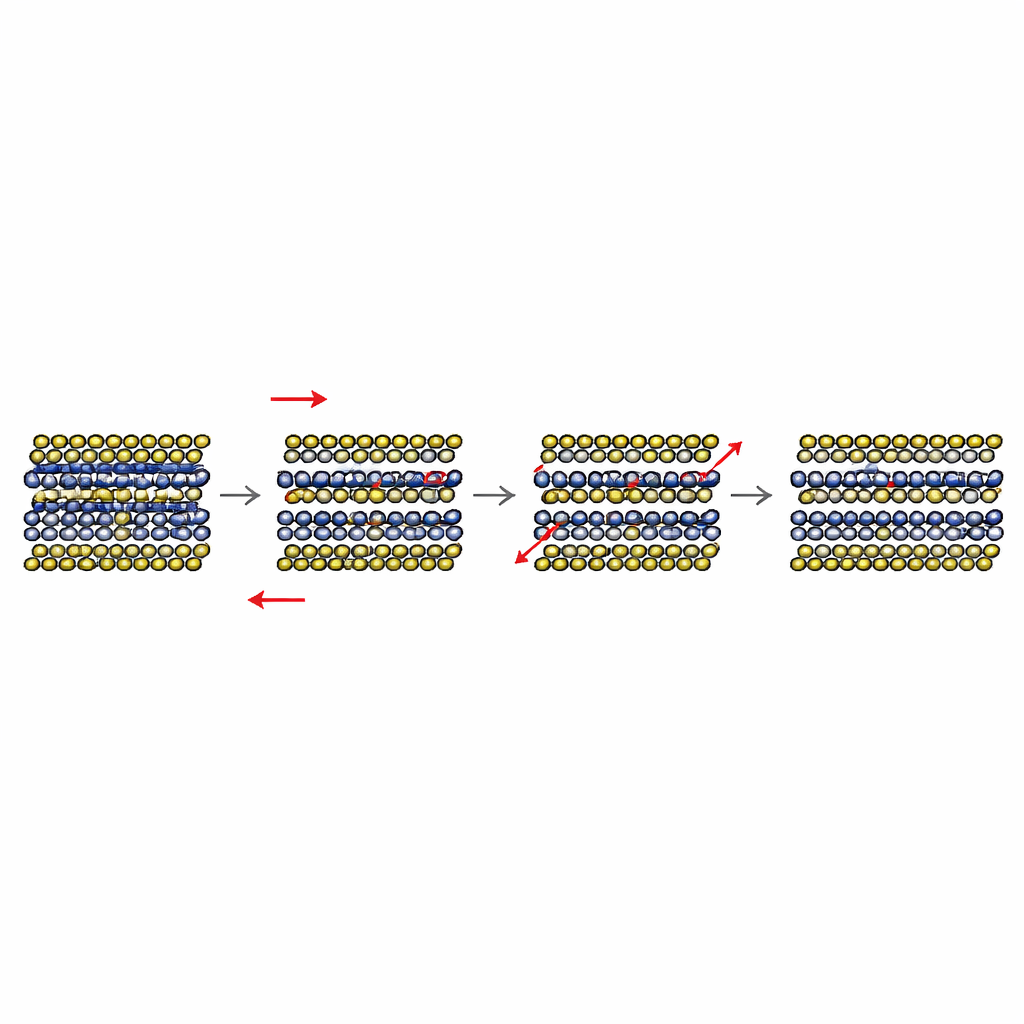
The numbers reveal a material that defies expectations for atomically thin sheets. Ti3C2Tx shows an in-plane shear modulus of about 279 gigapascals in the initial loading stage, far higher than the roughly 70 gigapascals reported for monolayer graphene. Even as loading continues and localized internal strain develops, the effective shear stiffness only drops to around 111 gigapascals, and the sheet endures shear strains of nearly 9 percent before fracturing at strengths near 19 gigapascals. Crucially, during this entire process the monolayer does not buckle into pronounced wrinkles; instead, it remains largely flat. Computer simulations back up these observations, showing that Ti3C2Tx’s multi-layered atomic structure and strong internal bonding keep deformation mostly in-plane, with stress redistributed through its stacked titanium and carbon layers rather than relieved by out-of-plane rippling.
What This Means for Future Devices
For non-specialists, the main takeaway is that Ti3C2Tx MXene monolayers behave more like tiny metal plates than fragile cling film when pushed sideways. They combine high electrical conductivity with an unusual resistance to wrinkling and shearing, even at large deformations. This blend of properties makes them strong contenders for use in flexible electronics, micro- and nanoelectromechanical systems, structural composite films, and other technologies where thin, solution-processable materials must remain both strong and stable under complex real-world stresses. By directly measuring how a single Ti3C2Tx sheet responds to shear and showing that it can stay flat and tough, this work points toward more reliable, long-lasting devices built from the thinnest of building blocks.
Citation: Rong, C., Su, T., Yu, T. et al. Shear properties and stable wrinkle resistance in 2D Ti3C2Tx MXene monolayers. Nat Commun 17, 2411 (2026). https://doi.org/10.1038/s41467-026-70573-2
Keywords: MXene, 2D materials, flexible electronics, shear mechanics, wrinkle resistance