Clear Sky Science · en
Unlocking large-area free-standing MOF-glasses for molecular sieving gas separation membranes
Cleaner Gas Separations for a Busy Planet
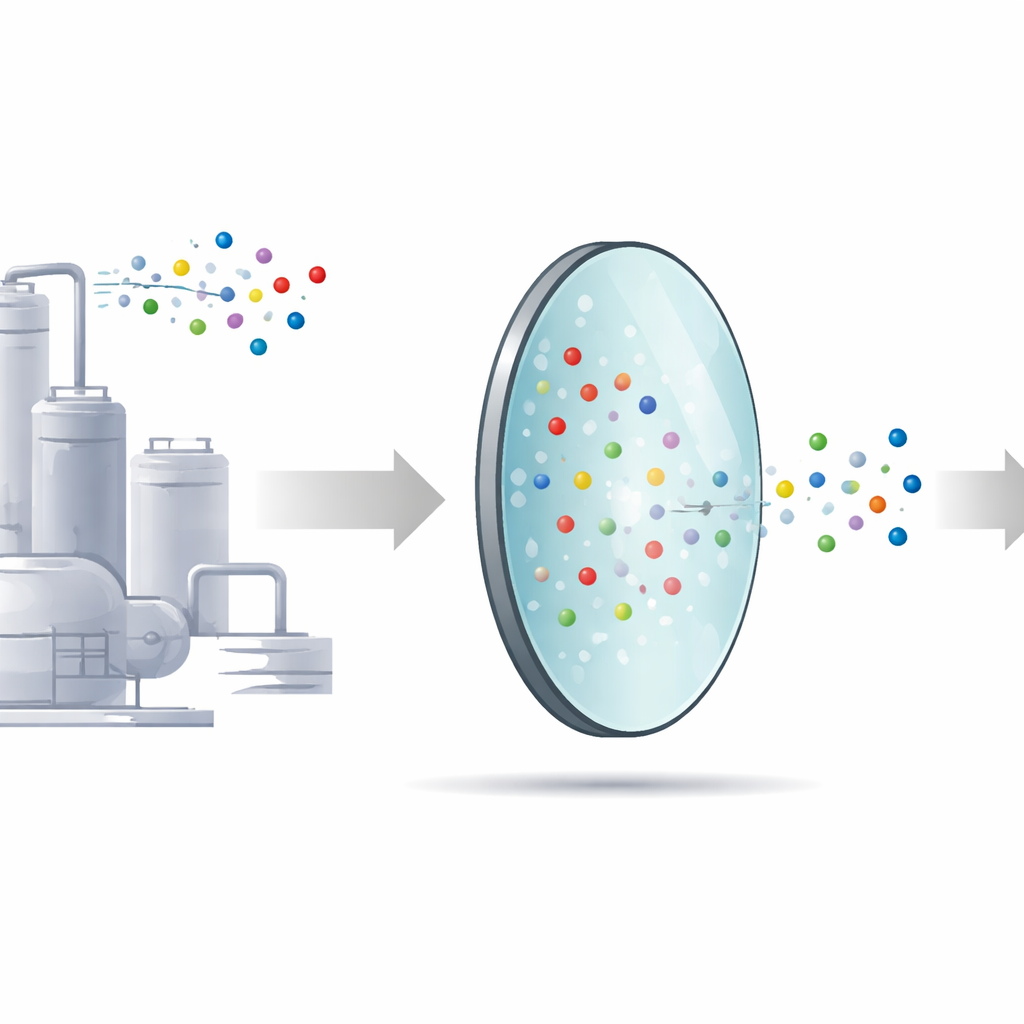
Modern society relies on separating gas mixtures to produce everything from natural gas and hydrogen fuel to clean air for industry. Today, this often means running giant distillation columns that guzzle energy. This paper introduces a different path: thin sheets of a special “metal–organic framework” glass that can act as ultra-precise filters. The researchers show how to make these fragile materials as large, crack‑free, self-supporting membranes—and how they can let small gas molecules slip through while completely blocking methane, one of the main components of natural gas and a powerful greenhouse gas.
Why Gas Filters Matter
Separating gases is one of the most energy-hungry tasks in the chemical industry. Conventional methods like cryogenic distillation work by cooling and reheating huge volumes of gas, consuming up to 80% more energy than membrane-based processes. Membranes—thin barriers that let some molecules pass more easily than others—promise big energy savings because they rely on the built-in properties of the material instead of constant heating and cooling. The most efficient membranes act like a sieve, where only molecules small enough to fit through tiny openings can pass, while larger ones are held back.
A New Kind of Glass Filter
Metal–organic frameworks (MOFs) are highly porous materials built from metal atoms linked by organic molecules, forming a regular network of tiny cavities. Some of these MOFs can be melted and then cooled into a glass, much like window glass, but with built-in nanoscale passages. These MOF glasses have several advantages over their crystalline cousins: they can be shaped from a liquid, polished, cut, and—crucially for membranes—formed into continuous, grain‑free sheets that do not have weak spots where gas can leak through. The challenge has been that these melts are extremely viscous, tend to crack when cooled, and often densify so much that their pores close, ruining their filtering ability.
Making Large, Crack-Free Glass Membranes
The authors focus on a well‑studied MOF called ZIF‑62, which can be melted into a glass known as agZIF‑62. They systematically tune each step of the process—from how the crystals are ground, to how they are heated, to how the glass is cooled—to balance mechanical stability with preserved porosity. A key insight is choosing the right support during melting. By pressing the ZIF‑62 powder between aluminum foils, whose thermal expansion behavior closely matches that of the MOF glass, they avoid the internal stresses that cause cracks when the material cools. They also add a carefully controlled annealing step just below the glass transition temperature, which allows the internal network to relax without collapsing the pores. The result is centimeter‑scale, thin, transparent sheets of MOF glass that are free of bubbles, grain boundaries, and visible defects.
Turning Glass Sheets into Working Membranes
To use these sheets in real gas separation equipment, the team builds a sandwich-like structure. The MOF glass film is glued between two ring-shaped pieces of ordinary soda‑lime glass with epoxy resin, which both seals the edges against leaks and mechanically protects the brittle core. Microscopy and electron microscopy show that the MOF glass, the epoxy, and the surrounding glass rings form continuous, tightly bonded layers without gaps or voids. This architecture allows the membrane to survive the high pressure needed to clamp it into a gas permeation cell, while leaving a central circular area of freestanding MOF glass as the active filtering region.
Letting the Smallest Through, Locking Methane Out
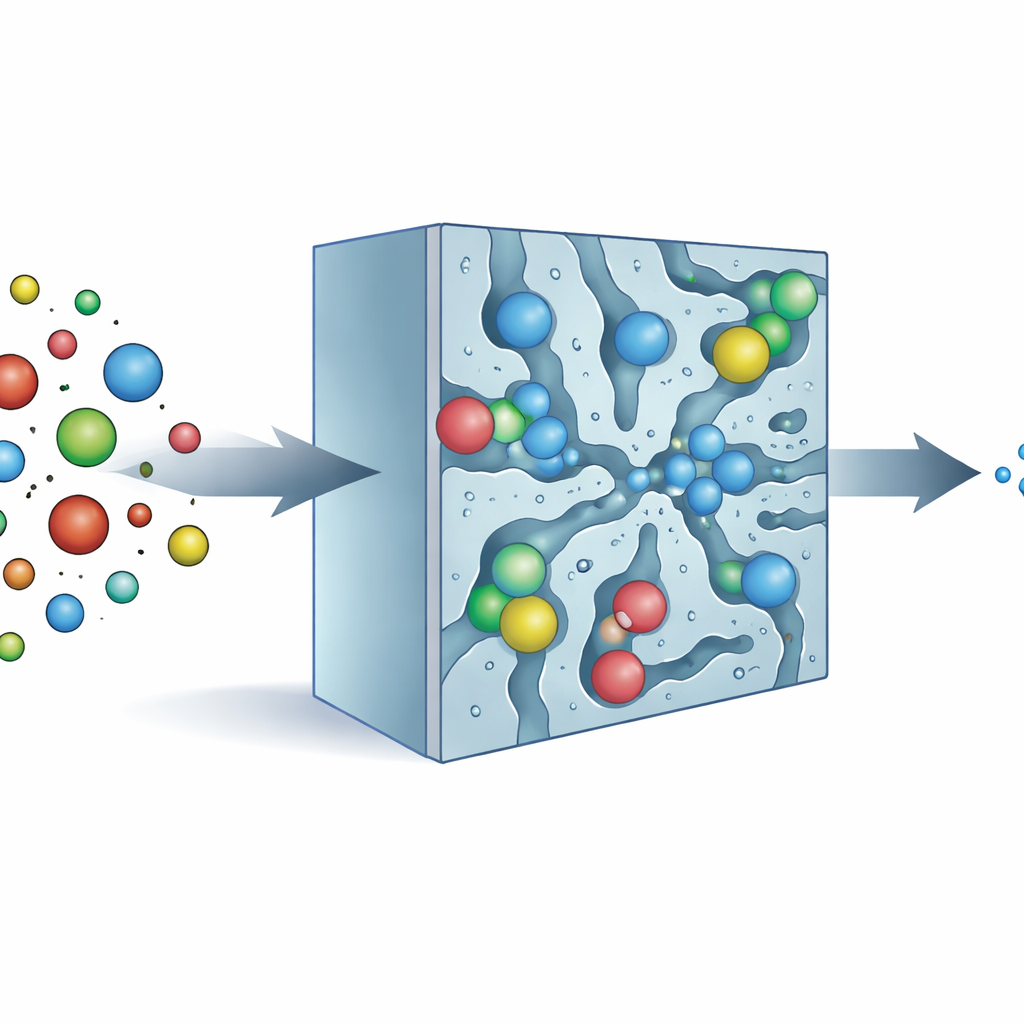
When tested with single gases and mixtures, the agZIF‑62 membrane behaves like an exceptionally sharp molecular sieve. Very small molecules such as helium and hydrogen pass through readily, while slightly larger ones, like carbon dioxide and nitrogen, move more slowly. Methane, however, is blocked so completely that it is undetectable by gas chromatography over many hours of measurement—effectively 100% retention. This behavior matches earlier microscopic studies showing that the glass contains a distribution of very narrow channels, most of which are just large enough for the smallest gases but not for methane. Because the glass is monolithic and lacks grain boundaries, there are no “shortcuts” for methane to leak through, which explains the extraordinary selectivity.
Where This Could Lead
In simple terms, the authors have learned how to make large, smooth sheets of a sponge-like glass that acts as an almost perfect size filter for gases, especially powerful for keeping methane out while letting smaller molecules through. Although the current membranes are relatively thick and therefore not yet optimized for fast gas flow, the same glass-processing tricks that work for everyday glass—such as polishing and thinning—can be applied to speed them up. The work suggests that similar strategies could be used with other MOF glasses and scaled up using modular designs, opening a path toward industrial membranes that combine very sharp molecular sieving with lower energy use in key separation processes.
Citation: Smirnova, O., Duval, A., Komal, A. et al. Unlocking large-area free-standing MOF-glasses for molecular sieving gas separation membranes. Nat Commun 17, 2575 (2026). https://doi.org/10.1038/s41467-026-70571-4
Keywords: gas separation membranes, metal-organic framework glass, molecular sieving, methane exclusion, ZIF-62