Clear Sky Science · en
A connectivity threshold between grass patches amplifies coastal dune formation
Why sand dunes need team players
Along many coasts, low ridges of sand held together by hardy grasses are the first line of defense against storms and rising seas. This study asks a deceptively simple question with big consequences for coastal protection: do individual grass clumps build dunes on their own, or does it take cooperation among many patches to raise truly protective dunes? By tracking a young Dutch dune field for a decade, the authors reveal that the way grass patches are spaced—not just how big they are—can trigger a kind of chain reaction that rapidly builds tall, stable dunes.
How living landscapes build themselves
Coastal dunes are classic examples of “living landscapes,” where plants and physical forces constantly reshape one another. Pioneer grasses colonize bare beach, their stems slowing the wind so that blowing sand drops out and piles up around them. As sand buries the plants, they respond by producing more shoots and spreading outward, which in turn traps even more sand. Over time, this positive feedback can transform a flat shore into a protective dune belt that also stores carbon, shelters freshwater and creates habitat for many species. Traditionally, scientists have looked at these feedbacks patch by patch, asking how much sand a single grass clump can capture. Yet many coastal ecosystems—from dunes to salt marshes and seagrass meadows—start out as a patchwork, raising the question of whether interactions among patches might be just as important as what happens within each one.
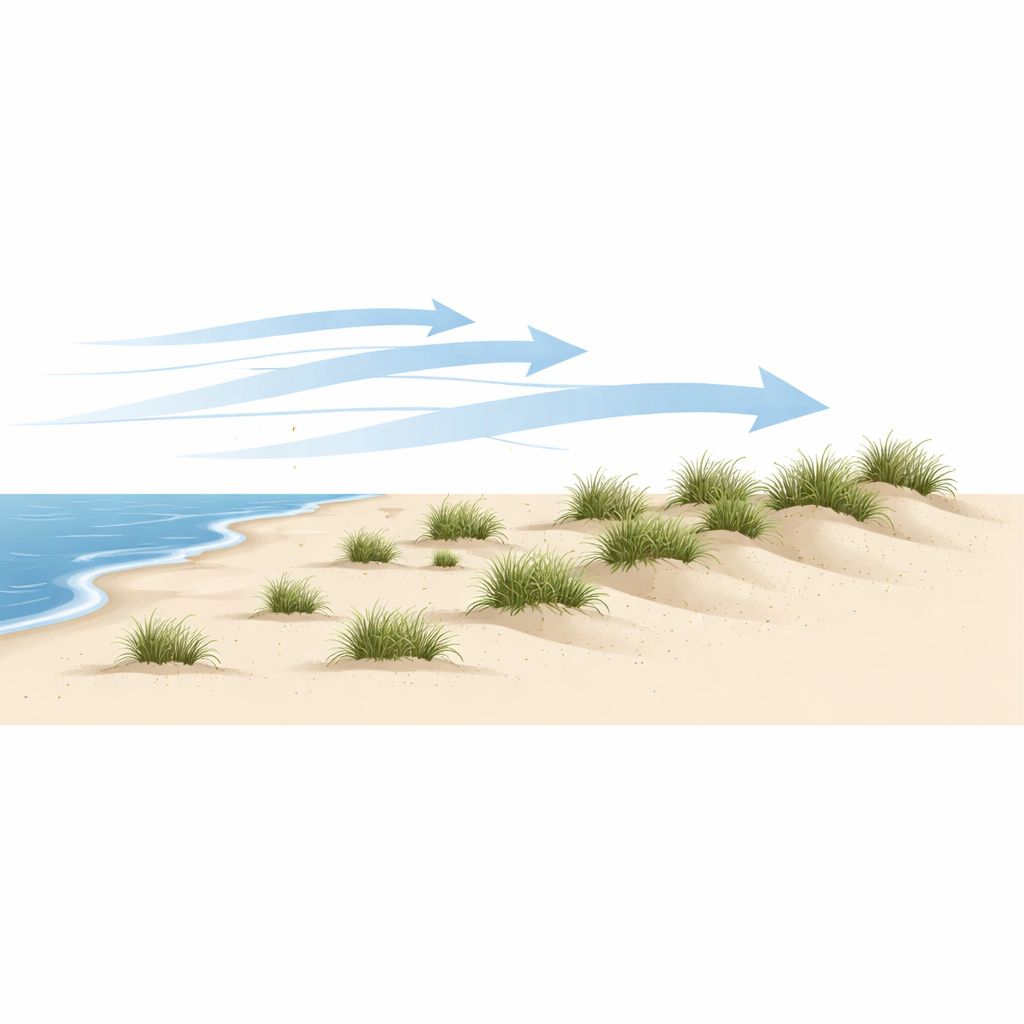
Watching a young dune field grow up
The researchers focused on a 12-hectare section of a rapidly developing dune field on the island of Texel in the Netherlands. Using annual high-resolution aerial photos and elevation models taken over more than ten years, they mapped over 4,000 individual grass patches and measured how the sand surface around them rose through time. This allowed them to compare two possible drivers of dune growth: the size of each patch itself, and the local “crowdedness” of patches in its surroundings. Surprisingly, they found that initial patch size was only weakly related to how tall the dune became a year later. In contrast, the number of neighboring patches within about seven meters was a strong predictor of dune height, both in the short term and over nearly a decade.
A tipping point in grass patch connectivity
When the team plotted dune height against local patch density, the relationship took on a distinctive S-shape. At very low densities, isolated grass clumps remained small bumps in the sand. As density increased beyond a certain threshold, dune height rose sharply, before leveling off again at high densities. This pattern matches what physicists call a percolation transition, where scattered elements suddenly become part of a continuous, connected network once they are close enough together. By applying a mathematical framework from percolation theory, the authors estimated how far the “zone of influence” of each grass patch extends and how close neighbors must be for their effects on wind and sand transport to overlap. They found that once patches are within roughly 4.5 meters of one another, their combined ability to slow wind and trap sand far exceeds what any single patch can do alone, effectively merging them into a shared dune body.
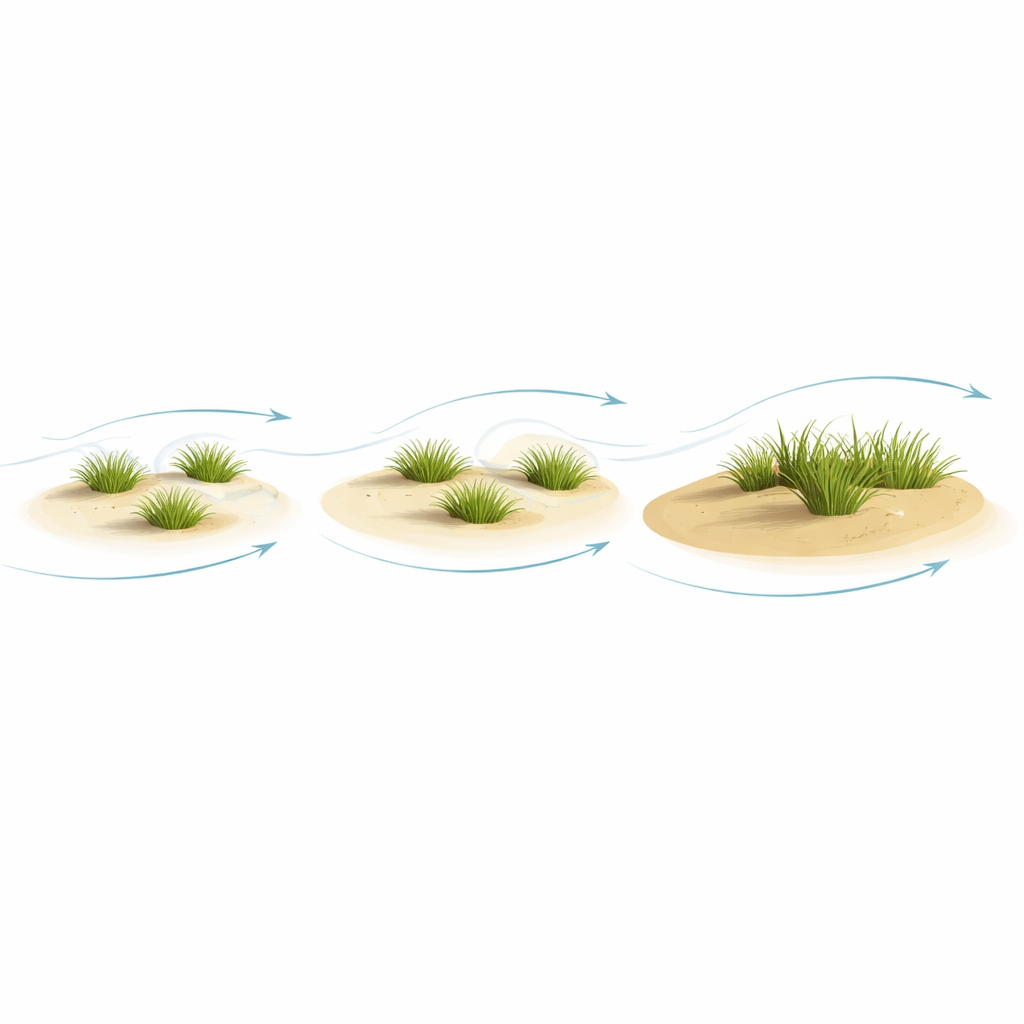
Early patterns that shape the future coast
One of the most striking results is how long the imprint of these early patch arrangements persists. The density and spacing of grass patches measured in 2013 continued to predict dune height up to ten years later, even as the vegetation expanded and the dunes matured. As time went on, the contrast between areas that had started above the connectivity threshold and those that had not became more pronounced: clustered patches grew into tall, well-developed dunes, while more isolated ones lagged behind. This shows that the first few years of colonization set a long-lasting template for the entire landscape, steering where the coast will be most strongly defended by natural dunes.
Rethinking how we restore and protect coasts
These insights have practical implications for coastal management and restoration. Many current dune restoration projects plant grasses in evenly spaced grids or at very high, uniform densities that do not mimic natural patchiness. The new findings suggest a more efficient strategy: arrange grasses in patches that are close enough—on the order of a few meters apart—to let their influence zones overlap and form functionally connected clusters. Such designs could build higher, more resilient dunes with fewer plants and lower costs, while tapping into the same self-organizing processes that shape intact dune systems. In plain terms, this study shows that for dune-building grasses, being a good neighbor matters as much as being strong individually: once enough patches “hold hands” across the sand, the coastline gains a powerful, self-reinforcing shield against the sea.
Citation: Berghuis, P.M.J., Reijers, V.C., van de Koppel, J. et al. A connectivity threshold between grass patches amplifies coastal dune formation. Nat Commun 17, 2534 (2026). https://doi.org/10.1038/s41467-026-70552-7
Keywords: coastal dunes, ecosystem engineering, vegetation patterns, landscape connectivity, coastal restoration