Clear Sky Science · en
Extended valley lifetime and giant energy splitting induced by chiral plasmon-valley exciton selective coupling
Light as a tiny information switch
Modern electronics store information in the charge or spin of electrons, but a newer idea called “valleytronics” aims to use where in a material’s energy landscape an electron sits—its “valley”—as an extra on–off switch. This paper shows how specially shaped gold nanoparticles can give that valley switch a much longer memory and a cleaner signal at room temperature, which is a key step toward practical, light-based information technologies.
What are valleys and why they matter
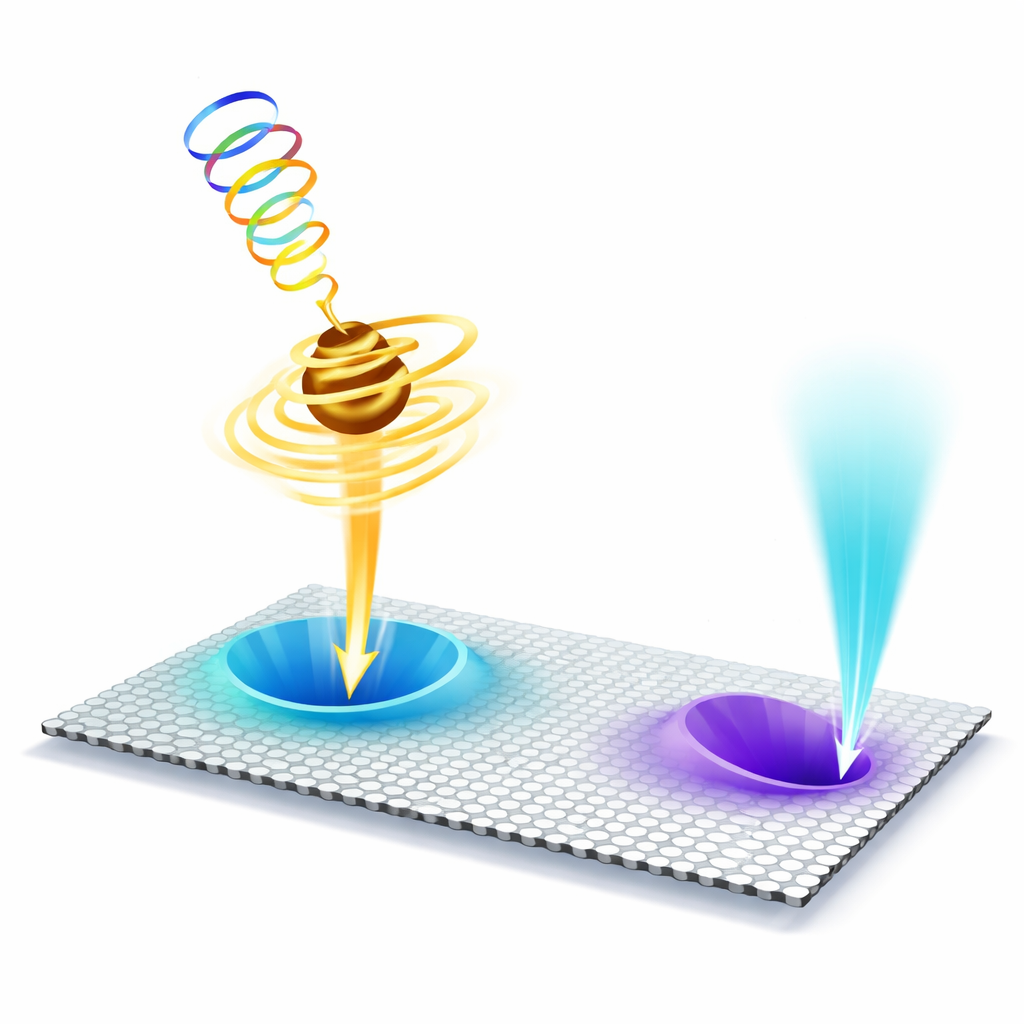
In a crystal, electrons do not move freely; they follow a band structure that relates their energy to their motion. In some advanced sheet-like materials, such as monolayer molybdenum disulfide (MoS2), this band structure has two distinct energy pockets, or valleys. Shining circularly polarized light—light whose electric field corkscrews in a chosen direction—can selectively fill one valley more than the other by creating bound electron–hole pairs called excitons. Because each valley can be addressed with a particular light helicity, they naturally form a pair of binary states that could encode digital information. The challenge is that random interactions quickly shuffle excitons between valleys, erasing the stored information almost as soon as it is written.
Using twisted gold to favor one valley
The authors tackle this problem by bringing MoS2 into contact with a single “nanohelicoid” of gold—a tiny three-dimensional spiral that strongly prefers one twist of light over the opposite. When circularly polarized light excites this chiral nanohelix, it supports swirling surface plasmons, collective electron oscillations that concentrate light into a deep, twisted near field at the interface with the MoS2. Because the twist of this field matches one valley’s preferred helicity better than the other’s, excitons in that valley couple more strongly to the plasmonic mode. This selective strong coupling mixes light and matter into new hybrid states called polaritons, but crucially, it does so differently in the two valleys, breaking their usual energy degeneracy.
Watching valley populations evolve in time
To see how this selective coupling affects valley memory, the team used a set of optical tools that separate light by its circular polarization and track signals over trillionths of a second. Dark-field scattering revealed that coupling between the nanohelix plasmon and MoS2 excitons splits the original exciton energy into two polariton branches, a hallmark of strong light–matter interaction. Photoluminescence measurements showed that, near the nanohelix, the emitted light became about ten times more circularly polarized than from bare MoS2, indicating a strong imbalance between valley populations. Time-resolved reflectivity then uncovered that this valley imbalance persists: the characteristic valley polarization lifetime stretched from about 21 picoseconds in pristine MoS2 to nearly 700 picoseconds when coupled to the chiral nanoresonator, with theory suggesting it can last even longer.
Breaking valley symmetry without magnets
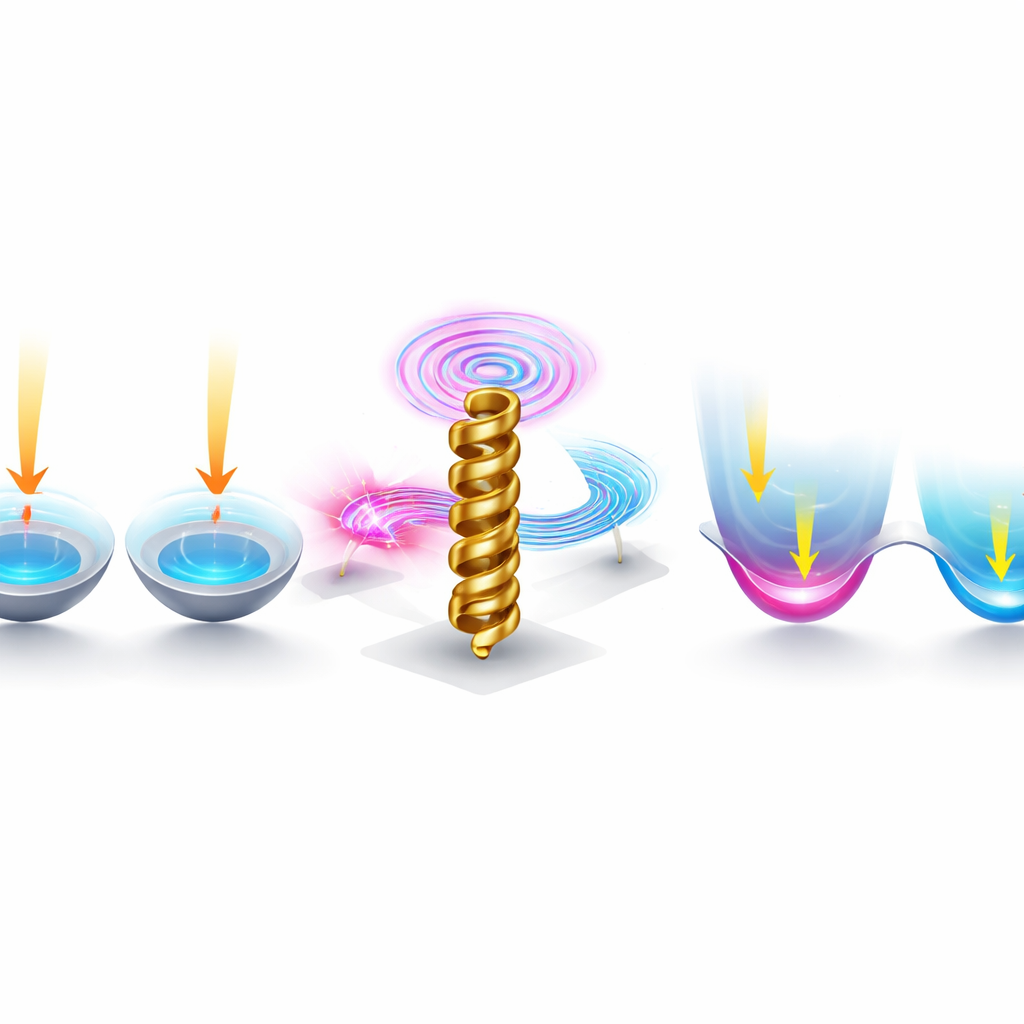
A closer look at the emission spectra revealed that the two valleys no longer share the same energy. Because the nanohelix couples more strongly to one valley, the lower-energy polariton state in that valley sinks farther down than in the other, producing a “valley energy splitting” of up to roughly 19 millielectronvolts. In previous work, similar splittings required huge laboratory magnets or carefully engineered magnetic interfaces. Here, the effect arises purely from optical design and the local chiral field near a single gold nanohelix. By tuning the energy mismatch between the plasmon resonance and the exciton, the authors could further control both the strength of this splitting and the degree of circular polarization of the emitted light.
Why this matters for future devices
In everyday terms, this work shows how to build a nanoscale light-powered selector that both prefers one information state and keeps it intact for far longer than usual, all at room temperature and without bulky magnets or extreme cooling. The chiral gold nanohelicoid acts as a valley-specific amplifier and stabilizer, deepening the energy well for one valley while weakening the pathways that rapidly equalize the two. This dual achievement—giant valley energy splitting and greatly extended valley lifetime—points toward compact, on-chip components that could encode, store, and read out information using the valley degree of freedom in two-dimensional materials, opening a practical route for valleytronic memories, switches, and light sources.
Citation: Liu, J., Liu, F., Xing, T. et al. Extended valley lifetime and giant energy splitting induced by chiral plasmon-valley exciton selective coupling. Nat Commun 17, 2444 (2026). https://doi.org/10.1038/s41467-026-70544-7
Keywords: valleytronics, chiral plasmonics, monolayer MoS2, exciton polaritons, nanophotonics