Clear Sky Science · en
Millennial-to-orbital-scale subsurface ocean warming and Polynya formation off Dronning Maud Land during the last glacial
Why hidden warmth under Antarctic ice matters
When we imagine the last ice age, we picture a frozen, unchanging world. Yet beneath the sea ice fringing Antarctica, the ocean was anything but still. This study looks deep below the surface of the Weddell Sea, off Dronning Maud Land in East Antarctica, and finds that pulses of relatively warm water repeatedly rose toward the surface, opening large areas of ice-free water called polynyas. These hidden heat releases did not melt the ice sheet away; they may actually have helped it grow. Understanding how this ancient dance between ocean, ice, and atmosphere worked is crucial for predicting how today’s warming oceans might reshape Antarctica and global sea levels.
A unique ocean time capsule on the seafloor
The researchers recovered a long sediment core from the Bungenstock Plateau, a submarine rise in the eastern Weddell Sea, about 70 kilometers north of the modern Antarctic shelf edge. In this core, mud and tiny shells of drifting microorganisms called foraminifera (specifically Neogloboquadrina pachyderma) built up almost continuously between 75,000 and 20,000 years ago, spanning much of the last ice age. These shells preserve subtle chemical fingerprints of the water in which they grew. By measuring several independent signals in the shells—oxygen and carbon isotopes, magnesium-to-calcium ratios, and rare "clumped" isotopes—the team reconstructed changes in subsurface temperature, saltiness, and nutrients in the upper 50–150 meters of the ocean over tens of thousands of years.
Warm water lurking beneath the cold surface
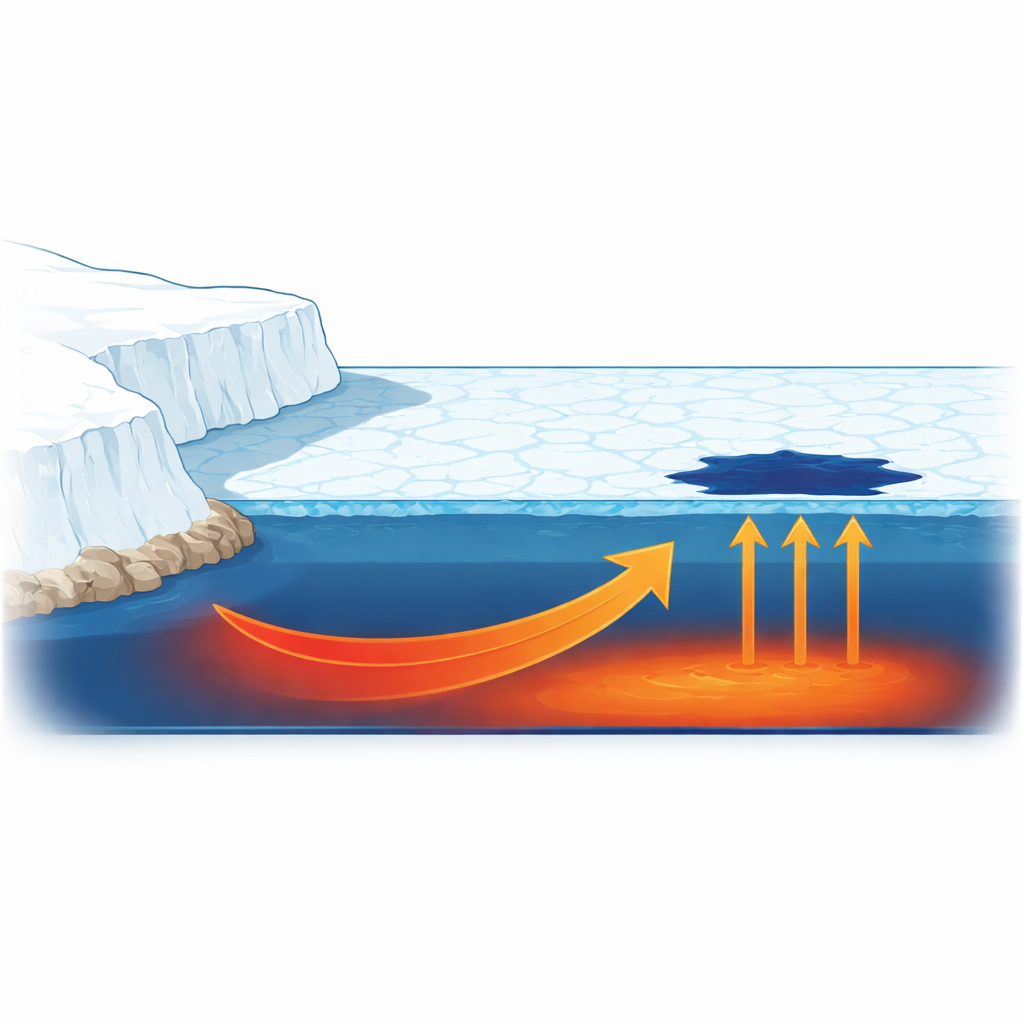
Today, the upper Southern Ocean is layered: a very cold, relatively fresh surface layer sits above a saltier, slightly warmer mass of "Warm Deep Water." The density contrast between these layers keeps the warm water at depth and helps shield coastal ice shelves from melting. The sediment core shows that during the last glacial period this balance repeatedly shifted. The proxies reveal episodes when temperatures 50–150 meters below the surface rose by about 1–2 °C at the same time as Antarctic air temperatures cooled. These warm spells in the subsurface also coincided with saltier and more nutrient-rich conditions, signaling that the deeper warm water mass had moved upward into shallower depths where the foraminifera lived.
Ancient polynyas opening within a frozen sea
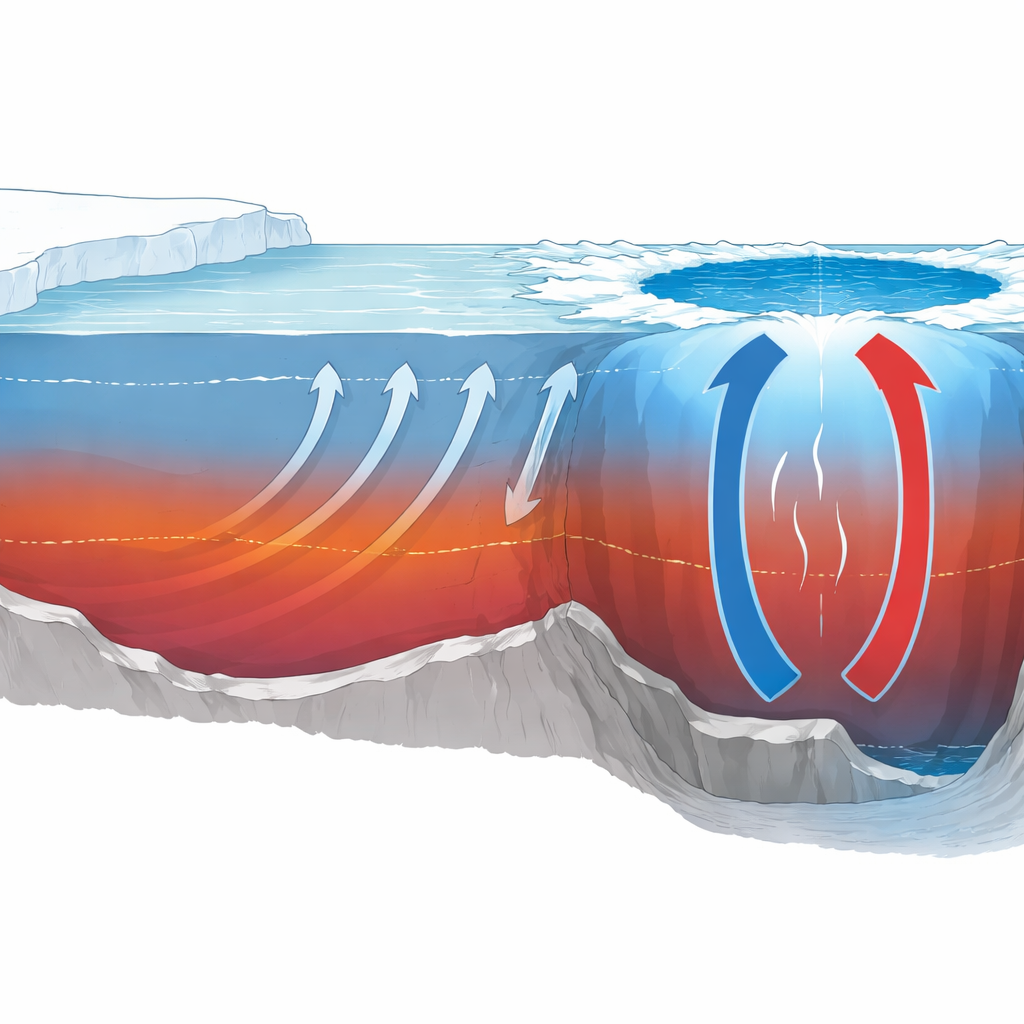
During the coldest parts of the last ice age—especially around 72–63, 58–55, 52–48, 43–40, and 38–20 thousand years ago—the evidence points to the warm deep water rising closest to the surface. The authors argue that this vertical rearrangement of heat and salt repeatedly weakened the density layering and encouraged open-water polynyas to form off Dronning Maud Land, even though sea ice was widespread and thick elsewhere. In these polynyas, sea ice could not easily form or persist because heat kept welling up from below and escaping to the atmosphere. Independent clues back up this picture: other sediment cores in the region show unusually high productivity and good preservation of shells during glacial times, and fossils from snow petrel colonies on land indicate that open water must have been available within their limited foraging range despite the expanded sea-ice cover.
Winds, ice, and distant oceans as co‑conspirators
The study links these recurring polynyas to a web of interacting forces spanning different timescales. On orbital timescales of about 41,000 years, changes in Earth’s tilt altered the contrast between low- and high-latitude climate. Periods of low tilt strengthened temperature differences between the tropics and poles, favoring stronger westerly winds and enhanced delivery of warm deep water into the Weddell Gyre. At the same time, extensive glacial sea ice and strong downslope (katabatic) winds from a larger Antarctic ice sheet helped trap heat at depth until the upper ocean became unstable enough to overturn. On shorter, millennial timescales, the subsurface warmings in the Southern Ocean tended to occur when the Atlantic Meridional Overturning Circulation—a key component of global ocean circulation—was strong. This points to a see-saw-like link between climate shifts in the North Atlantic and the Southern Ocean.
What this means for ice ages and our future
The authors conclude that a recurring "Glacial Dronning Maud Land Polynya" was a normal feature of the last ice age, likely as large as the Great Weddell Polynya observed in the 1970s, but operating over thousands rather than just a few years. By venting heat from the ocean to the atmosphere during cold spells, these polynyas may have increased snowfall over Antarctica and thickened the ice sheet at the continental margin, even as they stirred the deep ocean and potentially affected global circulation and carbon storage. Although modern polynyas seen in satellite images are shaped by different background conditions, they reveal that this region remains highly sensitive to small shifts in winds, sea ice, and ocean structure. The past thus offers a warning: changes in hidden subsurface heat around Antarctica can rapidly reorganize the ice–ocean system, with consequences that can echo around the globe.
Citation: Pinho, T.M.L., Nürnberg, D., Nele Meckler, A. et al. Millennial-to-orbital-scale subsurface ocean warming and Polynya formation off Dronning Maud Land during the last glacial. Nat Commun 17, 2440 (2026). https://doi.org/10.1038/s41467-026-70498-w
Keywords: Antarctic polynyas, Southern Ocean circulation, subsurface ocean warming, last glacial period, Dronning Maud Land