Clear Sky Science · en
Bioinspired maskless structural colour patterning via tunable nanoparticle segregation
Printing Color Without Pigments
Imagine books, banknotes, or phone cases whose vivid colors never fade because they contain no dyes at all. Instead, their hues come from tiny structures that bend and scatter light, much like a peacock feather or a butterfly wing. This paper describes a new way to "print" such structural colors in a single step, without complex masks or multiple inks, opening the door to greener displays, secure anti‑counterfeiting labels, and objects that can even hide in infrared camera view.
How Nature Builds Shimmering Feathers
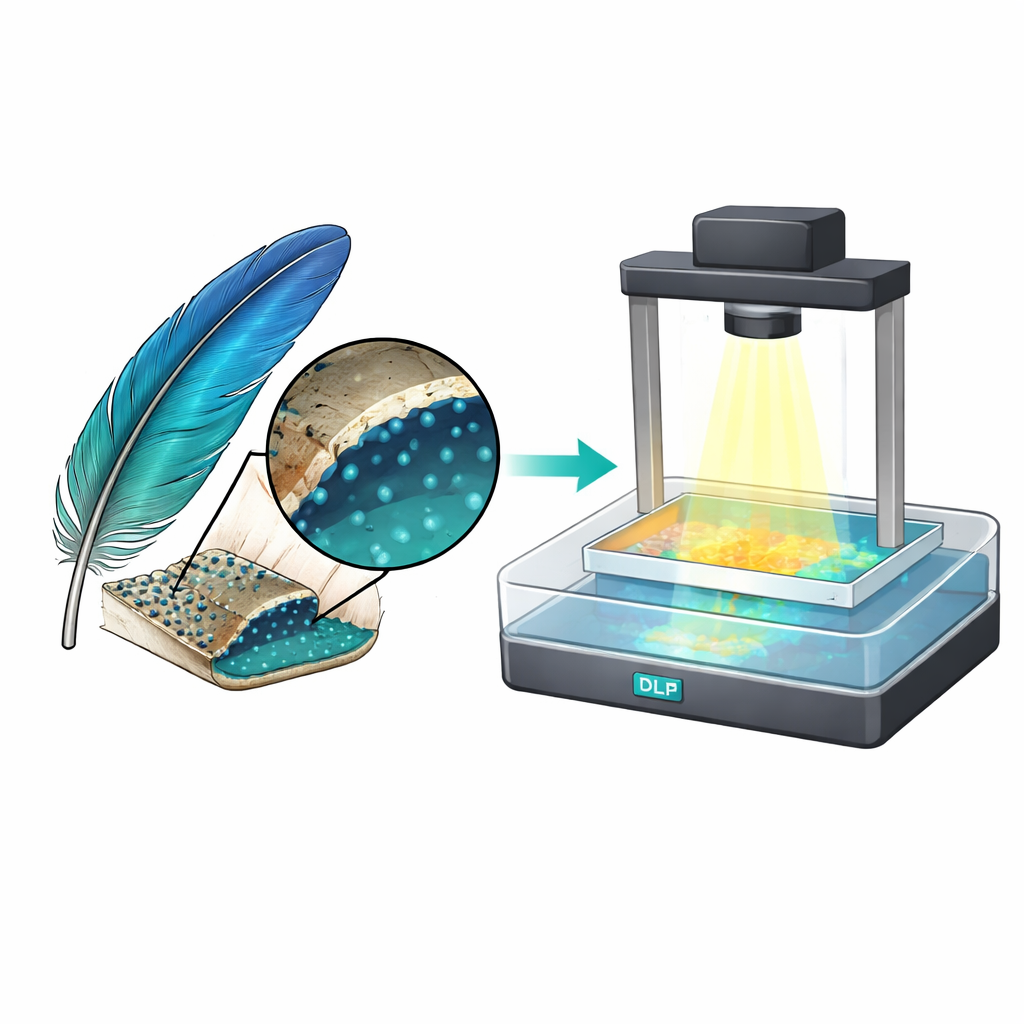
Many birds get their bright, metallic-looking colors not from chemical pigments, but from nanoscopic beads of dark material packed inside feather cells. During feather growth, these beads naturally drift toward the cell’s outer edge and arrange into a dense layer that reflects certain wavelengths of light. The authors borrow this idea: if they can coax man‑made nanoparticles inside a liquid resin to migrate and pile up in a thin surface layer while the resin hardens, they can generate controllable color simply by shaping that layer—no printed dyes or etched patterns required.
Guiding Nanoparticles With Oxygen and Light
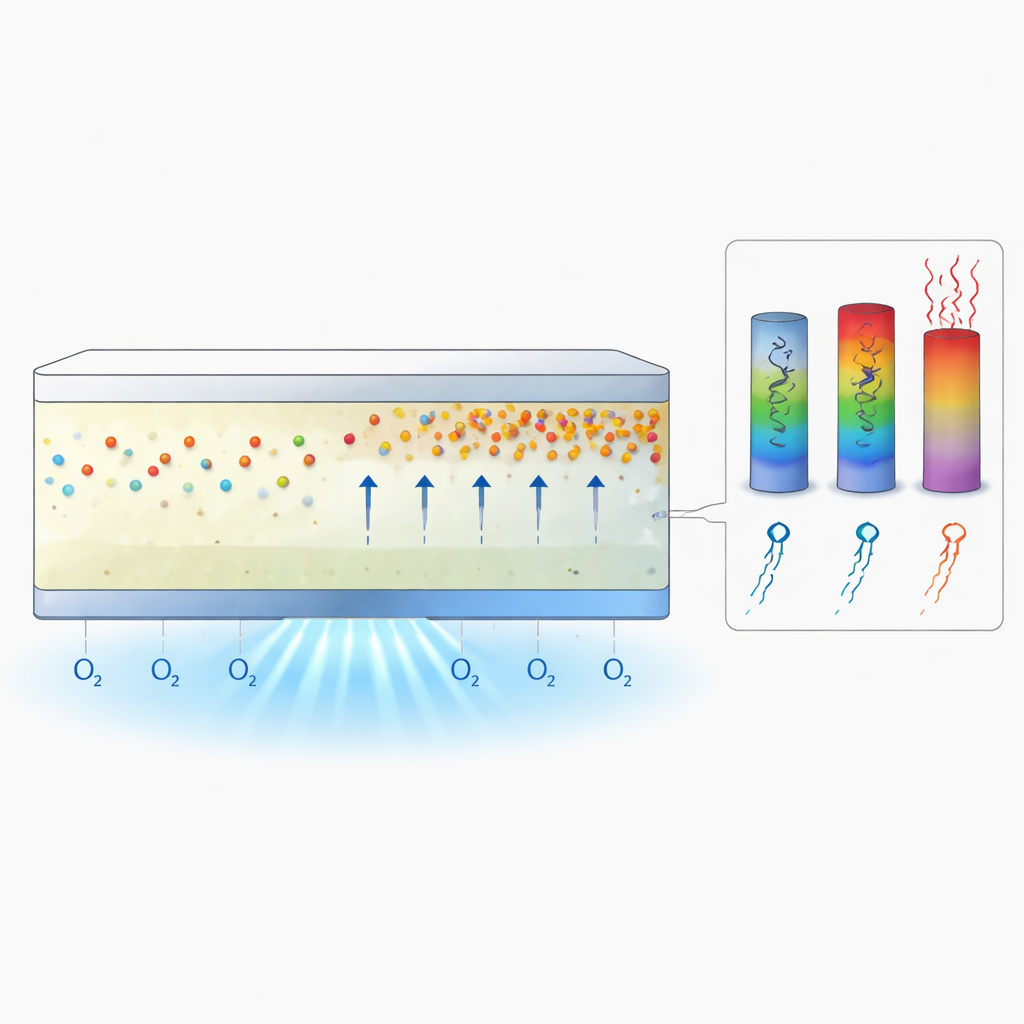
The team suspends uniform silica nanoparticles in a clear acrylic resin, creating a "photonic ink" that looks colored when the particles form ordered arrays. They then shine ultraviolet light to solidify this ink on top of plastic films that let oxygen pass through. Oxygen seeps in from the film and slows the hardening reaction near the bottom interface, while regions farther away solidify more quickly. This mismatch sets up a gradient in fluid composition: monomer molecules flow toward the solidifying region, and the nanoparticles are effectively pushed toward the oxygen‑rich interface. As the resin finally hardens everywhere, a distinct, nanoparticle‑rich layer remains at that surface above a particle‑poor zone. By changing light intensity, exposure time, resin chemistry, and particle loading, the researchers tune how thick this enriched layer becomes—ranging from well below a micrometer to several micrometers.
Two‑Sided Color and Hidden Infrared Patterns
This vertically layered structure gives each printed object two different faces. On the back side, where particles sit in more ordered arrangements, the color is bright and changes with viewing angle, reminiscent of a metallic sheen. On the exposed side, the packed surface layer is more disordered, producing softer colors that barely shift with angle. Adjusting layer thickness, particle size, and printing conditions lets the authors dial in these colors over a wide range. Because the thickness of the nanoparticle‑rich layer is similar to the wavelengths of mid‑infrared light, it also alters how strongly the surface reflects thermal radiation. Using both experiments and optical calculations, the team shows that changing this thickness can shift and reshape infrared reflection peaks, allowing patterns that are invisible in normal light but detectable by thermal cameras.
Mask‑Free Printing of Detailed Color Images
To turn this physical effect into a practical tool, the researchers pair their ink with grayscale digital light processing (DLP) 3D printing. In this setup, a projector shines patterns with finely controlled brightness onto the resin one thin slice at a time. Brighter regions cure faster and end up with thinner segregation layers; dimmer regions maintain thicker nanoparticle piles. Because local color and infrared response depend on this thickness, a single formulation of ink can produce rich, high‑resolution images. The team prints intricate Chinese characters, a cultural sun‑bird emblem, and a landscape scene with smooth color gradients, achieving pixel sizes around 50 micrometers—comparable to or better than many commercial display technologies. They also show 3D objects, like a bird figurine and a bronze‑style bust, whose surfaces carry built‑in structural color motifs and infrared‑only security marks.
What This Means for Everyday Technology
In plain terms, this work shows how to "grow" color and infrared patterns directly inside printed plastics by letting nanoparticles sort themselves during curing, instead of painstakingly drawing tiny features or switching between colored inks. The key insight is that oxygen leaking through a soft plastic window can be turned from a nuisance into a design tool that nudges particles into a controlled surface layer. With a single, recyclable ink and a mask‑free printer, manufacturers could someday mass‑produce detailed, long‑lasting color images and stealthy security tags that work in both visible and thermal light, all while using less material and avoiding conventional dyes.
Citation: Yang, L., Peng, Y., Wang, Z. et al. Bioinspired maskless structural colour patterning via tunable nanoparticle segregation. Nat Commun 17, 2450 (2026). https://doi.org/10.1038/s41467-026-70490-4
Keywords: structural color, nanoparticle segregation, 3D printing, anti-counterfeiting, infrared camouflage