Clear Sky Science · en
Synthesis of high-entropy hydride from the cantor alloy (fcc–CoCrFeNiMn) at extreme conditions
Why this new metal matters for hydrogen
Hydrogen is often hailed as a clean fuel of the future, but storing it safely and preventing it from damaging metals are major challenges. This study explores an unusual alloy known as the Cantor alloy, made from five metals in equal parts, and asks two key questions: How stubbornly does it resist hydrogen, and what happens if we finally force hydrogen into it under extreme conditions? The answers help chart a path toward safer hydrogen technologies and new hydrogen-rich materials.
A five-metal blend with unusual behavior
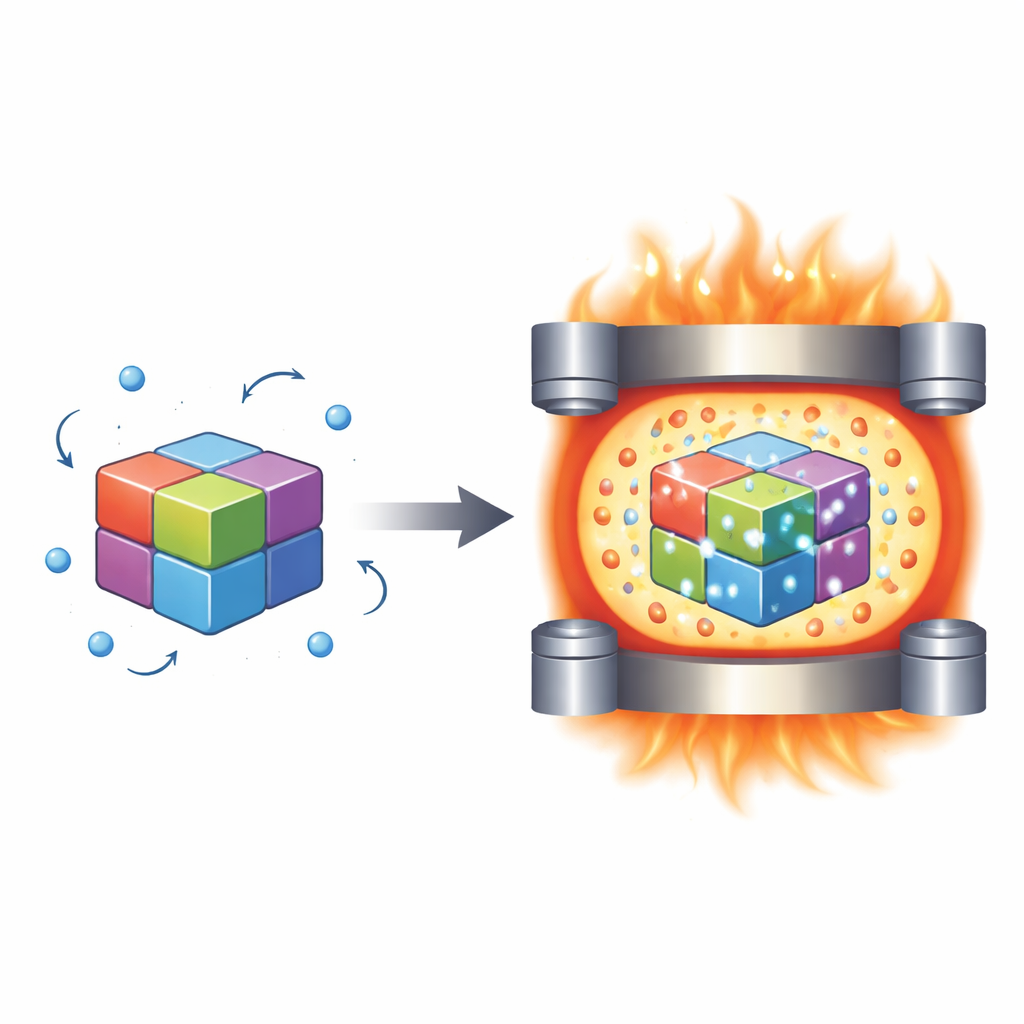
Most everyday metals are based on one main element, like steel on iron. The Cantor alloy instead mixes cobalt, chromium, iron, nickel and manganese in equal amounts, producing a highly disordered yet surprisingly simple crystal structure. Alloys of this type, called high-entropy alloys, are being studied for their strength, corrosion resistance and possible use in energy systems. Earlier work showed that the Cantor alloy barely takes up hydrogen, even when squeezed to enormous pressures at room temperature, hinting that it could be a promising hydrogen-resistant material.
Pushing the alloy to its limits
To see whether hydrogen could ever be forced into the alloy, the researchers exposed Cantor alloy samples to hydrogen at both high pressure and high temperature. They used two types of high-pressure devices: diamond anvil cells, which squeeze tiny samples between diamonds, and large-volume presses, which compress bigger pieces. In some experiments, hydrogen gas was loaded directly; in others, a solid chemical released hydrogen when heated. X-ray and neutron beams passing through the samples revealed how the crystal structure and atomic volume changed as conditions were ramped up.
Creating a new hydrogen-rich phase
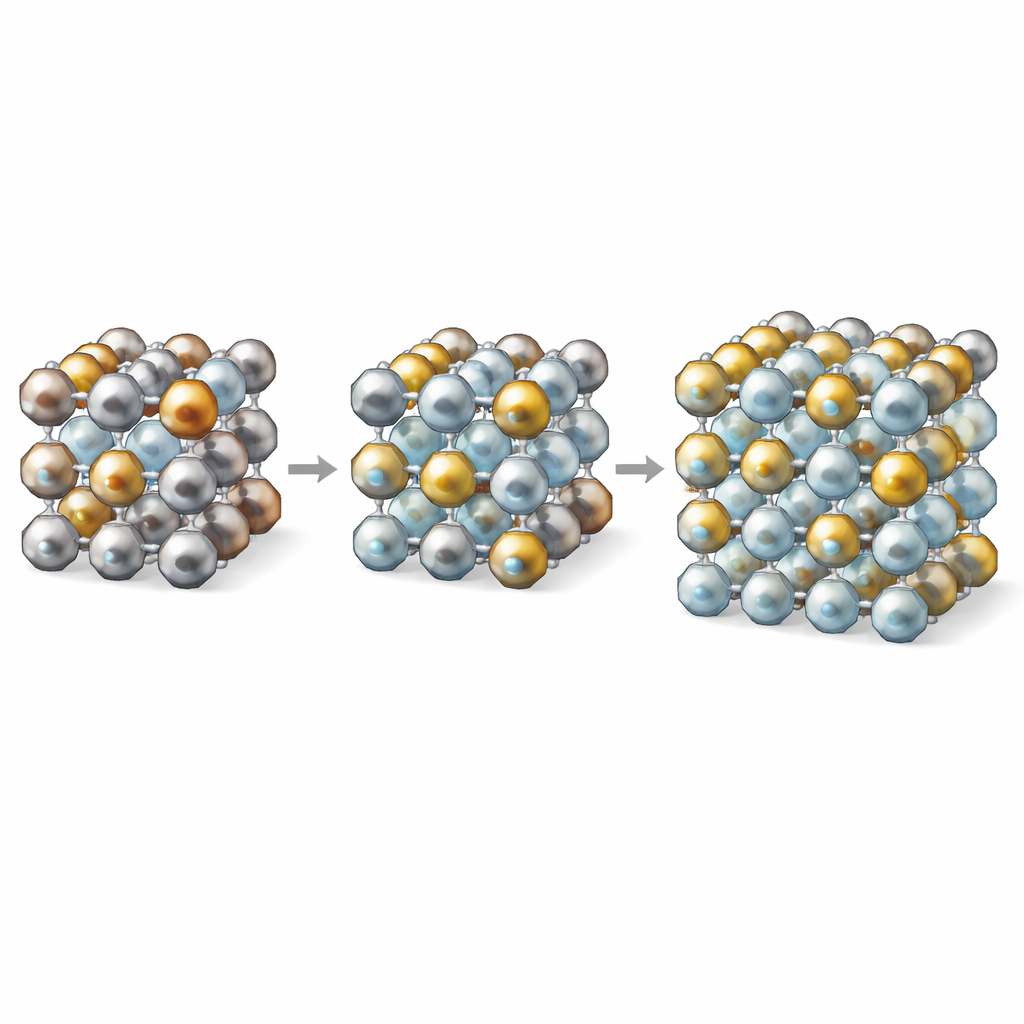
Under moderate temperatures near or just above 100 °C, and very high pressures well above anything found in typical industrial equipment, the alloy finally gave in and formed a new hydrogen-bearing phase. This phase kept the original face-centered cubic arrangement of the metal atoms but swelled in volume, a clear sign that hydrogen atoms had slipped into the gaps between metals. Careful comparison with known metal–hydrogen systems suggested that, on average, the material could host roughly one hydrogen atom per metal atom under the most extreme conditions tested. At more moderate pressures, the hydrogen content was lower, showing that the alloy still clings to its reputation for resisting hydrogen uptake.
Where the hydrogen actually sits
To pinpoint hydrogen’s position in the lattice, the team combined computer simulations with neutron diffraction, a technique especially sensitive to light atoms like hydrogen (studied here as its heavier twin, deuterium). The calculations showed that hydrogen prefers to occupy larger “octahedral” pockets in the metal lattice rather than smaller “tetrahedral” ones, and that filling these octahedral sites stabilizes the face-centered cubic phase over competing structures. Neutron data from high-pressure, high-temperature experiments confirmed this picture, directly revealing deuterium in these octahedral sites and indicating a variable hydrogen content that decreases again when pressure is released.
What this means for hydrogen technology
For practical applications, the key message is that the Cantor alloy remains highly resistant to hydrogen under real-world pressures and temperatures, which supports its use as a robust, hydrogen-exposed structural material. At the same time, the study proves that, if pushed hard enough, this alloy can transform into a hydrogen-rich “high-entropy hydride” with roughly one hydrogen atom per metal atom, occupying specific pockets in its crystal lattice. This dual personality—tough against hydrogen in service, yet capable of forming a well-defined hydride under extreme conditions—adds an important piece to the broader puzzle of how complex alloys interact with hydrogen and may guide the design of future materials for the emerging hydrogen economy.
Citation: Glazyrin, K., Spektor, K., Bykov, M. et al. Synthesis of high-entropy hydride from the cantor alloy (fcc–CoCrFeNiMn) at extreme conditions. Nat Commun 17, 2622 (2026). https://doi.org/10.1038/s41467-026-70483-3
Keywords: high-entropy alloys, Cantor alloy, metal hydrides, hydrogen storage, high-pressure materials