Clear Sky Science · en
Genome-centric metagenomics reveals electroactive syntrophs in a conductive particle-dependent consortium from coastal sediments
Hidden Power Lines Beneath the Seafloor
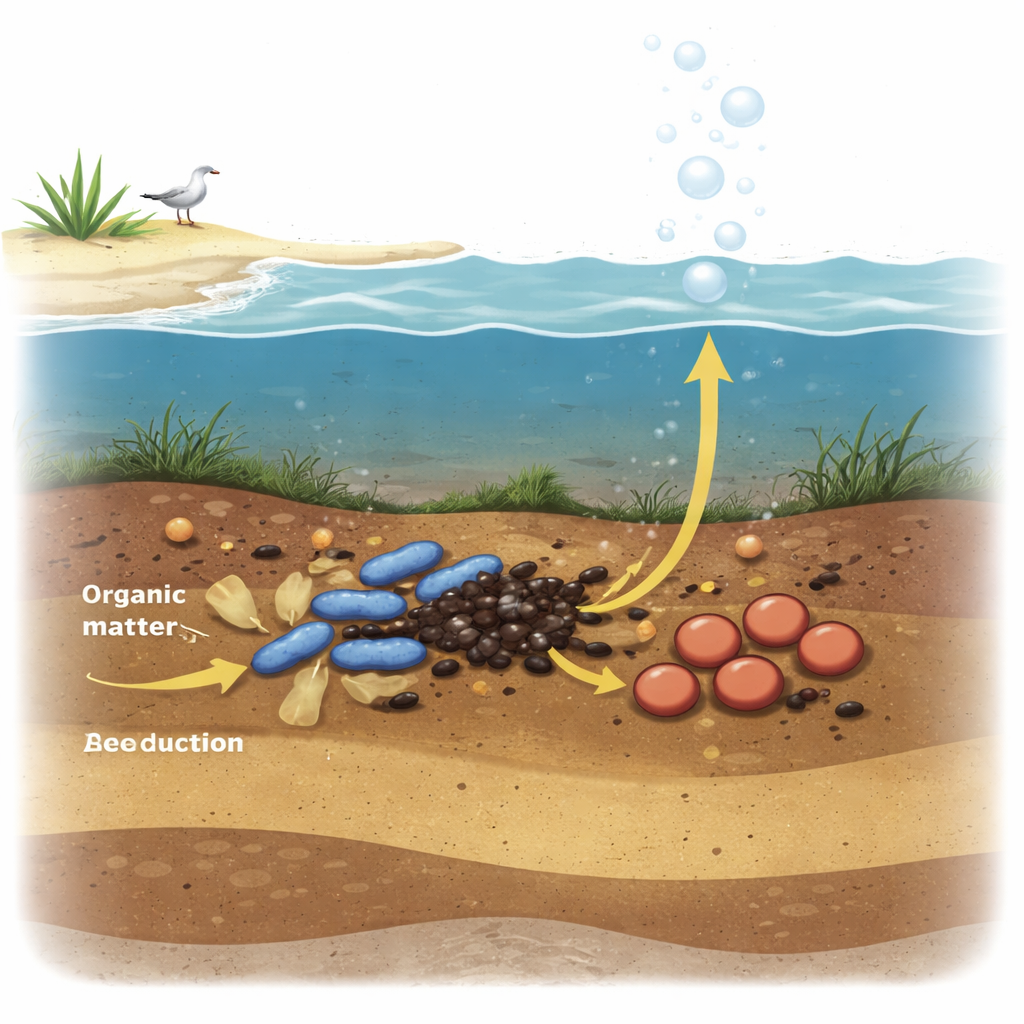
Muddy seafloors might seem lifeless, but they hide bustling microbial communities that help control how much methane, a potent greenhouse gas, escapes into our atmosphere. This study uncovers a remarkable partnership between microbes living in coastal sediments and tiny conductive particles, such as soot-like black carbon and iron minerals. By acting like underground power lines, these particles help certain microbes pass electrical current between one another, turning simple compounds into methane more efficiently than scientists realized.
Electric Alliances in Muddy Shores
In oxygen-free layers of coastal sediments, microbes break down organic matter into smaller molecules, including acetate. Methane, a strong heat-trapping gas, can then be produced from acetate through different routes. The authors focused on a community of microbes originally collected from Baltic Sea sediments and grown in the lab for a decade. These microbes could only thrive when supplied with grains of granular activated carbon, a man‑made stand‑in for natural conductive particles. When the carbon grains were present, acetate was steadily consumed and methane was produced; without them, both processes nearly stopped. Microscopy images showed bacteria and methane-forming archaea scattered over the carbon surface but not in direct contact, suggesting that electricity moves through the particles rather than from cell to cell.
A Specialized Food Web on Conductive Grains
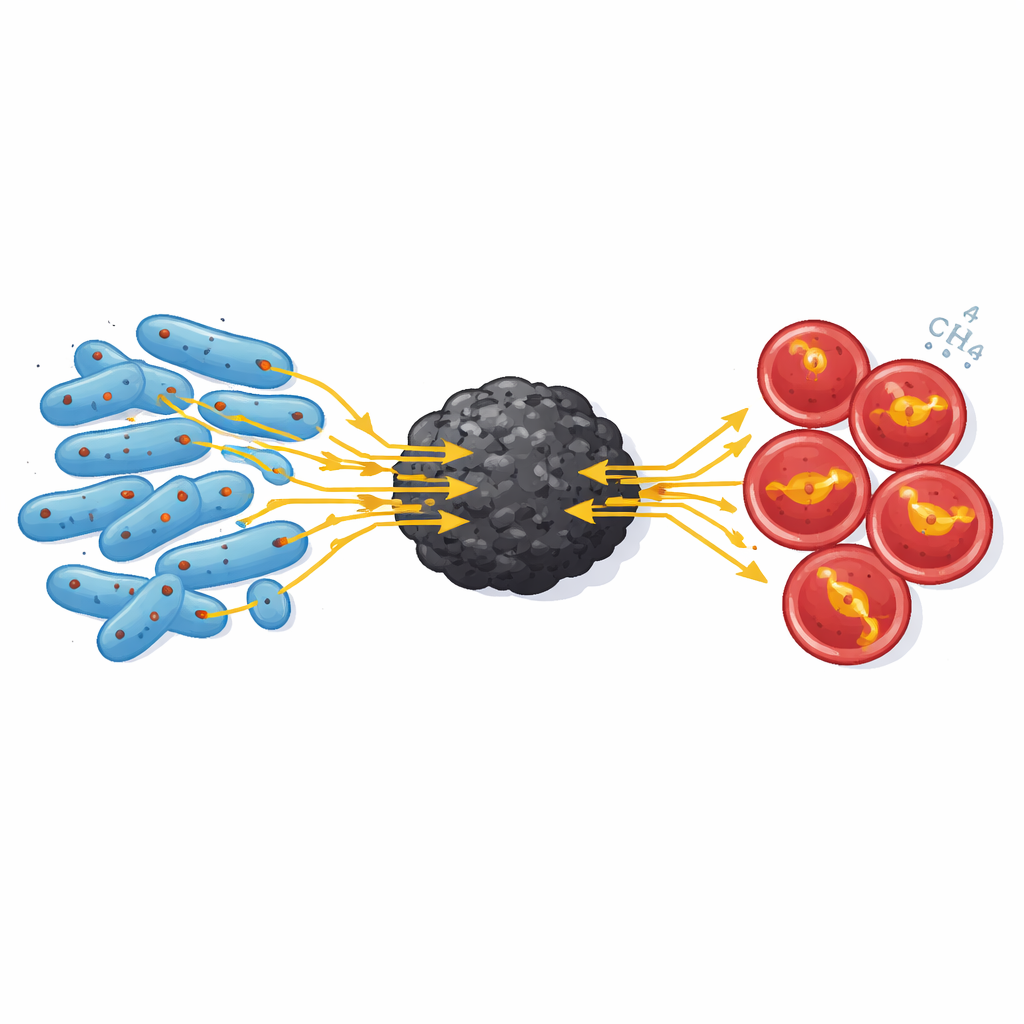
Using genome-resolved metagenomics, the researchers reconstructed 24 microbial genomes from this community and identified its core players. The central "worker" is a newly described bacterium named Candidatus Geosyntrophus acetoxidans. This microbe specializes in oxidizing acetate, essentially burning it for energy, and in the process releases electrons. A type of methane-forming archaeon from the genus Methanosarcina sits at the other end of the electrical connection, using incoming electrons to turn carbon dioxide into methane. Around them is a supporting cast of other bacteria that likely recycle dead biomass and leftover organic fragments, helping keep the system running but not directly driving the electrical exchange.
Microbial Wiring for Long-Distance Electron Flow
The genome of Ca. Geosyntrophus acetoxidans reveals an elaborate toolkit for shuttling electrons out of the cell. It carries enzymes to fully oxidize acetate and a rich collection of multiheme cytochromes—protein "wires" that move electrons stepwise from the cell interior to its surface. It also encodes structures similar to conductive pili, hairlike filaments that can relay electrons further outward. Two major protein conduits span the outer membrane, focusing this wiring toward the surrounding carbon grains. On the methanogen side, the Methanosarcina genome holds a key multiheme cytochrome called MmcA and rotary structures known as archaella, both associated with taking up electrons from outside the cell. Once electrons arrive, they are fed into the cell’s internal machinery that converts carbon dioxide into methane while generating usable energy.
Why Conductive Particles Are Essential
Unlike many laboratory-made microbial partnerships, this natural consortium cannot survive without conductive grains. After many transfers in particle-free conditions, methane production collapsed and the key electrogenic bacterium and its Methanosarcina partner nearly vanished, replaced by simple fermenters. The researchers suggest that Ca. Geosyntrophus has streamlined its electrical network for a stable, particle-rich environment, shedding backup mechanisms that might allow direct cell-to-cell contact. As a result, the microbes are locked into using environmental conductors—such as wildfire-derived charcoal or iron minerals—as their shared power grid.
What This Means for Climate and Coasts
The findings provide a genomic "blueprint" for how conductive particles can knit together microbial partners that funnel acetate into methane in coastal sediments. Because black carbon and iron minerals are widespread—and in some regions heavily enriched by erosion, pollution, and wildfires—such electrical alliances may be more common than currently appreciated. This suggests an additional, previously overlooked pathway by which human activities that add conductive particles to coastal zones could amplify methane emissions. Recognizing and tracking the genetic signatures of these electrically connected microbes will help scientists better predict when and where coastal sediments act as powerful, particle-driven methane factories.
Citation: Jovicic, D., Anestis, K., Fiutowski, J. et al. Genome-centric metagenomics reveals electroactive syntrophs in a conductive particle-dependent consortium from coastal sediments. Nat Commun 17, 2708 (2026). https://doi.org/10.1038/s41467-026-70468-2
Keywords: methane emissions, coastal sediments, electrogenic microbes, conductive particles, syntrophic acetate oxidation