Clear Sky Science · en
Massive-scale spatial multiplexing of multimode VCSELs with a 3D-printed photonic lantern
Brighter laser light in a smaller package
From powering industrial cutters to driving ultra‑fast internet links, many modern technologies rely on moving lots of laser light through thin glass fibers. Today that often means stitching together many tiny lasers on a chip and funneling their light into a single fiber. But doing this efficiently without bulky optics is hard. This study shows how a microscopic 3D‑printed structure, called a photonic lantern, can neatly gather light from dozens of chip‑scale lasers and feed it into an optical fiber while keeping the beam bright and the hardware compact.
Why combining many small lasers is difficult
Arrays of vertical‑cavity surface‑emitting lasers (VCSELs) are attractive because they are cheap, compact, and easy to manufacture in large numbers. Each VCSEL in such an array produces a small, multi‑lobed beam rather than a single clean spot, and the beams from different lasers are not synchronized. Conventional optics use tiny lenses to collimate each source and a larger lens to focus all of them into a thick multimode fiber. That large fiber accepts many patterns of light, which makes coupling easy but spreads the energy over a wider area and angle, reducing the overall brightness that can be delivered to a distant target.
A microscopic funnel for complex light
The researchers designed a new kind of photonic lantern that acts as a three‑dimensional funnel for complex light. Instead of starting from many perfectly clean single‑mode inputs, their lantern accepts inputs that already carry several spatial patterns from each VCSEL. Using advanced computer simulations and a genetic optimization algorithm, they shaped the curves and tapers of dozens of tiny waveguides so that light from up to 37 multimode lasers gradually merges into a single waveguide matched to a multimode fiber that supports the same total number of patterns. This gentle, adiabatic transition is key to keeping energy in the desired patterns and avoiding loss. 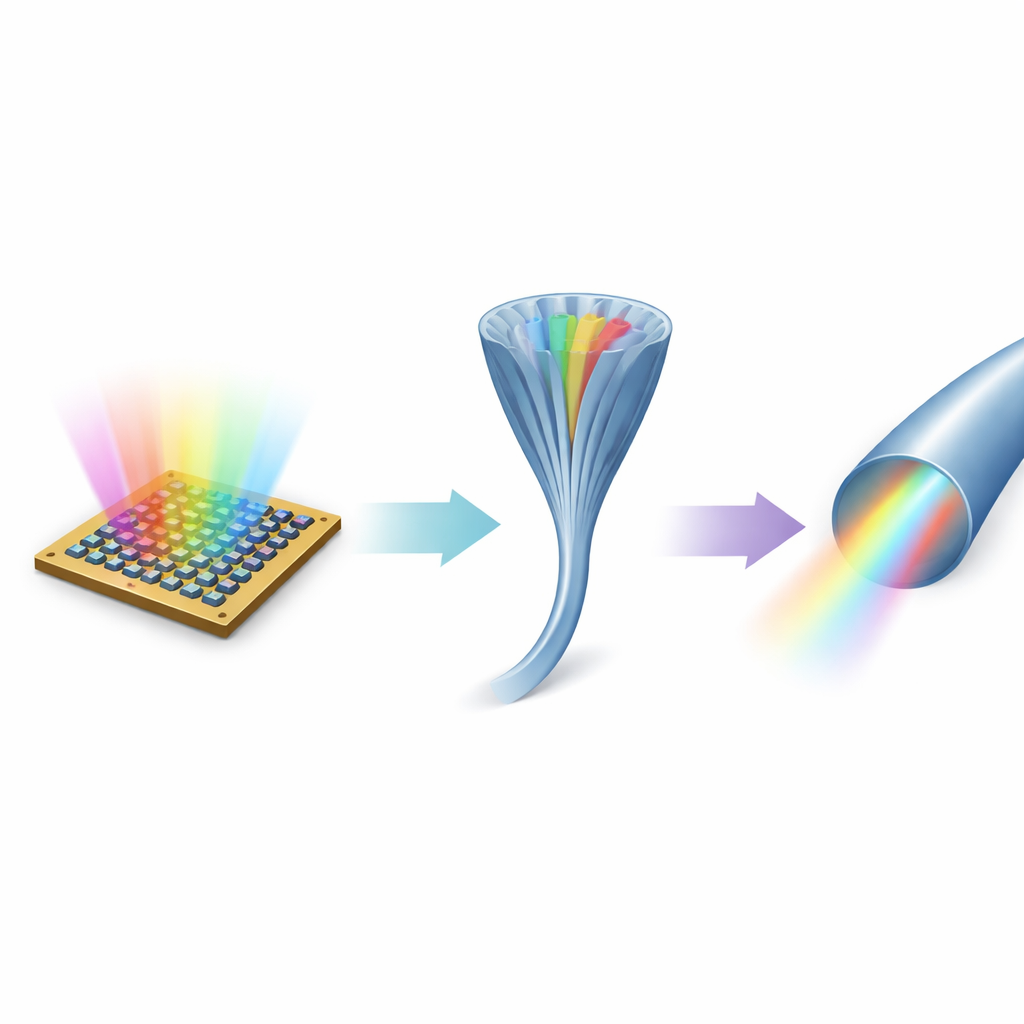
Printing optics directly on the laser chip
To make these intricate structures, the team used two‑photon 3D nanoprinting with a polymer that can be sculpted with sub‑micron precision. They printed three lantern designs—handling 7, 19, or 37 laser inputs—directly on the corners of commercial VCSEL arrays. Each lantern is only a few hundred micrometers long, smaller than a grain of dust, yet contains a carefully arranged forest of curved waveguides that converge into a single, slightly flared output sized to match a standard 50‑micrometer‑core glass fiber. Electron microscope images confirm that the printed lanterns align cleanly with the laser apertures and maintain smooth, well‑defined shapes needed for low‑loss guidance.
Testing beam quality and power delivery
To see how well the lanterns perform, the authors measured both the detailed shape of the emerging light and the total power that reached the output fiber. Using digital holography—a technique that reconstructs the full wavefront of the beam—they mapped how input patterns are redistributed by the lantern and confirmed that most energy stays within the target set of modes. For the 7‑input device they reconstructed the full transfer matrix, finding that nearly all supported patterns are transmitted with modest loss. When the 19‑ and 37‑input lanterns were butt‑coupled to a multimode fiber, the extra loss at the interface was only about half a decibel, meaning most of the light that exits the lantern enters the fiber. Overall transmission from lasers through lantern and into fiber remained better than about 60% even for the largest device, competitive with or better than idealized lens‑based systems while using a much smaller footprint. 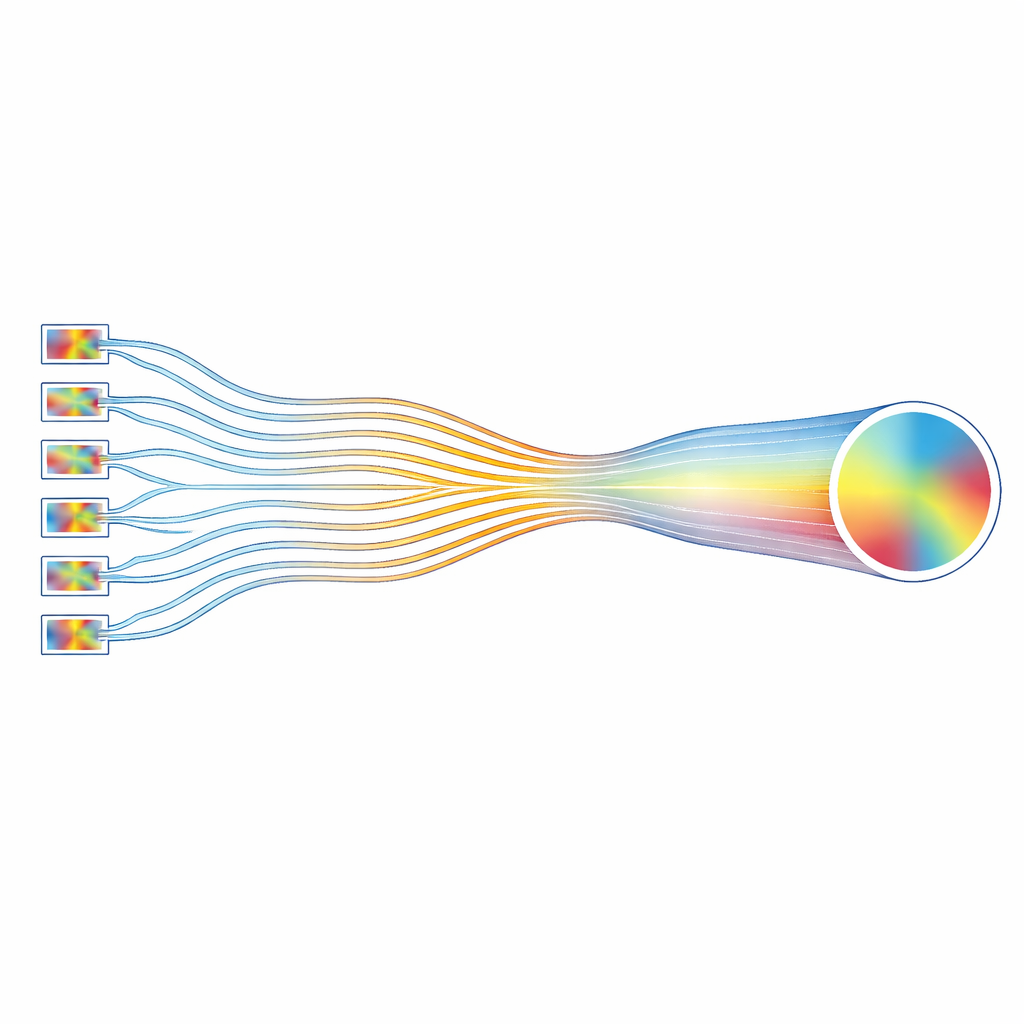
Stable performance over time and room to grow
Beyond raw efficiency, practical laser systems must be stable. The team ran the lantern‑equipped VCSEL array continuously for hours while tightly controlling temperature, tracking the output power at different drive currents. The measured fluctuations were tiny—more than fifty decibels below the average signal—indicating that the polymer structures and the laser array form a robust package. Simulations and fabrication limits suggest the same design approach could be extended to hundreds of input lasers as 3D printing tools improve, using either the current polymer or more heat‑tolerant glass‑like materials for higher powers.
What this means for future light engines
In everyday terms, the work demonstrates a microscopic light combiner that lets many small, somewhat messy laser beams behave like one bright, well‑delivered beam inside an optical fiber, without relying on complicated synchronization or bulky lenses. By matching the fiber to the true information‑carrying capacity of the sources, the system preserves brightness and uses power efficiently. Such 3D‑printed photonic lanterns could become key building blocks for next‑generation high‑power fiber lasers, compact industrial tools, and short‑reach data links, where delivering more light through less hardware is a continual goal.
Citation: Dana, Y., Shukhin, K., Garcia, Y. et al. Massive-scale spatial multiplexing of multimode VCSELs with a 3D-printed photonic lantern. Nat Commun 17, 2286 (2026). https://doi.org/10.1038/s41467-026-70458-4
Keywords: VCSEL arrays, photonic lantern, 3D nanoprinting, multimode fiber, beam combining