Clear Sky Science · en
Community structure unveils the path multiplicity in complex networks
Why many routes matter
Whenever you send a message online, drive through a city, or signals travel inside your brain, they move on networks of connections. We usually care about the shortest route from A to B. But often there isn’t just one best route—there can be many equally short options. This study shows that the way a network is divided into tightly knit groups, or “communities,” is the main reason why so many alternative shortest routes exist. Understanding this hidden structure can help us design safer, faster, and more reliable systems in technology, cities, and biology.
A world of short yet hesitant routes
For decades, scientists have known that many real networks are “small worlds”: even with huge numbers of nodes, any two are linked by only a few steps. Recent work added a twist: we also live in a “hesitant world,” where pairs of nodes are often connected by many different shortest paths. In a brain network with only 242 regions, one pair of regions can be connected by 649 equally short routes. This abundance of options matters. It can make networks more robust when some links fail, but it can also create bottlenecks where many routes funnel through the same links, raising the risk of congestion or attack. For people, machines, or algorithms that must choose a route, too many equally good options can cause “choice overload” and slower decisions.
Measuring how many choices a network offers
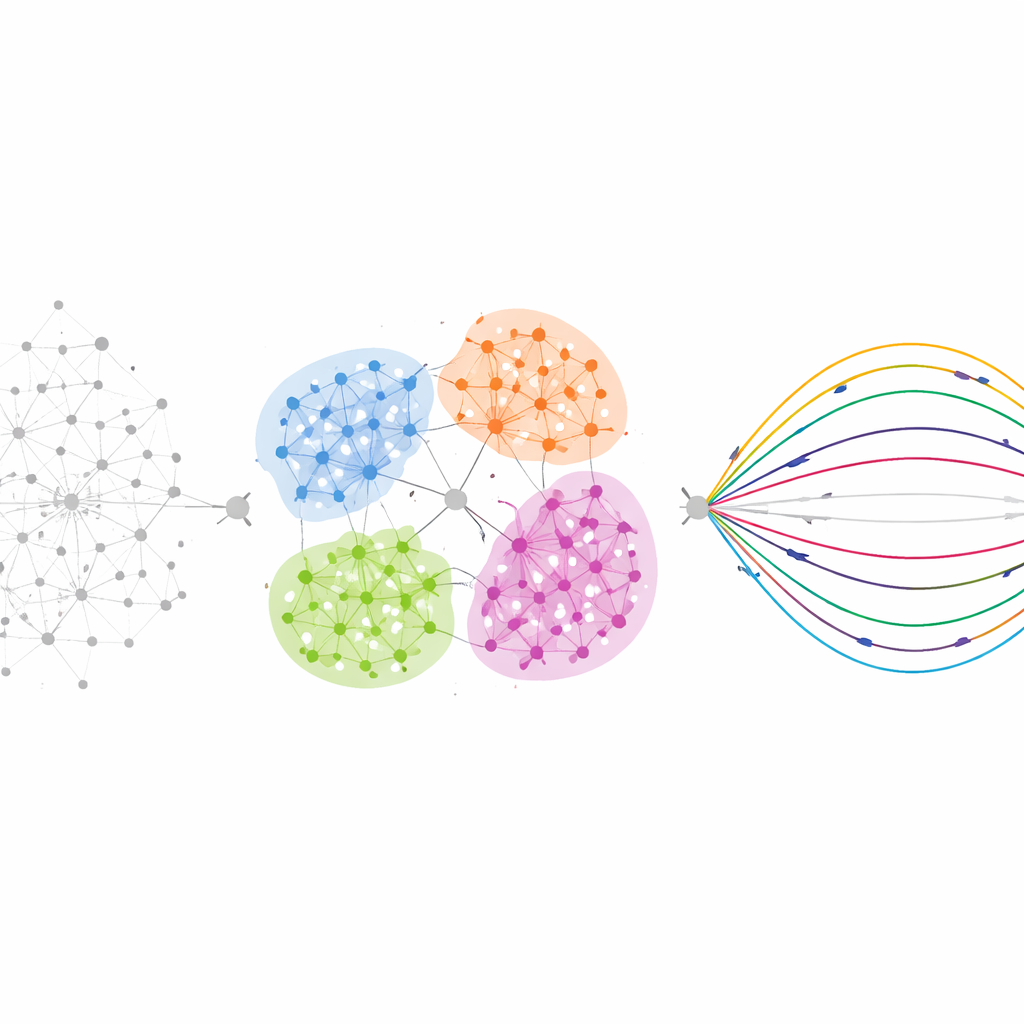
The authors first needed a clear way to quantify how “hesitant” a network is. They defined a path multiplicity index, which averages how many shortest paths exist between all pairs of nodes. High values mean many equally good options. But larger or denser networks naturally tend to have more paths, so the team introduced a relative index: they compared each real network to a random network with the same size and density. This normalized measure reveals how much extra path richness comes from internal organization rather than just from having many links. When they tested 140 real-world networks—from biology, infrastructure, and social systems—they found that the usual summary statistics (like average degree, clustering, or overall efficiency) explained little of this extra path richness.
Communities as the engine of many paths
The surprising culprit turned out to be community structure: the tendency of networks to fall into groups of nodes that are densely connected internally but only sparsely linked to other groups. Using several independent measures of correlation, the number of communities showed a much stronger association with relative path multiplicity than any other metric. Networks with many clear communities consistently had higher levels of path multiplicity than comparable networks with only a few, more diffuse groups. Visual comparisons of real examples underscored this finding: highly modular networks, with many distinct clusters, displayed far richer families of shortest routes than more uniform networks.
Testing cause and effect with rewired links
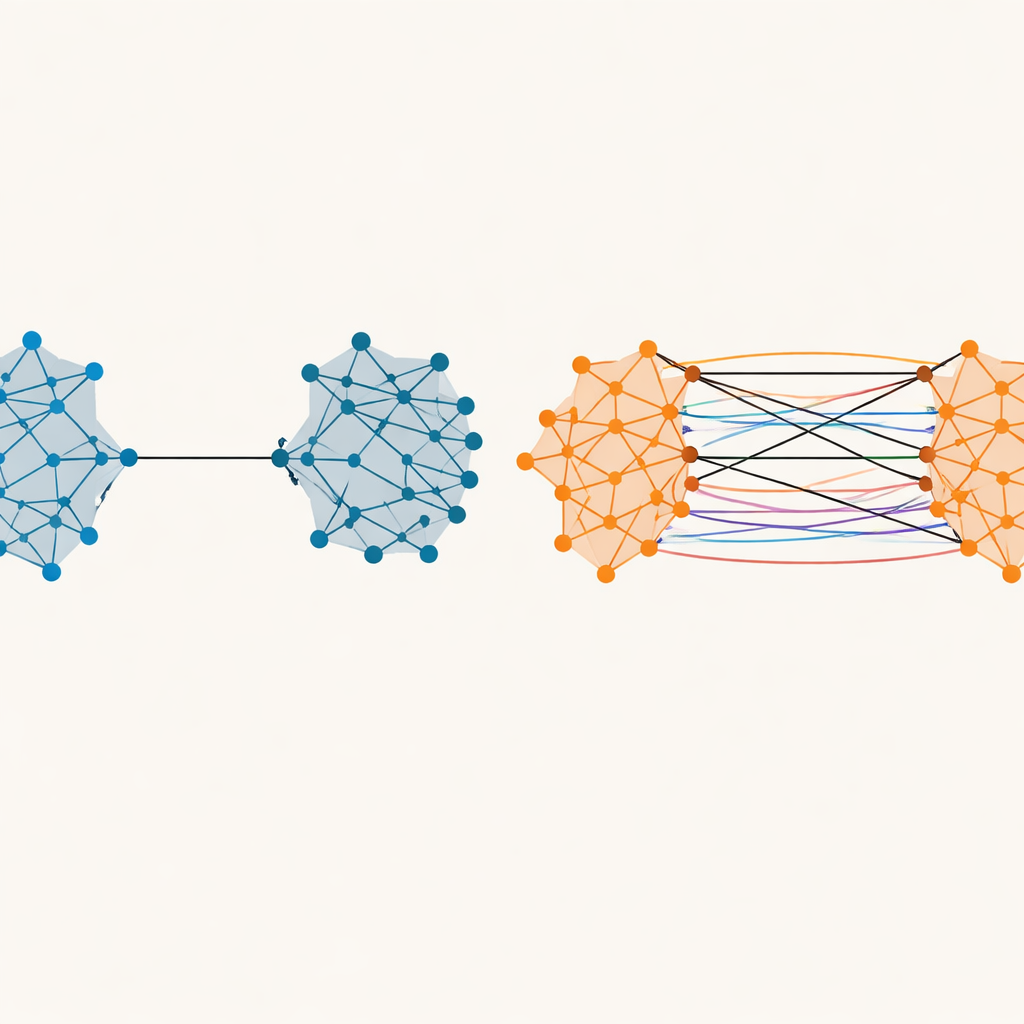
Correlation alone does not prove cause. To probe the mechanism, the researchers performed controlled “surgery” on model networks. They repeatedly rewired edges to either maximize the number of shortest paths or maximize the number of communities, all while keeping the total number of nodes and links fixed. When they pushed the network to have more shortest paths, the number of communities climbed. When they instead pushed to increase the number of communities, the count of shortest paths also rose. Other properties, such as clustering or assortativity, did not show this strong two-way link. This suggests a genuine causal relationship: building up modular, community-rich structure tends to generate many alternative shortest routes, and vice versa.
A simple model of tribal networks
To capture this mechanism in a clean way, the authors proposed a “Tribal Scale-Free” network model. In this picture, a large network is made of several “tribes,” each of which is a scale-free subnetwork with its own hub nodes. These tribes are then connected with a controlled number of cross-tribe links. This setup naturally creates rich interfaces between communities. When they compared this model with classic network models, only the tribal model reproduced the extreme variety and power-law pattern of path multiplicity seen in real data, including the very highest counts of shortest paths and their overall averages.
What this means for real systems
The study concludes that community structure is the main driver of the hesitant-world effect: the more clearly a network is split into communities, the more alternative shortest routes it will offer. In plain terms, boundaries between groups—such as neighborhoods in a city, modules in a brain, or circles of friends—create many different yet equally efficient ways to travel from one place to another. This insight can guide the design of communication, transport, and biological networks that are both resilient and efficient, by deliberately shaping how communities form and how they are connected.
Citation: Deng, Y., Wu, J., Lu, X. et al. Community structure unveils the path multiplicity in complex networks. Nat Commun 17, 2283 (2026). https://doi.org/10.1038/s41467-026-70369-4
Keywords: complex networks, community structure, shortest paths, network robustness, modular topology