Clear Sky Science · en
Tudor domain-containing protein 9-targeting siRNA nanoparticles alleviate Pseudomonas aeruginosa lung injury in preclinical models by promoting neutrophil cuproptosis
Turning the Body’s First Responders into Precise Allies
Pneumonia caused by the bacterium Pseudomonas aeruginosa is notoriously hard to treat, especially in people with weakened immune systems or damaged lungs. This study explores a new way to help the body’s own immune cells, called neutrophils, clear these infections more safely and effectively. By delivering tiny strands of genetic material inside specially designed nanoparticles, the researchers reprogram neutrophils so they die at the right time and place, easing lung damage while still fighting the bacteria.
Why This Bacterium Is So Hard to Beat
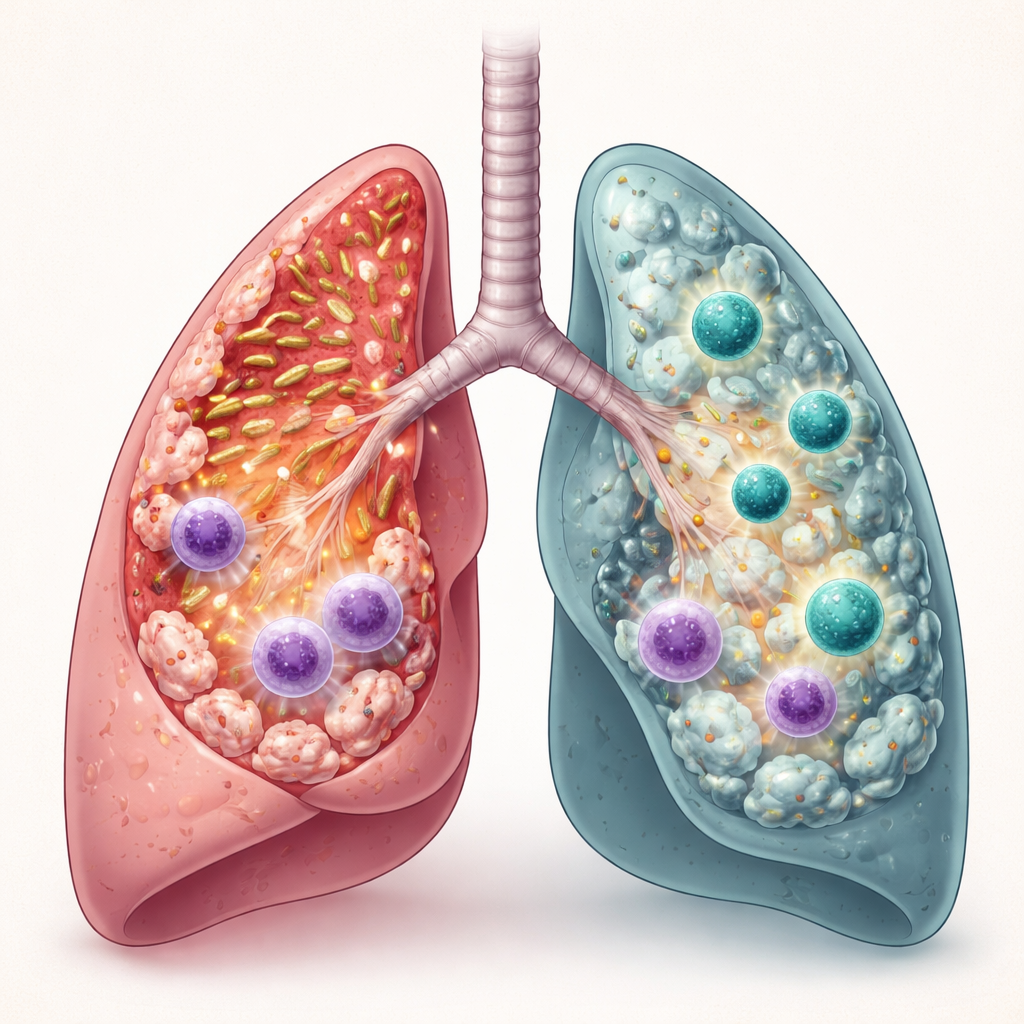
Pseudomonas aeruginosa is a highly adaptable germ that can resist many antibiotics and form protective biofilms, making infections in the lungs difficult to control. In response, the body summons large numbers of neutrophils, white blood cells that act as first responders. While essential for killing microbes, an overabundance of neutrophils—and their delayed clearance from the lungs—can backfire, causing swelling, fluid build-up, and tissue destruction. Current treatments mostly focus on attacking the bacteria directly, leaving few options for safely tuning the immune response itself.
A Surprising Gene in Neutrophils
The team began by examining neutrophils taken from the lung fluid of patients with pneumonia, comparing those infected with Pseudomonas to those with other forms of pneumonia or no pneumonia at all. Using RNA sequencing, they discovered that a gene called TDRD9 was strongly switched on in neutrophils from Pseudomonas patients. TDRD9 was previously known mainly for roles in sperm development, not lung disease, yet its elevated levels showed up consistently in both human samples and infected mice. This suggested that TDRD9 might be driving harmful neutrophil behavior during severe bacterial lung infections.
Making Neutrophil Death Work for Healing
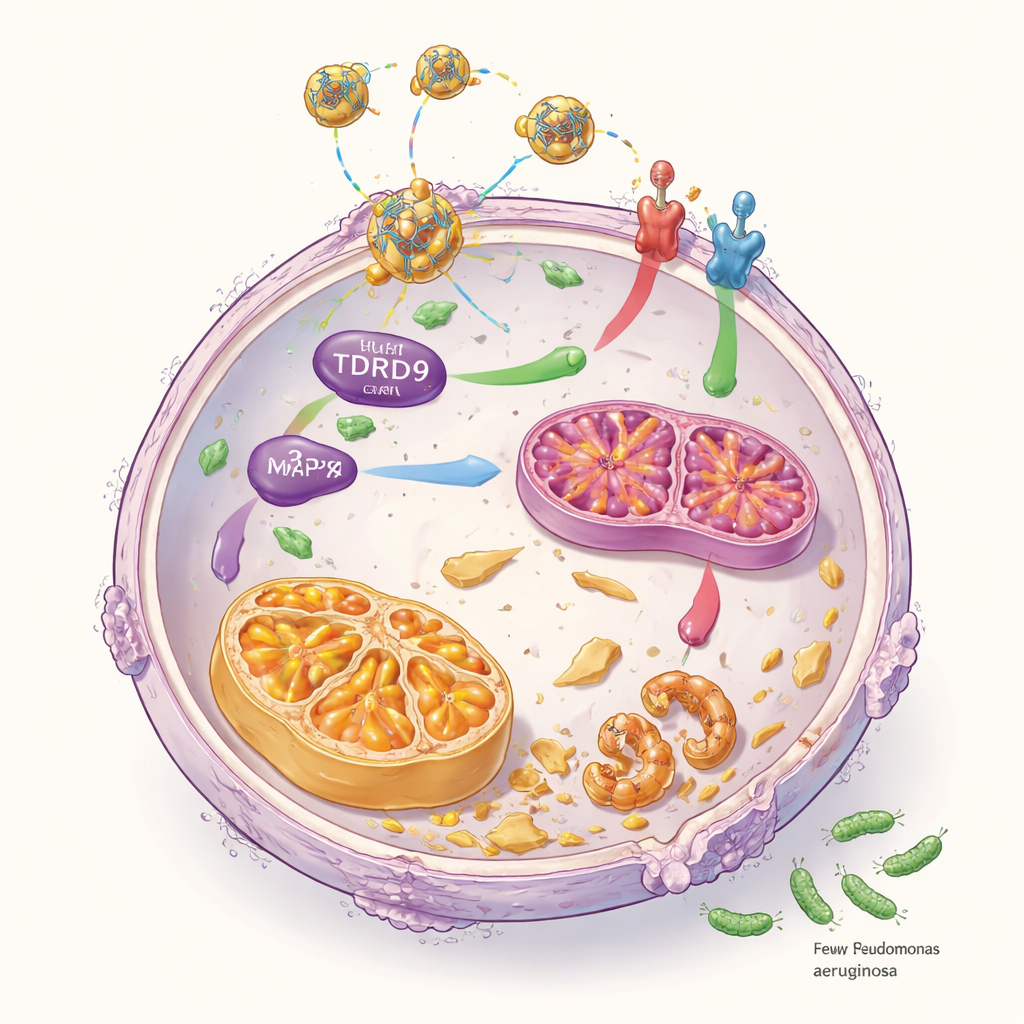
Neutrophils normally die in a controlled fashion after doing their job, allowing inflammation to resolve. The researchers focused on a newly recognized form of cell death called cuproptosis, which depends on copper inside cells. In mice and human neutrophils infected with Pseudomonas, they found that TDRD9 helped shield neutrophils from cuproptosis, keeping them alive longer in the inflamed lung. When TDRD9 was deliberately reduced, neutrophils became more prone to this copper-linked death, and the overall lung injury improved: there was less fluid in the lungs, fewer inflammatory molecules, and lower bacterial counts. Mechanistic experiments showed that TDRD9 works through a signaling chain involving proteins PD-L1, CD80, and the p38 MAPK pathway, a well-known controller of stress responses inside cells.
Smart Nanoparticles for Targeted Gene Silencing
To turn these insights into a potential therapy, the scientists built a delivery system based on nanoparticles coated with hyaluronic acid, a sugar that helps them home in on neutrophils via a surface receptor called CD44. Packed inside each nanoparticle is a small interfering RNA (siRNA) that specifically blocks TDRD9. In laboratory tests, these particles were readily taken up by human neutrophils, efficiently lowering TDRD9 levels. In infected mice, intravenous treatment with the TDRD9-targeting nanoparticles reduced bacterial load, lung swelling, and inflammatory signals without detectable liver or kidney toxicity. The neutrophils showed changes consistent with enhanced cuproptosis and a calmer inflammatory environment.
Bringing Human-Like Lungs into the Lab
To bridge the gap between animal models and human disease, the team also grew three-dimensional human lung organoids—tiny, tissue-like structures derived from non-cancerous lung samples. When exposed to Pseudomonas, these organoids developed structural damage, inflammation, and cell death. Treatment with TDRD9-targeting nanoparticles curbed bacterial growth, lowered inflammatory molecules, and reduced signs of cell death, suggesting that the approach could help protect human lung tissue from infection-driven injury.
What This Could Mean for Patients
Overall, the study shows that dampening the TDRD9 pathway in neutrophils, using precision-delivered siRNA nanoparticles, can promote a controlled form of cell death that helps clear excess neutrophils and eases lung damage during severe Pseudomonas infections. Rather than simply blasting bacteria with more antibiotics, this strategy fine-tunes the immune response itself. While more work is needed to confirm long-term safety and effectiveness in people, the findings point toward a future in which smart nanoparticles help transform overzealous immune cells from sources of damage into partners in healing.
Citation: Zhang, W., Li, H., Jia, H. et al. Tudor domain-containing protein 9-targeting siRNA nanoparticles alleviate Pseudomonas aeruginosa lung injury in preclinical models by promoting neutrophil cuproptosis. Nat Commun 17, 2277 (2026). https://doi.org/10.1038/s41467-026-70349-8
Keywords: Pseudomonas aeruginosa pneumonia, neutrophils, nanoparticle therapy, siRNA delivery, cuproptosis