Clear Sky Science · en
Spin-manipulation via novel MoPS3 nanocrystal for high-performance thick-film organic solar cells
Turning Sunlight into Power with Thicker Flexible Panels
Solar panels made from carbon-based materials promise lightweight, flexible sheets that could be printed like newspapers. Yet their most efficient versions today rely on extremely thin light‑absorbing layers, which are hard to manufacture reliably on large scales. This paper explores a new way to keep high efficiency even when those layers are made several times thicker, using tiny magnetic crystals to shepherd energy more effectively inside organic solar cells.
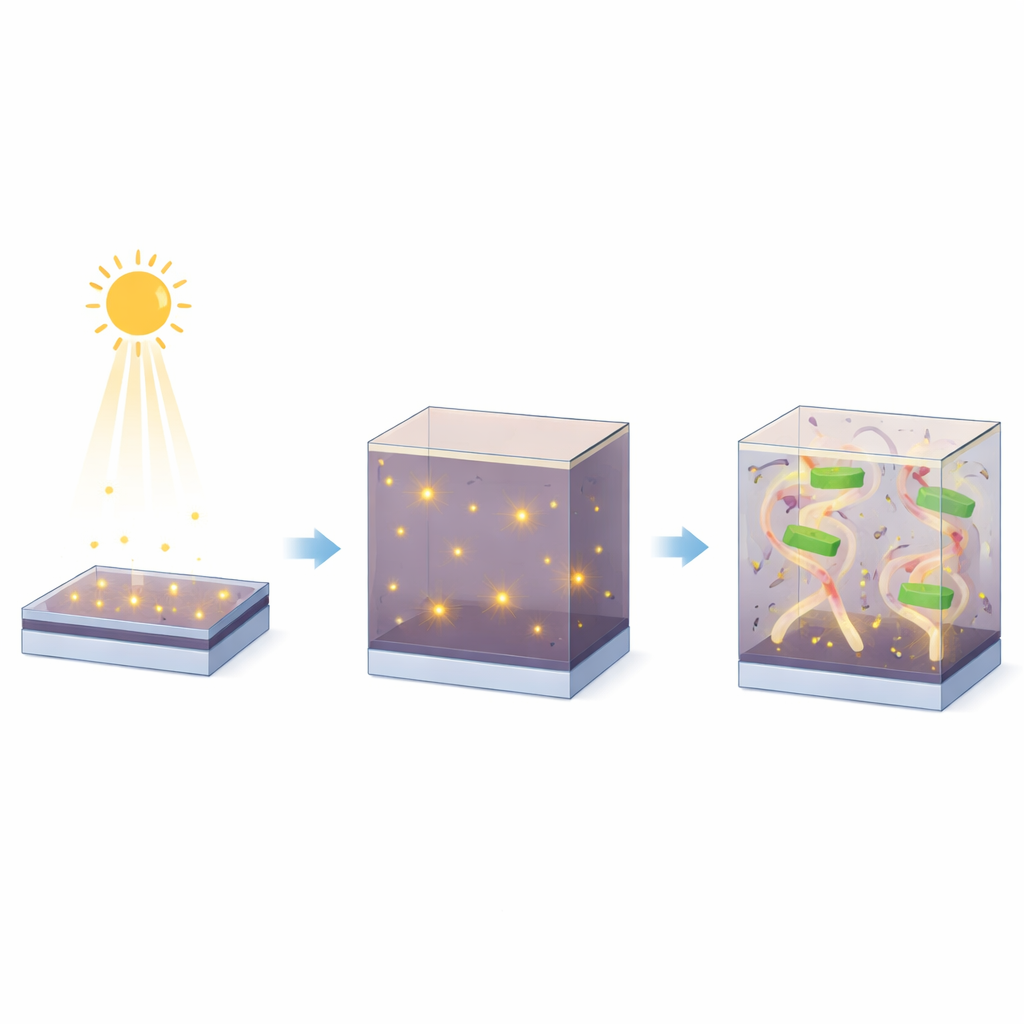
Why Thick Solar Films Usually Fall Short
Organic solar cells work by creating tightly bound packets of energy, called excitons, when sunlight hits the active layer. In conventional designs, these excitons can only travel a few billionths of a meter before fading, so the light‑absorbing film must be very thin to give them a chance to reach the regions where they split into useful charges. When manufacturers try to make the layer thicker—something essential for uniform, roll‑to‑roll printing over large areas—many excitons die out in transit, charges get stuck, and overall efficiency drops sharply.
Using Tiny Magnets to Guide Invisible Energy
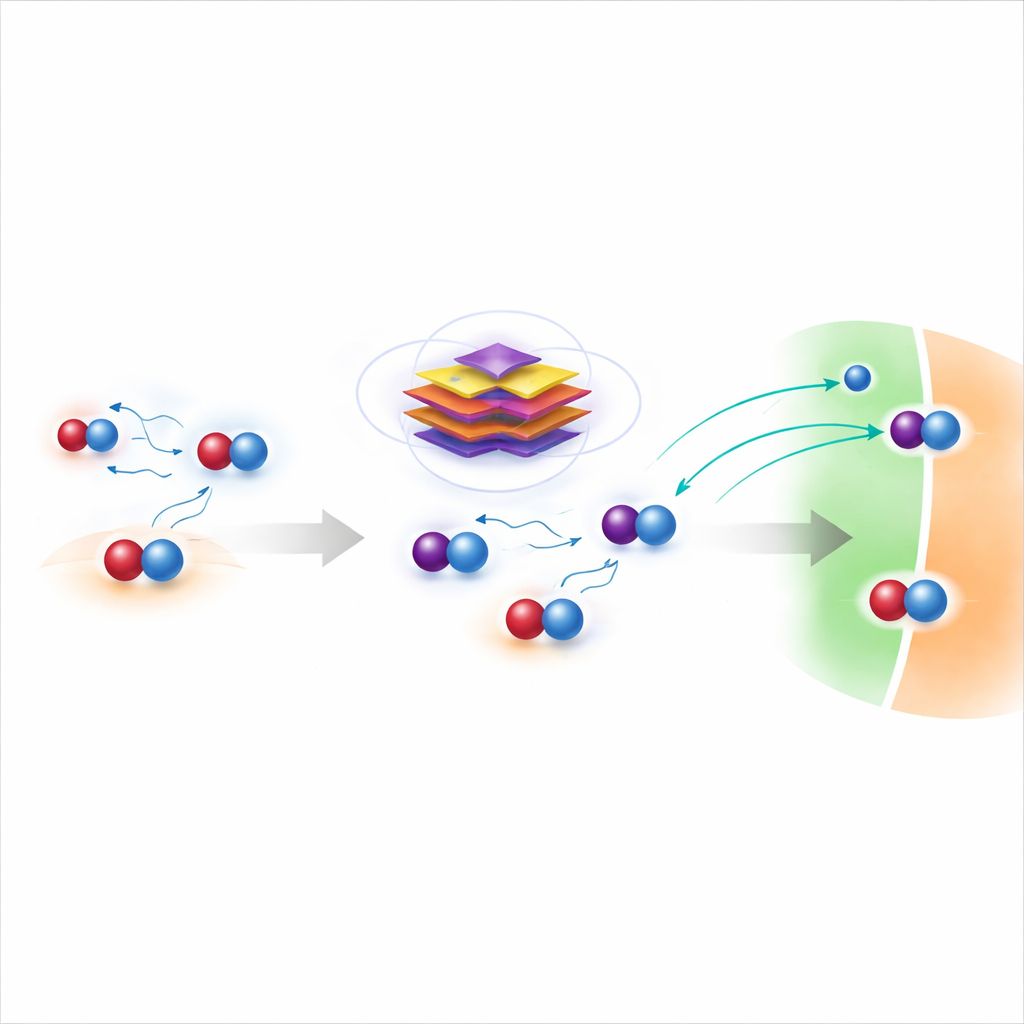
The researchers tackle this problem by sprinkling an ultrathin, two‑dimensional magnetic material called MoPS3 into the active layer. These nanocrystals behave like tiny built‑in magnets and also contain heavy atoms that naturally interact with the spins of excitons, a quantum property related to their internal magnetism. Together, these effects encourage excitons to switch from a short‑lived form into a longer‑lived one. In everyday terms, the nanocrystals turn fleeting sparks of energy into embers that glow long enough to reach the places in the device where they can be harvested as electricity instead of being lost as heat.
Making Energy Travel Farther and Reducing Waste
Using a range of advanced optical and magnetic measurements, the team shows that adding MoPS3 creates weak internal magnetic fields and reshapes the energy landscape inside the solar film. This change makes it easier for excitons to enter their long‑lived state and harder for them to fall into energy traps where they would disappear without doing useful work. As a result, the distance these energy packets can travel increases by roughly half or more, and the pathways for electrical charges become faster and more balanced. The tiny crystals also act as anchors during film formation, encouraging the surrounding molecules to pack more neatly, forming finer and more uniform pathways that help charges move cleanly to the electrodes.
High Performance Without the Thin‑Film Fragility
With this magnetic additive, solar cells based on several leading organic material combinations reach power conversion efficiencies above 20 percent in thin films and, crucially, keep nearly the same performance when the active layer is thickened to about 300 nanometers. One device using a fluorinated polymer blend reaches a certified efficiency just over 19 percent at this thickness, placing it among the very best thick‑film organic solar cells reported. The improved devices also show lower energy disorder, fewer loss channels, and better stability under heating and light, all of which matter for real‑world deployment.
A Path Toward Printable, High‑Efficiency Solar Sheets
In essence, this work introduces magnetic nanocrystals as a simple additive that rewires how energy moves inside organic solar cells, allowing thick, easy‑to‑print films to perform almost as well as delicate ultrathin ones. For non‑specialists, the takeaway is that by carefully engineering the quantum behavior of excitons using tiny magnetic plates, the researchers offer a practical route toward flexible, large‑area solar foils that can be manufactured at scale without sacrificing efficiency.
Citation: Li, Z., Pu, X., Su, Z. et al. Spin-manipulation via novel MoPS3 nanocrystal for high-performance thick-film organic solar cells. Nat Commun 17, 2330 (2026). https://doi.org/10.1038/s41467-026-70320-7
Keywords: organic solar cells, magnetic nanocrystals, thick-film photovoltaics, exciton diffusion, spin engineering