Clear Sky Science · en
Single-event fast neutron time-of-flight spectrometry with a petawatt-laser-driven neutron source
Why tiny bursts of neutrons matter
Neutrons, the uncharged particles inside atomic nuclei, are powerful probes of both nature and technology. They help scientists understand how the elements in the universe were made, how nuclear reactors behave, and how advanced materials respond to radiation. Yet the large machines traditionally used to make intense neutron beams—research reactors and big particle accelerators—are costly and increasingly scarce. This study explores a very different option: using an ultra‑powerful laser to create compact, intense bursts of fast neutrons and showing, for the first time, that these bursts can be measured one interaction at a time with high precision.
From giant machines to tabletop flashes
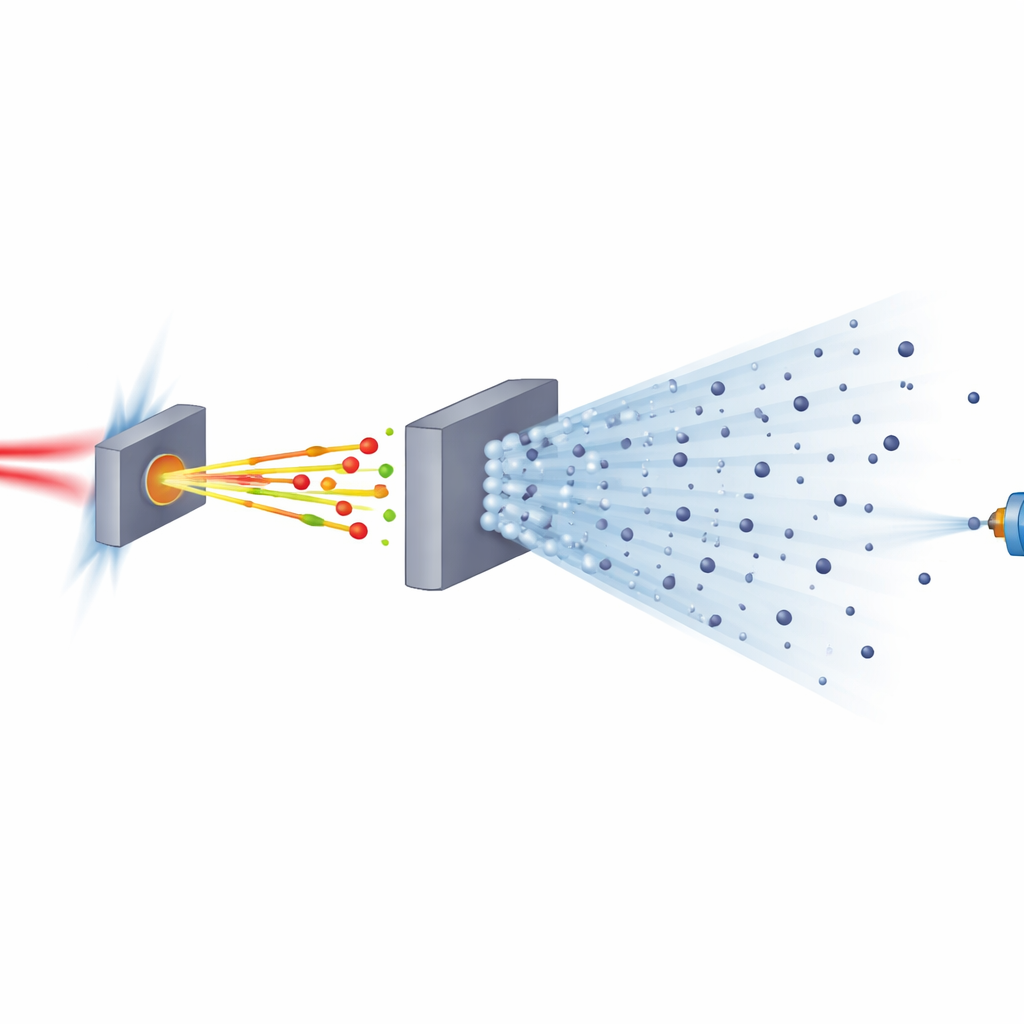
Conventional neutron sources rely on long accelerator tunnels or nuclear reactors to generate beams that travel many meters—sometimes hundreds of meters—before reaching an experiment. Their size and complexity limit access and make upgrades slow. By contrast, laser‑driven neutron sources use a petawatt‑class laser focused onto a tiny solid foil. The laser’s extreme electric fields rip particles from the foil and accelerate mainly protons to tens of millions of electron volts in just trillionths of a second. When these protons hit a second target, called a converter or catcher, they produce a very short, intense burst of fast neutrons. Because the initial pulse is so brief, in principle one can use a much shorter flight path to measure the neutrons’ energies, shrinking the entire setup to a room‑sized experiment.
Building a compact but clean experiment
Turning this idea into a precision tool is challenging. The laser interaction not only generates protons but also sprays out electrons, X‑rays, gamma rays, and electromagnetic noise that can easily swamp delicate detectors. Traditional neutron detectors in this field usually measure only the total signal from many particles at once, which is fine for counting neutrons but not for resolving individual reactions. In this work, the team built a streamlined arrangement around the DRACO petawatt laser in Dresden. They carefully characterized the laser‑accelerated proton beam and other particles, then used detailed computer simulations to design shielding and detector positions. Neutrons were created by firing the protons into either copper or lithium‑fluoride blocks. A small, radiation‑hard diamond detector was placed just 1.5 meters away—much closer than in standard facilities—to catch neutrons while still separating them in time from the earlier flash of photons.
Listening to single neutron “clicks”
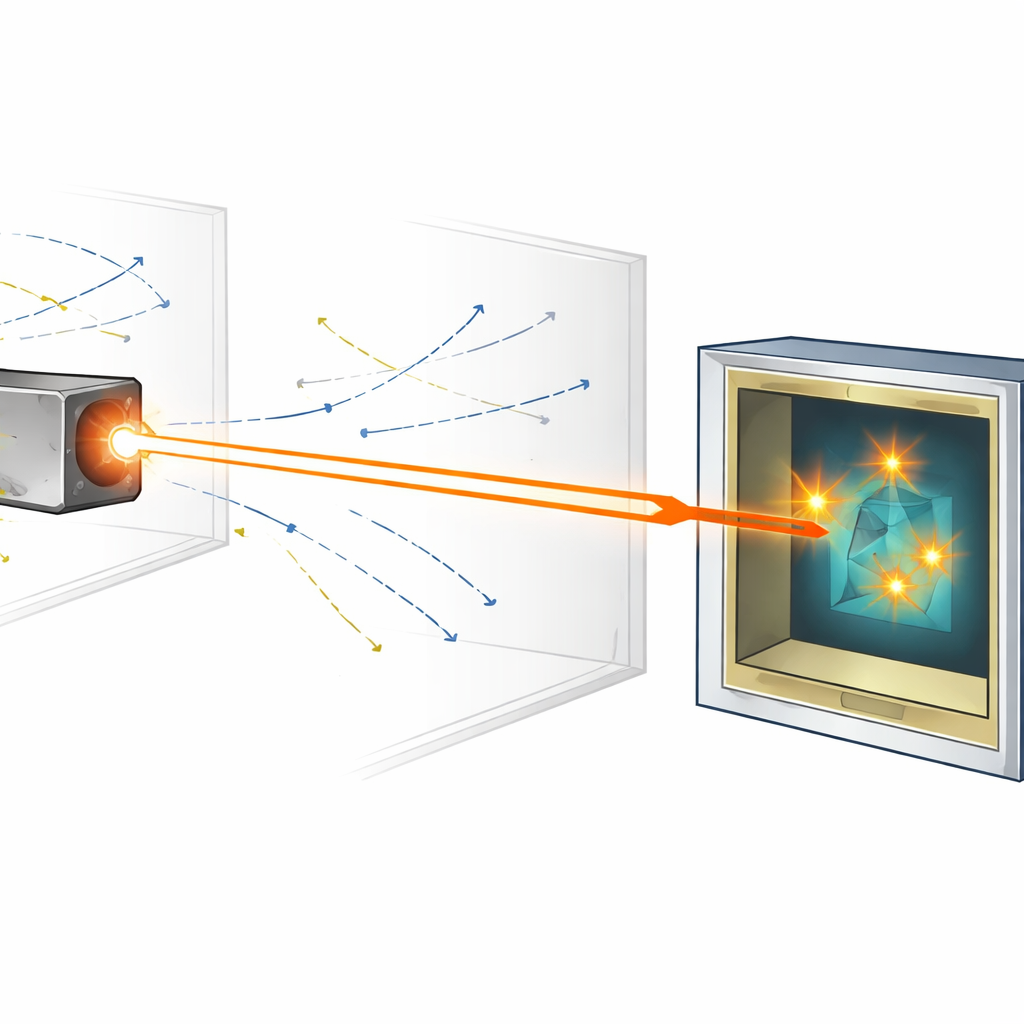
The heart of the study is the ability to detect single neutron‑induced events rather than just a blur of many. The diamond detector responds within less than a billionth of a second and is relatively insensitive to gamma rays, making it well suited to this harsh environment. Even so, the raw electrical signals were initially dominated by the prompt flash from X‑rays and by electromagnetic noise. The researchers recorded traces for each laser shot and developed a dedicated analysis method to subtract the common noise pattern and search for small, well‑shaped pulses arriving later in time. Each of these pulses corresponds to a neutron interaction within the diamond. By measuring the arrival time of each pulse relative to the laser shot and using the known 1.5‑meter flight path, they converted time into neutron energy and built up a spectrum by accumulating data over hundreds of shots.
Separating signal from background
A key difficulty was distinguishing neutrons that came straight from the converter target from those that had scattered off walls or other equipment. To quantify this background, the team alternated normal measurements with “shadowed” runs in which a block of neutron‑absorbing material was temporarily placed between source and detector. Signals recorded in this shadowed configuration mostly came from scattered neutrons and residual radiation. Using a statistical approach borrowed from astrophysics, they combined the two data sets to subtract the background and recover the direct neutron contribution. They then corrected for the detector’s energy‑dependent efficiency—known from separate simulations—to obtain the true neutron yield as a function of energy for both converter materials and compared the result with independent neutron‑counting methods and two major simulation codes.
What the results tell us
The experiment showed that a petawatt‑laser‑driven source can reliably produce on the order of one hundred million fast neutrons per shot above one million electron volts, and that individual neutron events can be cleanly recorded just 1.5 meters from the source despite intense background radiation. The measured energy spectra matched computer predictions and conventional detectors to within tens of percent, a strong agreement given the difficulty of the environment and the limited number of shots. When benchmarked against established accelerator facilities, the laser‑driven source offers comparable neutron energy resolution in a far more compact setup and competitive neutrons per pulse, with clear paths to improvement as lasers and high‑repetition targets advance. In practical terms, this proof of concept shows that future laser‑based neutron labs could perform detailed nuclear reaction studies—including on short‑lived, radioactive isotopes—in small spaces and with unprecedentedly short pulses, opening new opportunities in nuclear physics, astrophysics, and applied science.
Citation: Millán-Callado, M.A., Scheuren, S., Alejo, A. et al. Single-event fast neutron time-of-flight spectrometry with a petawatt-laser-driven neutron source. Nat Commun 17, 3154 (2026). https://doi.org/10.1038/s41467-026-70312-7
Keywords: laser-driven neutron source, fast neutron time-of-flight, petawatt laser, diamond detector, nuclear reaction studies