Clear Sky Science · en
An equilibrium rotator glass-forming phase for long-ranged repulsive colloidal rods
A Strange Solid That Behaves Half Like a Liquid
Everyday materials such as window glass or ice seem simple: they are either solid or liquid. But at the microscopic level, matter can occupy far more elusive states. This study reveals a new kind of equilibrium "glassy" phase made from tiny charged rods suspended in a liquid. In this state, the rods barely move from their spots, as in a solid, yet they continue to spin almost freely, as in a liquid. Understanding such hybrid behavior could reshape how scientists think about glass, crystals, and the design of smart, switchable materials.
Tiny Rods With a Big Story
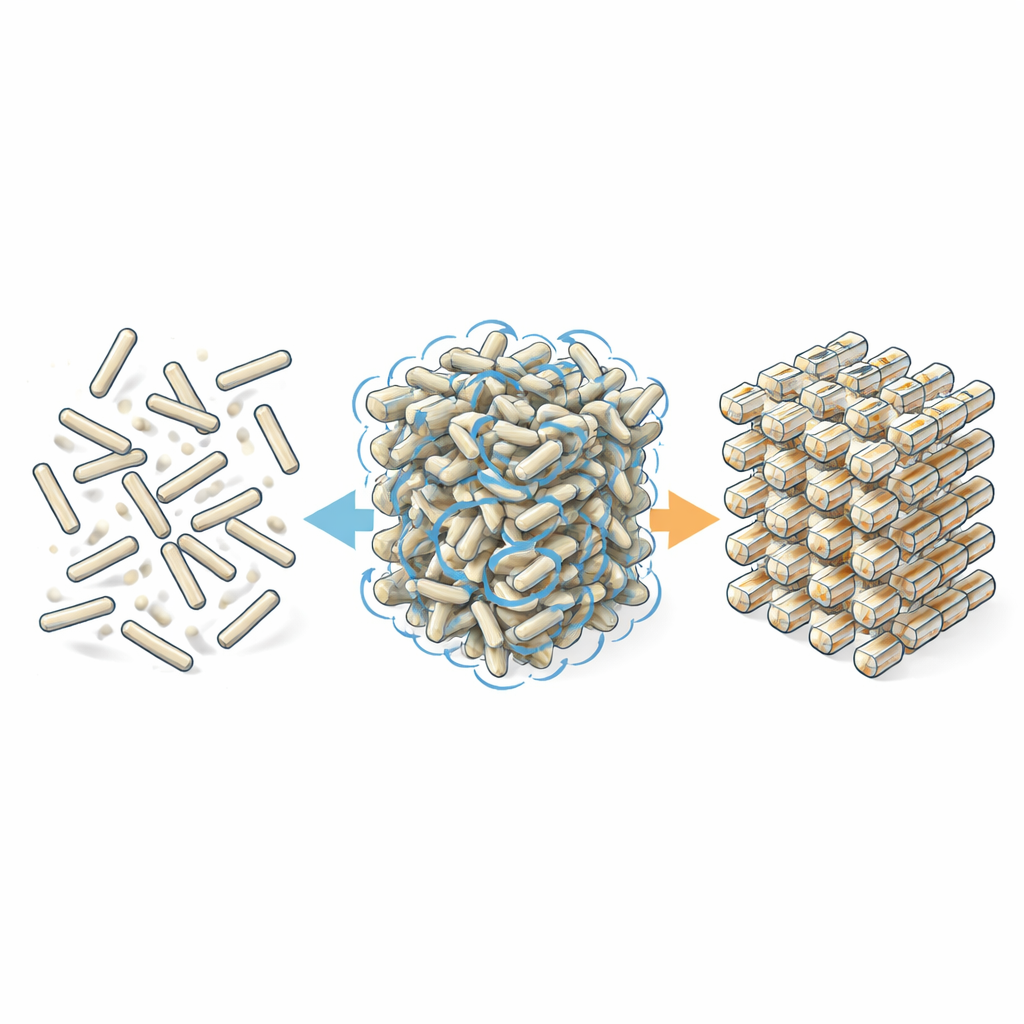
The researchers worked with microscopic silica rods dispersed in a solvent. Each rod was a few micrometers long—thousands of times smaller than a grain of sand—and carried electric charge, so neighboring rods repelled one another. By adjusting the salt content of the liquid and the concentration of rods, the team could tune how strongly and how far this repulsion reached. At low concentrations and short interaction ranges, the rods formed familiar liquid-crystal structures where they line up in layers yet still flow. At lower salt, the electric repulsion became long-ranged, and at moderate rod density the system formed a so‑called rotator crystal: the rods sat on a regular lattice like atoms in a crystal but were free to spin.
When Crowding Blocks Motion but Not Spin
As the number of rods was increased further under conditions of long‑range repulsion, the system did something unexpected. Instead of forming a more rigid crystal, the regular spatial pattern broke down. The rods became densely packed and disordered in position, yet still retained considerable freedom to rotate. Careful tracking of thousands of rods in three dimensions revealed that their centers were effectively trapped in cages made by neighbors: translational motion slowed by roughly two orders of magnitude, a hallmark of glassy arrest. Meanwhile, their orientations changed relatively quickly, indicating that rotations remained liquid‑like over the same timescales. Structural measurements also showed only short‑range positional order, confirming that this was not just a defective crystal but a genuinely amorphous, glass‑forming phase that nevertheless stays in thermodynamic equilibrium.
Computer Models Reveal the Hidden Frustration
To uncover why this rotator glass forms, the team built computer simulations of simplified charged rods, modeled as chains of repelling segments. Free‑energy calculations mapped out how an idealized system should behave as density and interaction strength change. The simulations reproduced a sequence in which a fluid turns into a rotator crystal at intermediate densities, then returns to a disordered phase at higher densities. The key lies in frustration: at low density, the rods are far apart and interact almost isotropically, favoring a neat crystal. As density rises, the detailed shape and orientation of each rod begin to matter. Different pairs of neighbors then experience slightly different effective interactions, mimicking a system with many particle “types” mixed together. This effective polydispersity makes it harder for the rods to settle into one regular lattice, promoting a disordered, glass‑like arrangement instead.
Switching Between Glass and Crystal With an Electric Field
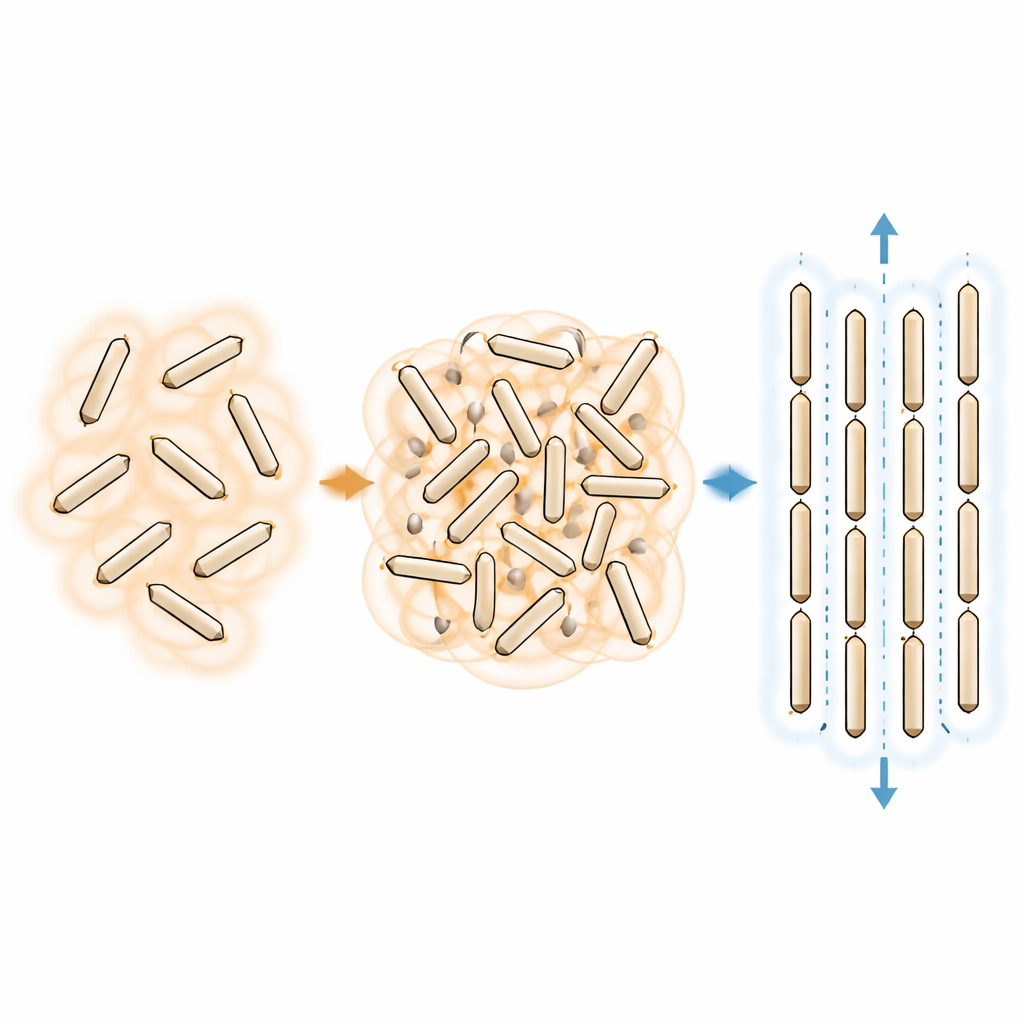
Because the rods are charged, an applied alternating electric field can nudge them to align along the field direction without pulling them together. When the researchers exposed the rotator glass‑forming phase to a strong, high‑frequency field, the rods gradually lined up and reorganized into a stretched three‑dimensional crystal. Crucially, this transformation involved only small shifts in position: the number of neighboring rods around each particle hardly changed. Turning off the field reversed the process. The ordered crystal melted back into the rotator glass‑like state, and repeated cycling revealed hysteresis typical of a first‑order phase transition. These experiments show that the glassy phase is not just a stuck, out‑of‑equilibrium state but actually has lower free energy than the field‑induced crystal under the same conditions.
Why This Matters for Understanding Glass
The discovery of an equilibrium glass‑forming phase in which particles are frozen in place but free to spin challenges the usual view that structural glasses are always trapped, non‑equilibrium materials. It demonstrates that translational and rotational motions can decouple in extreme ways, producing a solid that is positionally glassy yet orientationally fluid. The work suggests that similar rotator glass phases may arise in other rod‑like nanoparticles or even molecular systems with long‑range repulsions. By offering a clean, controllable system where individual particles and their spins can be tracked, this study opens new paths for theories of the glass transition and for engineering materials whose solidity and internal freedom of motion can be tuned on demand.
Citation: Besseling, T.H., van der Meer, B., Liu, B. et al. An equilibrium rotator glass-forming phase for long-ranged repulsive colloidal rods. Nat Commun 17, 2410 (2026). https://doi.org/10.1038/s41467-026-70295-5
Keywords: colloidal glass, rotator phase, charged nanorods, glass transition, electric field control