Clear Sky Science · en
RejuAgro A as an antimicrobial for fire blight control of pome fruits and beyond
Why protecting apples and pears matters
Apples and pears are everyday fruits with a hidden vulnerability: a fast-moving bacterial disease called fire blight that can kill entire trees and devastate orchards. For decades, farmers have relied on some of the same antibiotics used in human medicine to keep this disease in check, raising alarms about drug resistance and environmental impacts. This study unveils a new antimicrobial compound, RejuAgro A, that is designed specifically for plants yet may also have broader medical potential, offering a fresh path toward protecting harvests while easing pressure on conventional antibiotics.
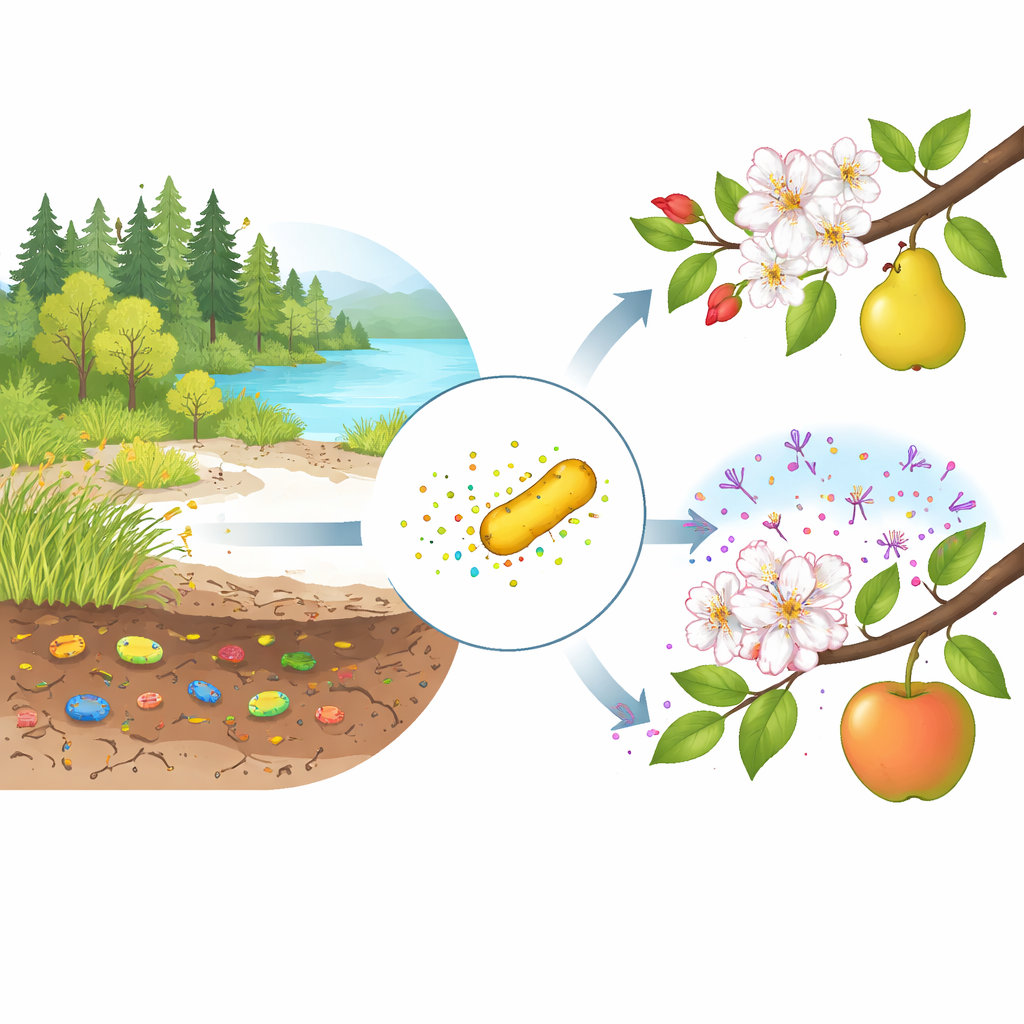
A new defender found in the soil
The story begins in Wisconsin soils, where researchers collected more than 40,000 bacterial isolates from forests, lakeshores, and marshes, searching for natural enemies of the fire blight pathogen, Erwinia amylovora. One strain, a harmless soil bacterium called Pseudomonas soli 0617-T307, stood out for its ability to strongly suppress the pathogen’s growth in laboratory tests. By extracting and separating the chemicals this microbe released, the team pinpointed a small molecule with potent activity and determined its structure using high-resolution mass spectrometry and X‑ray crystallography. They named this new antimicrobial RejuAgro A (RAA), and also identified a related, larger molecule, RejuAgro B, that appears along the way as RAA is built inside the bacterial cell.
How the new molecule fights plant diseases
When the scientists tested purified RAA against fire blight bacteria, they found that very low amounts were enough to stop growth, including in strains that no longer respond to streptomycin, a common orchard antibiotic. RAA’s performance matched or exceeded streptomycin in these assays. Unlike many current products that work only on bacteria, RAA also slowed or stopped several other important plant pathogens, including species that cause citrus canker, tomato leaf spots, bacterial wilts, and even some fungal and water‑mold diseases such as apple scab and late blight. This broad reach means a single compound could help manage multiple threats, reducing the need for farmers to juggle many different pesticides.
Real‑world tests in orchards
To see whether RAA works outside the lab, the team ran field trials over several years in apple and pear orchards across California, Connecticut, Michigan, and New York, covering both dry western and humid eastern climates. Trees were sprayed during bloom with either water, standard antibiotics, or various doses of RAA and then challenged with the fire blight bacterium. In untreated trees, as many as two‑thirds to more than four‑fifths of blossoms developed disease. In contrast, trees treated with RAA at 20–30 parts per million showed dramatically reduced infection, often matching the protection provided by standard antibiotics applied at five times the concentration. In one New York trial, RAA cut blossom infection to about one‑tenth of blossoms, outperforming streptomycin in an area where resistant fire blight strains are common.
What makes this compound different
RAA appears to attack harmful microbes in a way that sets it apart from most familiar antibiotics. In controlled experiments, the compound simultaneously shut down three core cellular processes: copying DNA, making RNA messages, and building proteins. This multi‑target effect is reminiscent of thiol‑reactive natural products like allicin, the pungent molecule in garlic, which chemically modifies key sulfur‑containing groups in proteins. Supporting this idea, adding the protective molecule glutathione, which can neutralize reactive sulfur chemistry, partially shielded bacteria from RAA but did not protect them from standard antibiotics. Chemical comparisons further showed that RAA occupies a distinct space from existing drug families, hinting that it represents a genuinely new type of antimicrobial.
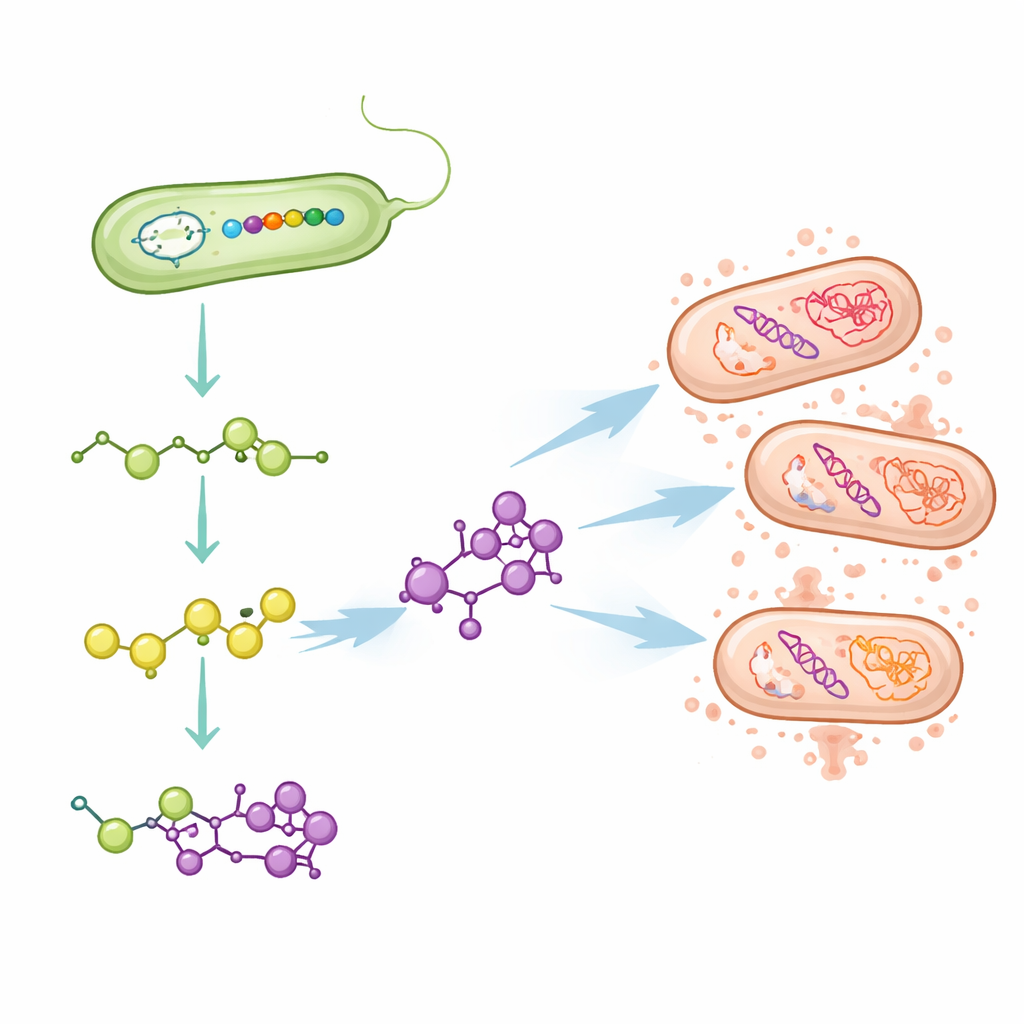
From bacterial genes to a useful tool
To understand how the soil bacterium makes RAA, the researchers scanned its genome for clusters of genes involved in secondary metabolites, the specialized molecules microbes often use for defense. By selectively deleting candidate genes and measuring RAA output, they identified a six‑gene cluster, named ras1 through ras6, as essential for RAA production. Some of the encoded enzymes work together to form the intermediate compound RejuAgro B, while others reshape and trim this precursor into the final, active antimicrobial. Supplying extra RejuAgro B could rescue RAA production in certain mutants, confirming that the pathway proceeds in at least two main steps. This genetic map opens the door to optimizing RAA production through fermentation, strain improvement, or even transfer of the pathway into other safe microbes.
What this could mean for farms and beyond
By discovering and characterizing RejuAgro A, this work offers a promising new option for controlling fire blight and other plant diseases while reducing reliance on antibiotics critical for human medicine. RAA is small and moderately fat‑soluble, properties that likely help it move into flower tissues at relatively low doses, which contributes to its strong field performance. Its broad activity against both bacteria and fungi, combined with a multi‑target mode of action, may also make it harder for pathogens to evolve resistance. Although more safety, environmental, and compatibility studies are needed before widespread use, RAA illustrates how carefully mined soil microbes can yield next‑generation tools for sustainable crop protection—and possibly inspire new approaches to treating infections in people as well.
Citation: Huang, J., Huyen, T.N.B.V., Liu, X. et al. RejuAgro A as an antimicrobial for fire blight control of pome fruits and beyond. Nat Commun 17, 2282 (2026). https://doi.org/10.1038/s41467-026-70229-1
Keywords: fire blight, apple disease control, plant antimicrobials, soil bacteria, antibiotic resistance