Clear Sky Science · en
Contrary effects of soil moisture-atmosphere feedback on dry and humid heatwaves
Why hot, sticky days are not all the same
When a brutal heatwave hits, it can feel very different depending on whether the air is bone-dry or oppressively muggy. This study explores how the moisture stored in the ground beneath our feet helps shape both types of heatwaves. By comparing climate-model experiments from around the world, the authors uncover a surprising twist: the same land–atmosphere feedback that makes many dry heatwaves worse can, in some regions, actually soften the blow of humid heatwaves that are most dangerous to human health.
Two kinds of dangerous heat
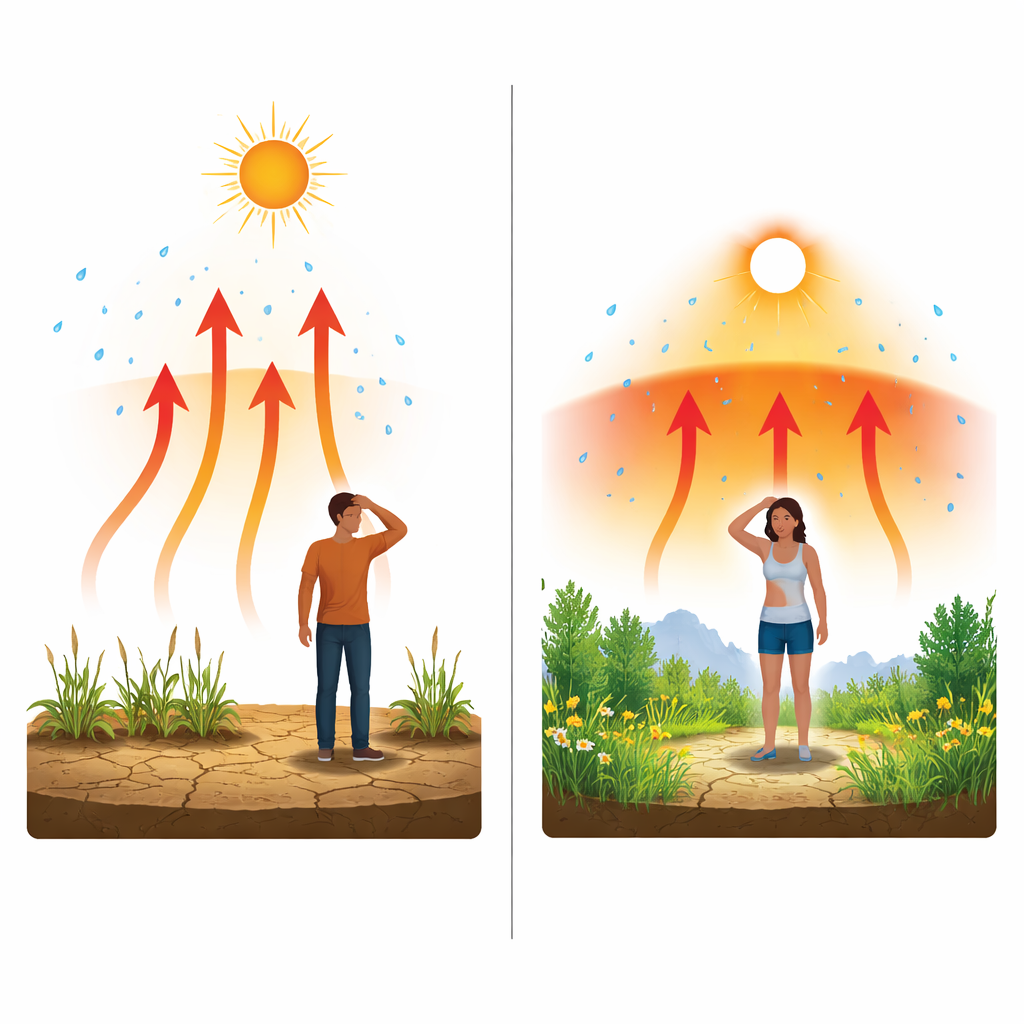
Not all extreme heat is equally harmful. Dry heatwaves are defined mainly by unusually high air temperatures. Humid heatwaves, in contrast, combine high temperature with high moisture in the air, measured through a quantity related to the familiar “feels like” temperature. Because our bodies cool by sweating and letting that sweat evaporate, humid heatwaves are often deadlier: when the air is already loaded with moisture, sweat cannot evaporate effectively, and the body overheats more easily. The authors set out to understand how changes in soil moisture—how wet or dry the ground is—feed back on the atmosphere to influence both dry and humid heatwaves around the globe from 1951 to 2014.
How thirsty soil talks to the sky
When soils dry, less water is available to evaporate. That lost evaporation means less natural “air conditioning” and more of the Sun’s energy goes into directly warming the air just above the ground. At the same time, the reduced evaporation also means less moisture is pumped into the atmosphere. This dual effect—stronger heating but weaker moistening—is known as soil moisture–atmosphere feedback. Using a special set of climate-model simulations in which soil moisture is either allowed to vary or held artificially constant, the researchers could isolate how this feedback changes the duration and severity of heatwaves. They combined these experiments with a detailed analysis of a human-relevant measure of heat stress called wet-bulb temperature, which depends on both temperature and humidity.
Opposite effects on muggy heat in different regions
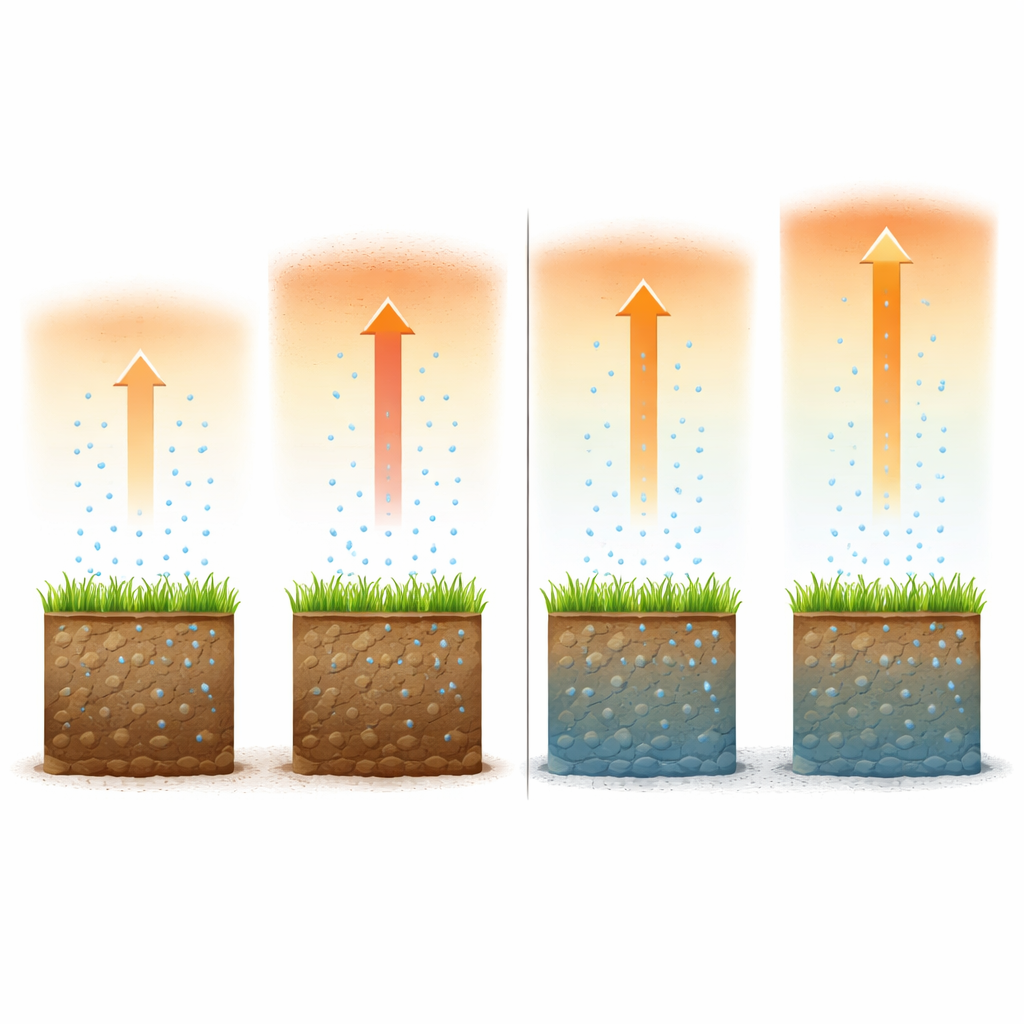
The study finds that this land–atmosphere feedback consistently lengthens and intensifies dry heatwaves almost everywhere, confirming earlier research. But for humid heatwaves the story is much more nuanced. In low and mid-latitude regions—such as South Asia, northern Australia, parts of Africa, and much of Europe—strong coupling between soil moisture and the atmosphere means that drying soils sharply cut back on evaporation. The resulting drop in near-surface humidity more than offsets the additional warming, so the combined heat-and-moisture burden on people actually decreases. In these regions, the feedback shortens the total duration of humid heatwaves by about 10–20 days per year and reduces their overall severity by roughly 20–40 percent, even as dry heatwaves become worse.
Why high-latitude regions face extra sticky heat
Closer to the poles, the same feedback tilts in the opposite direction. There, evaporation is often limited more by available energy than by soil moisture. As the atmosphere warms, it can pick up somewhat more moisture without causing the sharp drying seen in the tropics and subtropics. In these high-latitude areas—such as Alaska, northern Europe, and northern Asia—the soil moisture feedback mainly acts to raise air temperatures while leaving humidity relatively high. That combination pushes wet-bulb temperatures upward, increasing both the length and severity of humid heatwaves by 50 percent or more. The analysis shows that these contrasting outcomes are driven mostly by persistent shifts in average conditions, rather than by day-to-day swings in weather.
What this means for living with future heat
For societies planning to adapt to a hotter world, the findings carry an important message: the role of the land surface in extreme heat is not one-size-fits-all. In many low- and mid-latitude regions, drying soils will intensify classic dry heatwaves but at the same time can slightly ease the most oppressive muggy extremes by lowering humidity. At higher latitudes, however, the same feedback acts almost entirely in the opposite way, adding to both temperature and humidity and making humid heatwaves more hazardous. Recognizing this hidden “push–pull” between warming and drying helps explain why extreme heat behaves so differently from place to place, and it underscores the need for region-specific strategies—from urban design to water management—to protect people from both dry and humid heatwaves.
Citation: Chen, S., Ji, P., Yuan, S. et al. Contrary effects of soil moisture-atmosphere feedback on dry and humid heatwaves. Nat Commun 17, 2626 (2026). https://doi.org/10.1038/s41467-026-70210-y
Keywords: heatwaves, soil moisture, humidity, climate feedbacks, human heat stress