Clear Sky Science · en
The origins of patchy aurora at Jupiter
Why Jupiter’s Flickering Lights Matter
Jupiter’s poles glow with huge curtains of aurora, much like Earth’s northern lights but far more powerful. Hidden within this glow are small, bright patches that blink on and off and drift with the planet’s rotation. Understanding what creates these patchy lights is not just about pretty pictures: it reveals how energy moves through giant planetary magnetic fields, a process that may also shape the space weather of other worlds, including exoplanets.
Small Bright Spots on a Giant Planet
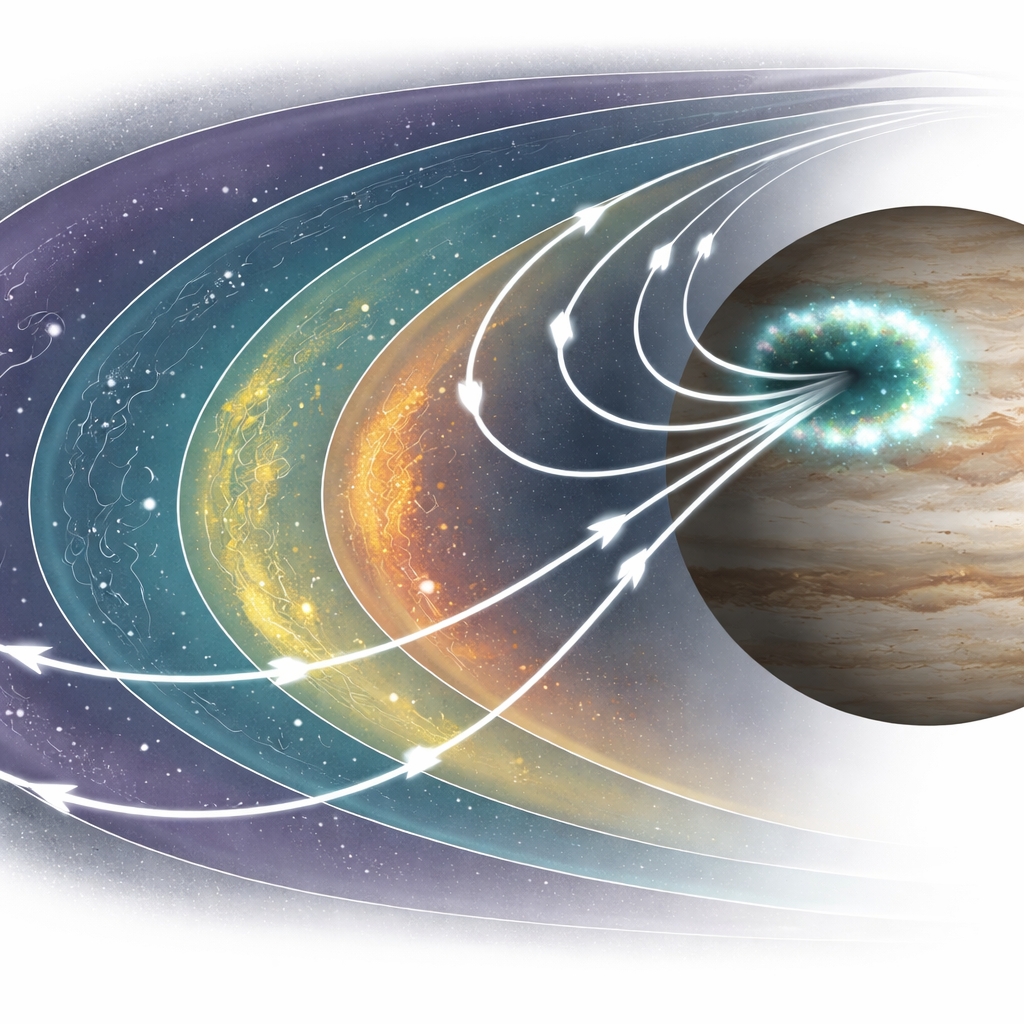
Auroras form when fast charged particles plunge into a planet’s upper atmosphere and make gases glow. At Jupiter, most of this activity is powered from within the planet’s own vast magnetic bubble rather than by the solar wind. Alongside broad, diffuse glows, telescopes have long seen isolated bright patches closer to the equatorward edge of Jupiter’s main auroral ring. These patches can last for hours and rotate with the planet. Earlier studies linked them to “injections” of fresh particles deeper into the magnetic field, but the exact cause of the patches remained uncertain because spacecraft rarely caught the lights and the surrounding space environment at the same time.
A Fortunate Flyby with Many Eyes
The Juno spacecraft offered a rare chance to solve this puzzle. During one close swing past Jupiter, Juno’s ultraviolet camera captured a set of patchy auroras while its other instruments measured particles, magnetic fields and plasma waves along the connected magnetic field lines. The team examined two key regions: a low‑altitude pass whose magnetic footprint cut directly through a bright patch, and an earlier pass near the magnetic equator where the same field lines thread through the middle of Jupiter’s magnetosphere. This pairing allowed the authors to compare what the aurora looked like in the atmosphere with what the particles and waves were doing out in space along the very same magnetic paths.
Not Every Particle Surge Makes a Patch
Juno’s instruments saw several bursts of energetic electrons, the injections that had been suspected to power the patches. However, these surges did not line up neatly with where the aurora brightened. At low altitude, enhanced electron precipitation—particles actually entering the atmosphere—matched the location and intensity of the patchy glow very well, but it did not correspond directly to the times or places of injections. Near the equator, injections dramatically reshaped the particle distributions, yet some occurred without any obvious counterpart in the aurora. This mismatch showed that injections alone cannot explain why patchy auroras appear only in certain places and times.
Waves in Space Sculpt the Lights
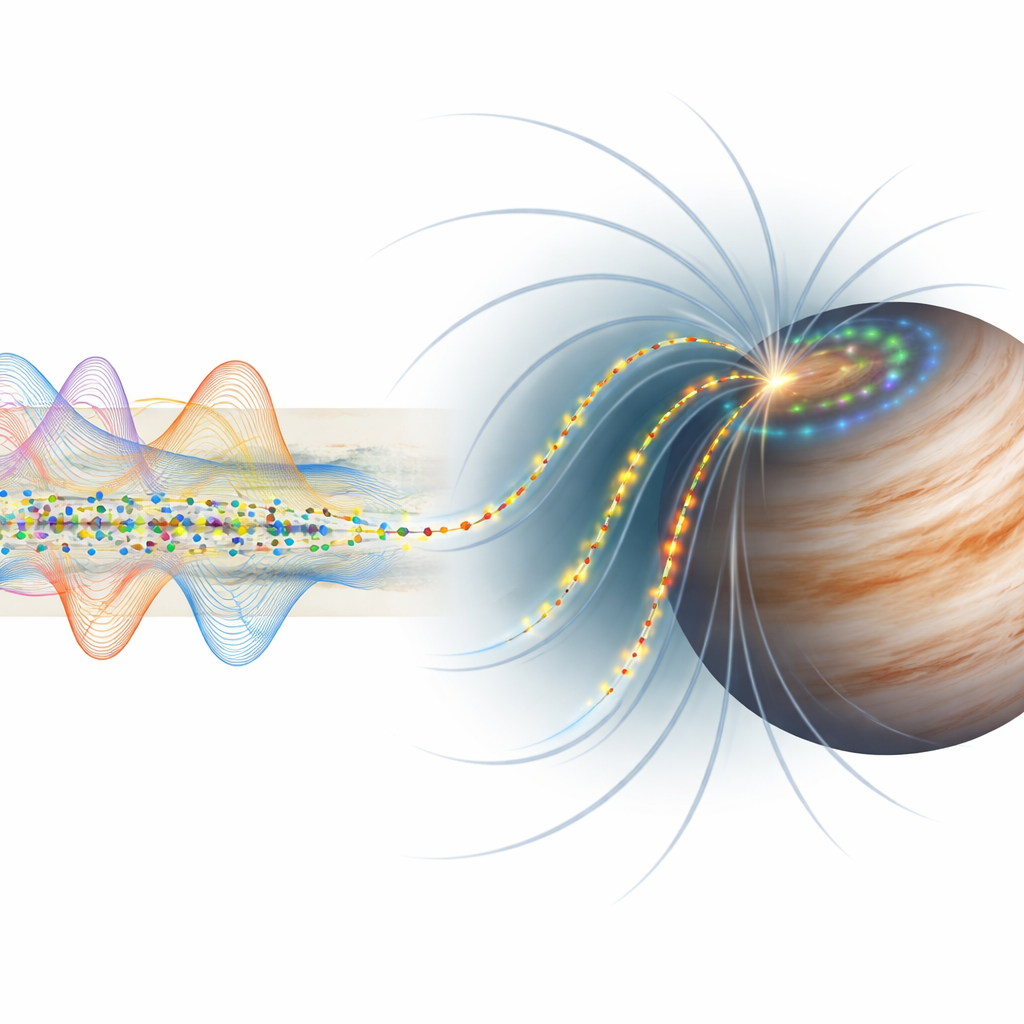
The missing ingredient turned out to be plasma waves—ripples in the electric and magnetic fields that thread Jupiter’s magnetosphere. Juno detected strong wave activity in the same regions whose field lines mapped to the observed patches. Two families of waves were especially important. Electron cyclotron harmonic waves mainly interacted with relatively low‑energy electrons, while whistler‑mode waves affected higher‑energy ones. By modeling how these waves nudge electrons into the narrow range of directions that send them spiraling into the atmosphere, the authors could predict both the energy carried by the falling electrons and how bright the resulting aurora should be. These modeled precipitation patterns closely matched the observed ultraviolet brightness and its color ratios, strongly tying the patches to wave‑driven scattering rather than to injections themselves.
Two Pathways to the Same Glow
The study points to a two‑step picture. In one pathway, injections help create unstable particle populations that feed certain kinds of waves, which then scatter electrons into Jupiter’s atmosphere and light up patchy regions. In another pathway, waves arise even without a recent injection and still drive electrons downward, forming patches that are not directly tied to obvious particle surges. In both cases, it is the plasma waves that immediately control where and how strongly the patches shine. For a layperson, this means that Jupiter’s flickering lights are less like simple splashes from a hose of charged particles and more like patterns created when ripples on a pond steer those splashes into focused spots. By revealing the central role of waves, the work helps explain how giant planets—and perhaps distant exoplanets—convert the invisible motion of space plasmas into spectacular polar light shows.
Citation: Daly, A., Li, W., Ma, Q. et al. The origins of patchy aurora at Jupiter. Nat Commun 17, 3117 (2026). https://doi.org/10.1038/s41467-026-70197-6
Keywords: Jupiter aurora, plasma waves, magnetosphere, Juno spacecraft, space weather