Clear Sky Science · en
Scalable and stretchable 1D multifunctional fibers for multimodal sensing and stimulation
Soft Threads That Listen to the Body
Imagine medical devices not as stiff patches or bulky gadgets, but as soft, hair‑thin threads that can bend, stretch, and move with your body like ordinary fibers in a T‑shirt. This study introduces such "electronic threads"—slender, stretchable fibers that can sense the body’s electrical signals, stimulate nerves, and even deliver wireless power when stitched into clothing. They promise more comfortable wearables, gentler implants, and smarter textiles that blend almost invisibly into daily life.
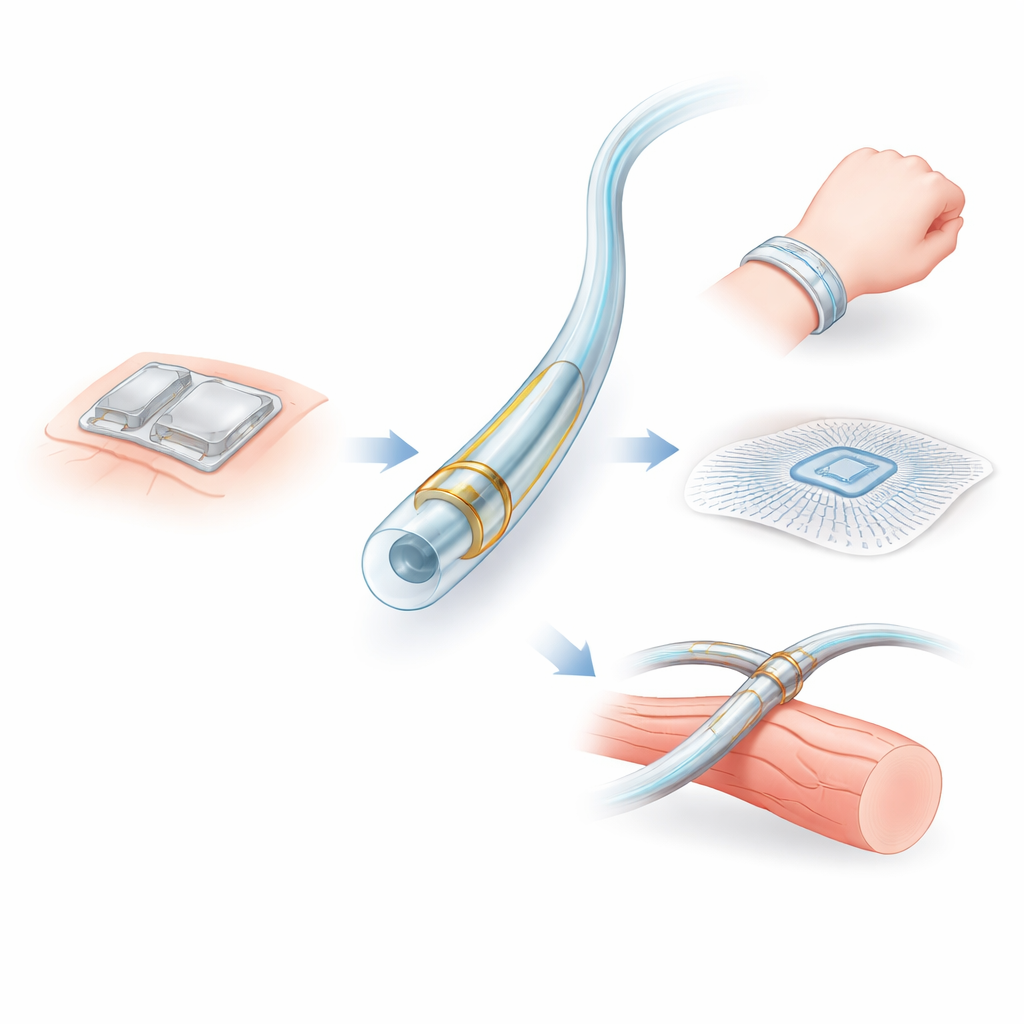
From Flat Patches to Flexible Threads
Traditional bioelectronic patches sit like stickers on the skin. They often peel with sweat, feel stuffy, and struggle to stay in close contact when the body moves. The researchers instead focused on one‑dimensional fibers, whose thin, thread‑like shape naturally conforms to curves, folds, and moving tissue. Fibers are breathable, lightweight, and easy to weave into fabrics or tie around tiny structures such as nerves. Yet making them truly useful has been difficult: the conductors inside must stay highly conductive while being stretched, bent, and soaked in salty body fluids for long periods.
Liquid Metal Wrapped Around a Stretchy Core
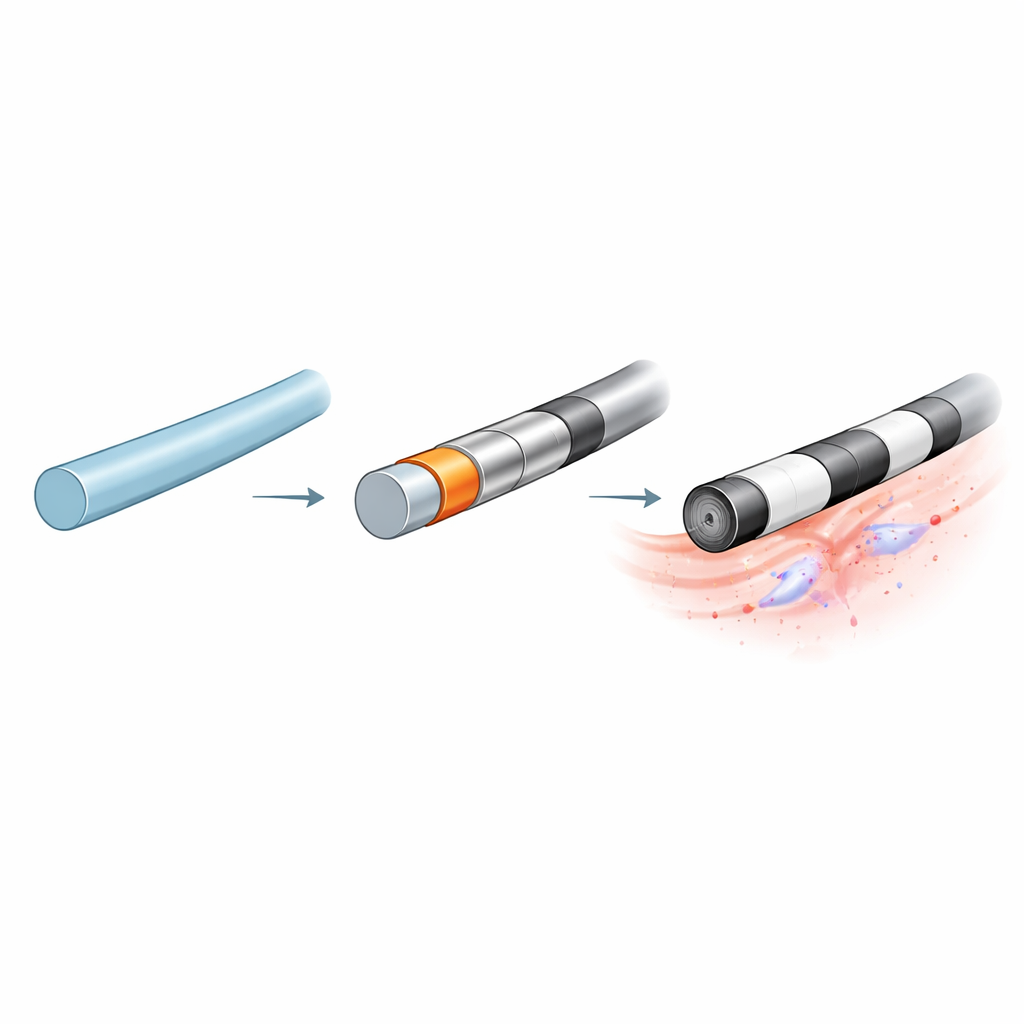
To solve this, the team built a new kind of fiber that hides a liquid metal pathway inside a stretchy plastic core. They start with a thin polyurethane thread and coat it step‑by‑step with a sticky layer, a thin metallic seed, and then copper. When this copper‑coated fiber meets a droplet of gallium‑based liquid metal in a mild acid bath, the two metals react and blend at the surface, forming a smooth, continuous liquid‑metal shell that clings tightly to the fiber. Because the conductor is liquid, it can deform without cracking, preserving very high conductivity even when the fiber is stretched to more than twice its length or twisted into loops.
Protective Shell and Gentle Skin Contact
The bare liquid metal would quickly corrode in watery, salty environments like sweat or blood, so the researchers add a thin elastic jacket that seals out moisture but still lets electrons flow along the inner pathway. They can also leave selected sections of the fiber unsealed and coat them with a soft, carbon‑based conductive layer topped by a polymer known for stable electrical behavior in wet conditions. These exposed zones act as electrodes, directly contacting skin or tissue while shielding the liquid metal beneath. Tests show that the coated fibers maintain stable resistance during heavy stretching and long soaking in salt solution, and that the electrode surfaces safely handle electrical charge without breaking down.
Threads That Power, Listen, and Move
Because these fibers can be made continuously and are as thin as a human hair, they can be embroidered into cloth using standard textile techniques. In fabric antennas, the liquid‑metal coils transmitted wireless power efficiently, rivaling standard copper wire while surviving hundreds of bending cycles that would break metal wire. Worn directly on the body, fiber electrodes recorded heart and muscle signals more cleanly than commercial gel pads, especially during motion or sweating, and stayed comfortable thanks to their breathability. By braiding several fibers together, the team recorded multiple muscle channels at once and, with machine‑learning software, recognized hand gestures with nearly perfect accuracy.
Gently Controlling Nerves and Protecting Cells
The researchers also tested the fibers inside the body by loosely wrapping them around a small leg nerve in rats. Short voltage pulses sent through the fiber electrodes made the animals’ hindlimbs flex and extend in a controlled, repeatable way across a range of frequencies and voltages, and the stimulation remained effective even after the devices had been soaked in a salt solution that mimics body fluid for days. In cell culture experiments, nerve‑safe coatings on the fibers showed no significant toxicity compared with standard lab conditions, suggesting that the materials are gentle enough for long‑term contact with living tissue.
Why These Smart Threads Matter
In everyday terms, this work turns soft, stretchable threads into tiny all‑in‑one wires, sensors, and electrodes that can be woven into clothing or placed directly on, or even around, delicate parts of the body. They stay conductive while you move, sweat, or stretch, and they interact with nerves and muscles without causing obvious harm in early tests. That combination of comfort, durability, and versatility makes these multifunctional fibers a promising foundation for next‑generation wearables and implants—from more reliable heart monitors and gesture‑controlled devices to minimally invasive nerve therapies.
Citation: Yin, J., Zhu, J., Wang, S. et al. Scalable and stretchable 1D multifunctional fibers for multimodal sensing and stimulation. Nat Commun 17, 2496 (2026). https://doi.org/10.1038/s41467-026-70178-9
Keywords: stretchable bioelectronics, liquid metal fibers, wearable sensors, electronic textiles, nerve stimulation