Clear Sky Science · en
Ancient DNA reveals 4000 years of grapevine diversity, viticulture and clonal propagation in France
A Long Story Hidden in Grape Seeds
Anyone who enjoys a glass of wine has probably heard of famous grapes like Pinot Noir, but few realize how deep their roots go in time. This study uses DNA recovered from ancient grape seeds to follow the history of French wine over nearly 4000 years. By reading genetic clues preserved in tiny waterlogged pips, the researchers uncover when wild forest vines first met cultivated varieties, how far grape plants traveled across the Mediterranean, and how early growers learned to copy their best vines again and again. The work shows that some of the grapes behind today’s celebrated wines are direct genetic matches to vines grown in the Middle Ages.
From Forest Vines to the First Vineyards
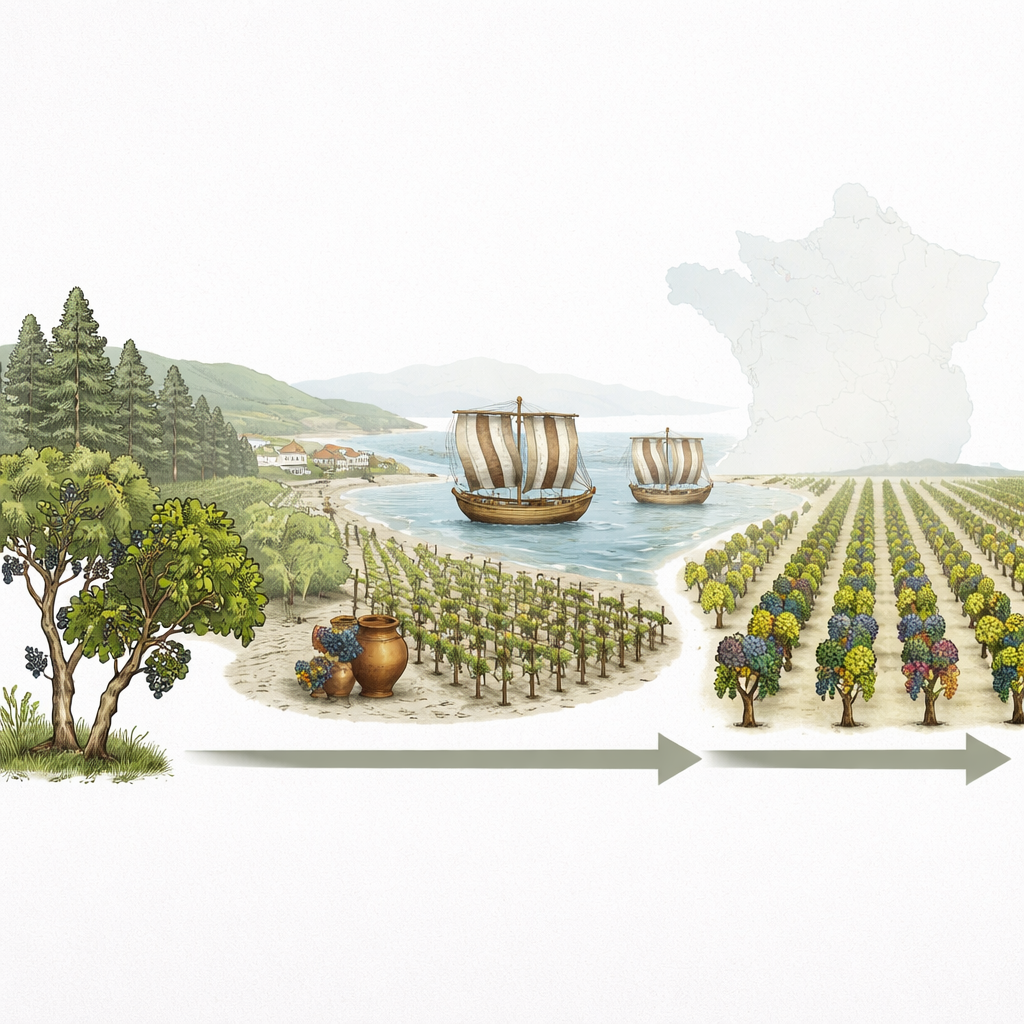
The story begins with wild grapevines that once climbed through European riverbanks and woodlands. Ancient seeds from Bronze Age southern France, dating to around 2300–2000 BCE, carry purely wild DNA, showing that local grapes at that time had not yet been shaped by farming. These wild lineages, especially one dominant group in western Europe, remained remarkably stable for millennia. Even as wine culture later spread through the region, the wild vines kept their distinct genetic identity, suggesting very limited mixing from nearby vineyards and perhaps careful human management that kept cultivated plants out of natural forests.
Newcomer Grapes Arrive with Trade and Contact
By the Iron Age, around the 6th to 5th centuries BCE, the genetic picture changes. Seeds from coastal and inland sites in southern France suddenly show the hallmarks of fully domesticated grapevines. Their DNA carries blends of ancestries that today are common in the Balkans, Iberia, the eastern Mediterranean, and the Caucasus. This pattern fits with historical evidence that Greek and other Mediterranean traders brought wine and planting stock to southern Gaul. The seeds also reveal early experiments: some pips carry mixed signatures of wild and cultivated ancestry, implying that growers crossed local forest vines with introduced stock, possibly to adapt grapes to new soils and climates.
Roman-Era Diversity Across the Map
During the Roman period, when vineyards and wine markets expanded dramatically, the genetic variety of French grapevines broadened further. Many Roman-era seeds are dominated by lineages that today underpin French and Spanish wine grapes, but traces of grapes from the Levant and Caucasus are also common. Seeds from northern and southern France show that imported vines were planted far from their original homes and then blended, through seeds or cuttings, into local cultivation. At the same time, wild ancestry still appears in many samples, confirming that mixing between forest vines and cultivated grapes continued as vineyards spread across Gaul.
Copying the Best Vines Again and Again
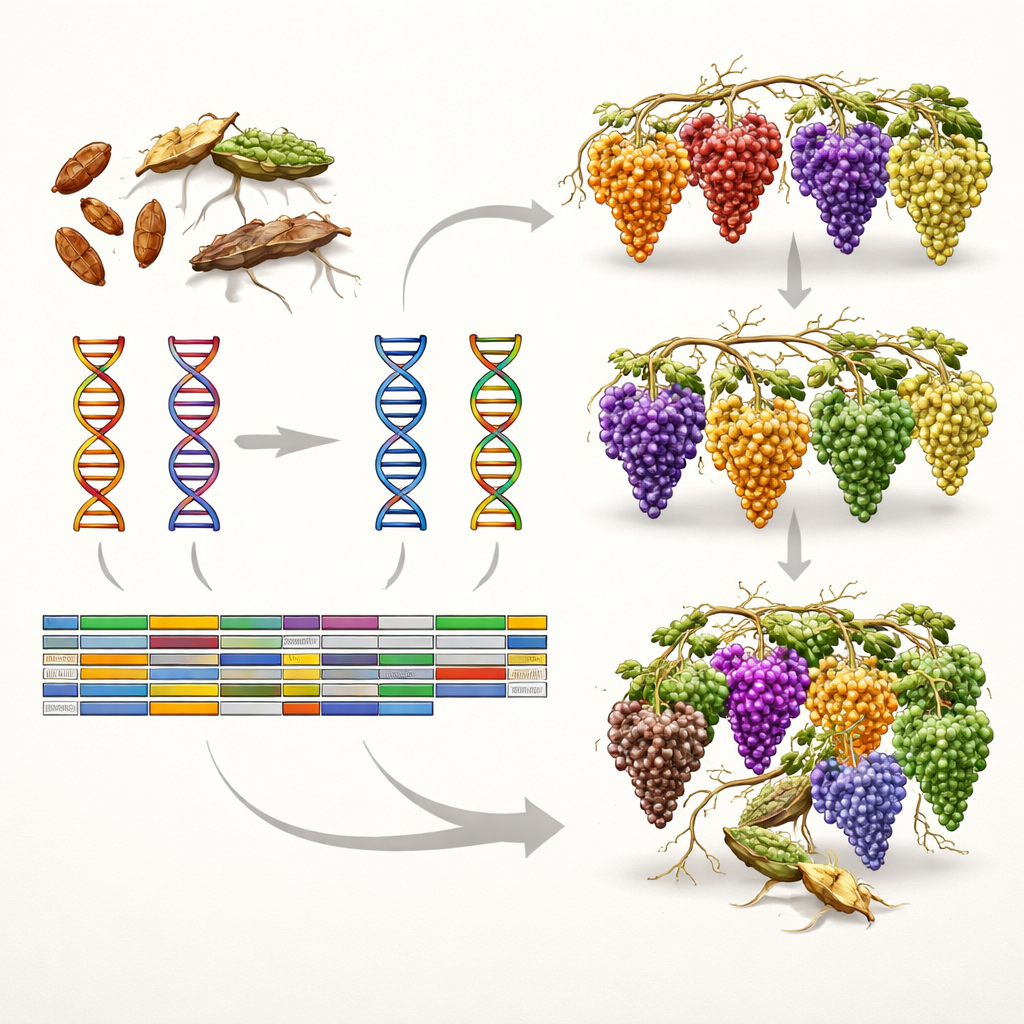
One of the most striking findings involves how growers multiplied their vines. Grapes can be grown from seed, which shuffles genes, or from cuttings, which produce near-perfect clones of the parent plant. Using genome-wide comparisons, the researchers found sets of ancient seeds that are genetically identical or as close as close family members. Some of these clones appear at different sites separated by hundreds of kilometers and by centuries. This shows that by at least the mid–Iron Age, farmers were moving cuttings between regions and deliberately preserving successful vines over very long periods. Medieval seeds from France and Ibiza even turn out to be exact genetic matches to modern cultivars still grown today, including one from Valenciennes that is identical to Pinot Noir.
What This Means for Today’s Wine
Why These Ancient Seeds Matter
Citation: Noraz, R., Chauvey, L., Wagner, S. et al. Ancient DNA reveals 4000 years of grapevine diversity, viticulture and clonal propagation in France. Nat Commun 17, 2494 (2026). https://doi.org/10.1038/s41467-026-70166-z
Keywords: ancient DNA, grapevine history, French wine, clonal propagation, viticulture