Clear Sky Science · en
Biomimetic actuator crafted from a relaxor ferroelectric polymer nanocomposite
Tiny Robots That Move Like Real Insects
Imagine a robot the size of a caterpillar that can crawl over rough terrain, or a butterfly-like device that flaps its wings and lifts off the ground—yet is made from a single, paper-thin piece of plastic and uses less power than an LED night light. This paper describes a new kind of soft material that can act like artificial muscle, making such insect-scale robots simpler, lighter, and more energy-efficient than before.
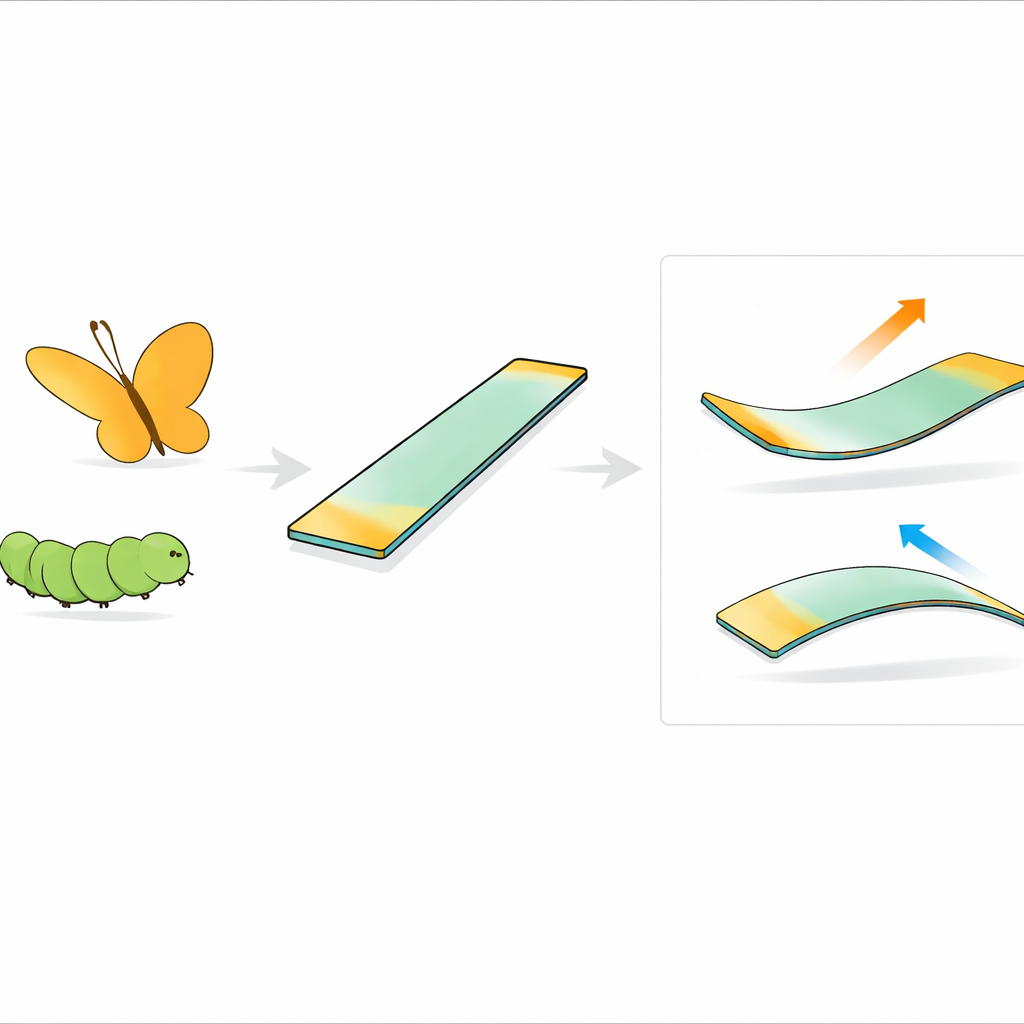
Why Small, Soft Machines Matter
Miniature robots inspired by insects could slip into collapsed buildings to search for survivors, snake through pipes to inspect infrastructure, or quietly monitor crops and forests. To work in these cramped and unpredictable spaces, they must be tiny, flexible, and tough, while consuming very little power. Many current designs rely on complicated assemblies of gears, hinges, and multiple materials, which add weight, waste energy, and are hard to shrink further. The authors argue that the ideal solution is a single material that can both generate movement and transmit it directly, much like real muscle does in animals.
A Smart Plastic Engineered from the Inside Out
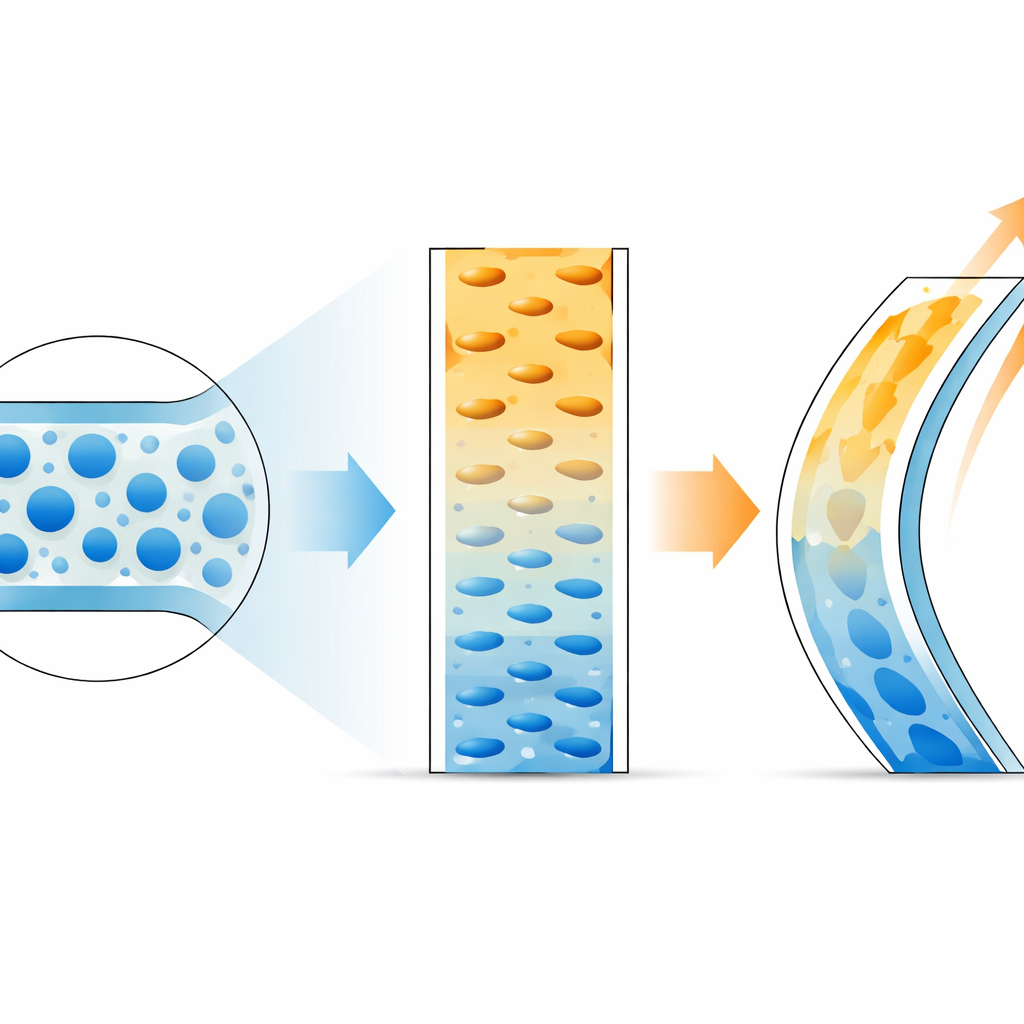
At the heart of this work is a thin plastic film based on a well-known family of materials called PVDF, already valued for their ability to deform when exposed to an electric field. The researchers mix this plastic with tiny “polymer dots,” nanometer-scale particles covered in chemical groups that can form hydrogen bonds. When the mixture is cast into a film and gently heated in a controlled way, solvent evaporates faster from the top than from the bottom. This uneven drying, together with the hydrogen bonding, encourages the plastic chains near the bottom surface to line up in a highly ordered, polar arrangement, while the top remains less ordered. The result is a built-in internal gradient across the thickness of a single layer.
From Hidden Structure to Powerful Motion
This subtle structural gradient has a big mechanical payoff. When an electric field is applied across the film, the more ordered, strongly polar bottom region responds more than the top, so one side of the sheet expands more than the other. That imbalance makes the whole strip bend, much like a classic bimetallic strip in a thermostat, but here it happens in an all-organic, flexible film only tens of micrometers thick. Careful measurements show that the film can change length by up to about 14 percent and store mechanical energy densities approaching those of hard ceramic actuators—yet it remains soft and lightweight. Compared with an otherwise identical film without polymer dots or gradient processing, the new material produces several times more strain and converts electrical energy into motion far more efficiently.
Building a Crawling Caterpillar and a Flying Butterfly
To show what this material can do in practice, the team cuts the film into insect-like shapes and adds simple carbon-based electrodes and thin copper supports. One design resembles a small caterpillar with a broader middle and tapered ends; when an alternating electric field is applied, the strip bends in a rhythmic pattern and crawls along a ridged track at speeds of several body lengths per second, using only a few milliwatts of power. A second design mimics a butterfly, with an active central region and flexible wings. Driven by similar electrical signals, the wings flap rapidly and can lift the device a few millimeters off a platform, even carrying loads up to twenty times its own weight—all with a total actuator mass of roughly 50 milligrams.
What This Means for Future Tiny Robots
This study shows that by carefully engineering how a plastic material is organized from one side to the other, it is possible to create a single, ultra-thin sheet that bends strongly under an electric field and can power complex, lifelike motions. Although the current devices still require relatively high voltages, their extremely low power consumption and featherweight construction make them promising building blocks for future insect-sized robots and smart devices. With further refinements to reduce operating voltage, similar films could one day enable fleets of tiny, autonomous machines that crawl, flap, and explore the world using artificial muscles only a hair’s breadth thick.
Citation: Chi, H., Bai, P., Zhou, Z. et al. Biomimetic actuator crafted from a relaxor ferroelectric polymer nanocomposite. Nat Commun 17, 2155 (2026). https://doi.org/10.1038/s41467-026-70165-0
Keywords: soft robotics, artificial muscles, polymer actuators, insect-scale robots, electroactive materials