Clear Sky Science · en
Femtosecond laser synthesis of multiscale high-entropy alloys/graphene composites for high-performance Joule heating
New Materials for Smarter Electric Heating
Home heaters, car defrosters, and anti-icing systems all rely on electricity to make heat, but much of that energy is wasted. This study introduces a new kind of ultra-thin, flexible heater made from a blend of metallic nanoparticles and graphene that converts electricity into heat far more efficiently than many existing devices, potentially cutting winter heating energy use by about half in some scenarios.
Building Heat from Metal Mixes and Graphene
The heart of this work is a marriage between two advanced materials: high-entropy alloy nanoparticles and laser-induced graphene. High-entropy alloys are made by mixing several metals together so thoroughly that they form a single, stable solid rather than separate phases. Here, the authors combine six metals—iron, cobalt, nickel, chromium, manganese, and ruthenium—into tiny particles only a few nanometers across. These particles are created directly on a sheet of graphene that itself is written onto a flexible plastic film using an intense, tightly focused laser. This graphene base is dark, porous, and excellent at soaking up laser light, making it an ideal platform for building the composite heater.
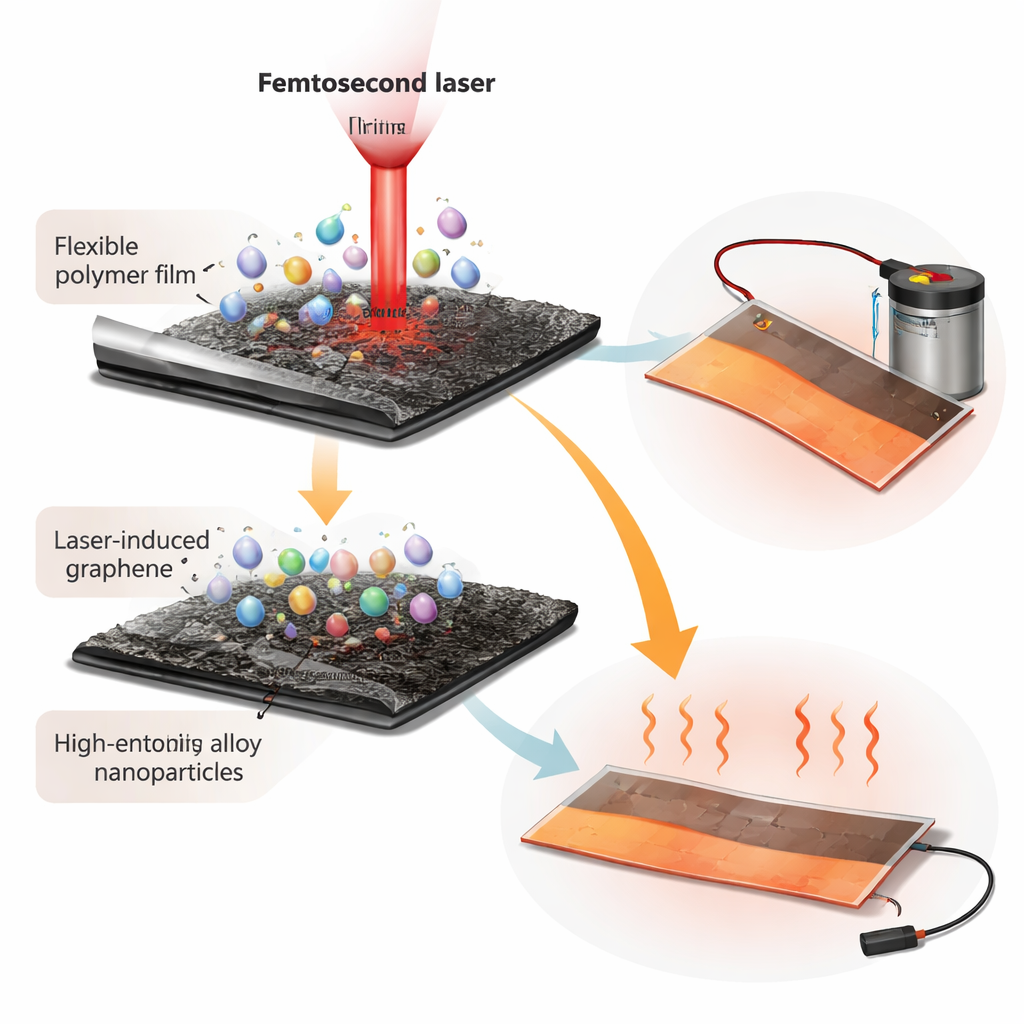
Laser Flashes that Forge Nanoparticles in an Instant
To create the heater material, the team first coats the graphene with a thin layer of metal salt solution. They then fire femtosecond laser pulses—bursts of light lasting only a few quadrillionths of a second—onto the surface. These pulses heat the surface to more than 3,000 kelvin and cool it again within billionths of a second. Under such extreme but fleeting conditions, the metal salts decompose and the metal atoms rapidly mix and freeze into uniform high-entropy alloy nanoparticles, while the plastic underneath remains intact. Computer simulations and electron microscopy show that the resulting particles are mostly between 5 and 30 nanometers in size, evenly scattered and anchored in the graphene surface, some wrapped in a thin protective graphene shell.
How the New Film Conducts and Radiates Heat
The combination of graphene and alloy nanoparticles significantly improves how well the film carries electricity and radiates infrared warmth. Measurements reveal that the sheet resistance—a measure of how easily current flows—drops compared with plain laser-induced graphene. Calculations suggest two main reasons: the metallic nanoparticles themselves provide extra pathways for electrons, and they also help strip oxygen-containing defects from the graphene, making it more conductive. At the same time, the rough, multiscale surface structures and a small amount of metal oxides give the film a very high infrared emissivity of about 0.98 across a wide range of wavelengths. In simple terms, when the film gets hot it is extremely good at glowing in the infrared, which is the form of radiation we feel as radiant heat.
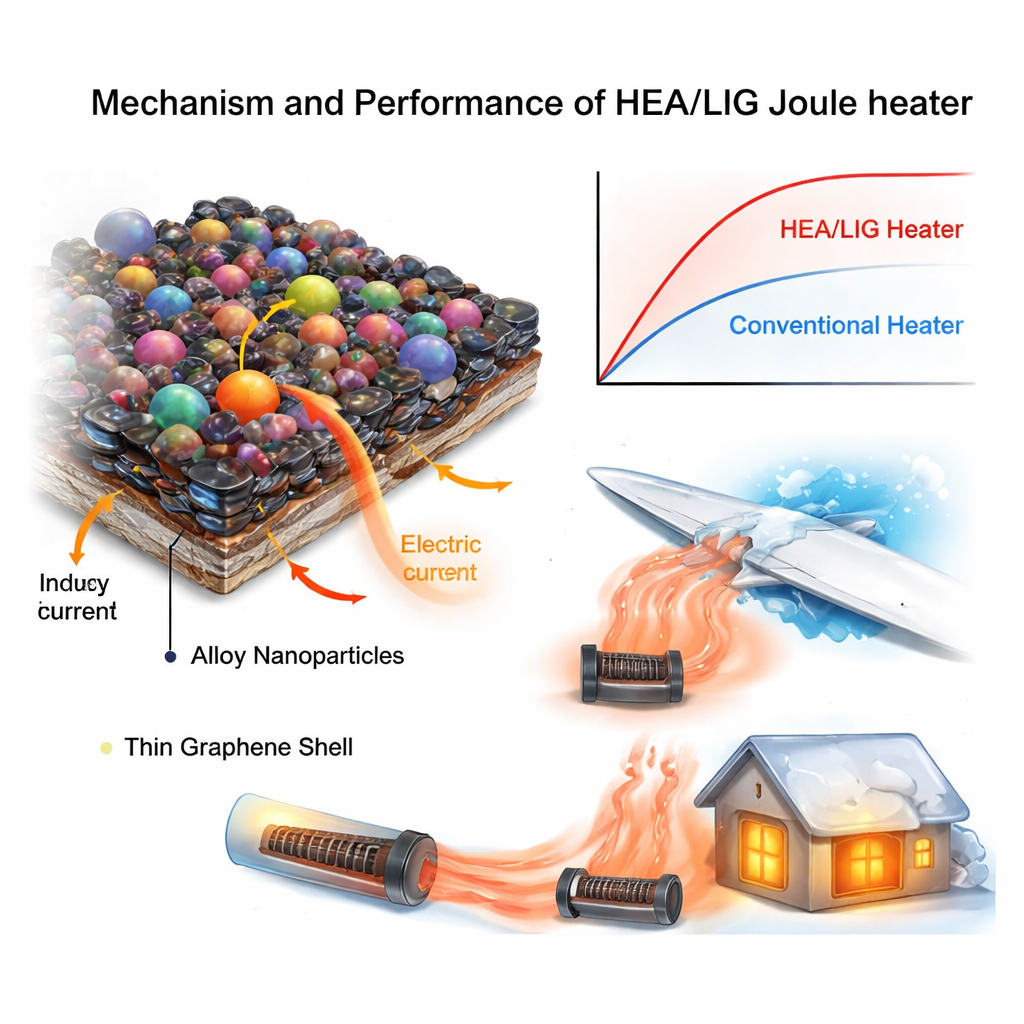
Thin, Fast, and Efficient Heating in Real Use
When a small voltage is applied, the composite film quickly heats up to more than 200 degrees Celsius while staying uniform across its surface and maintaining performance over repeated bending and on–off cycles. Comparing heaters with the same footprint and power supply, the new material reaches higher temperatures more quickly than a commercial electric heater. In tests, it melted ice within minutes, warmed a cold object at a distance more effectively than a standard heater, and maintained a comfortable temperature inside a model house at sub-freezing outdoor conditions while using roughly half the electrical power. The researchers also mapped how much winter heating energy could be saved by such devices in different cities, finding substantial potential savings, especially in colder regions.
What This Means for Everyday Heating
For non-specialists, the key message is that the authors have invented a flexible, paper-thin electric heater that turns electrical energy into comfortable radiant warmth with exceptional efficiency. By using ultrafast laser flashes to build a finely mixed metal–graphene coating, they achieve a material that is both highly conductive and an excellent thermal radiator. Deployed in real products—such as de-icing systems, wearable warmers, or room heaters—this approach could help keep people warm while using much less electricity, supporting more sustainable and targeted heating in a warming but still winter-cold world.
Citation: Wang, L., Yin, K., Xiao, J. et al. Femtosecond laser synthesis of multiscale high-entropy alloys/graphene composites for high-performance Joule heating. Nat Commun 17, 2121 (2026). https://doi.org/10.1038/s41467-026-70162-3
Keywords: Joule heating, high-entropy alloys, graphene heaters, infrared emissivity, energy-efficient heating