Clear Sky Science · en
Bipartite entanglement in a nuclear spin register mediated by a quasi-free electron spin
Why tiny spins in diamond matter
Future quantum computers and quantum networks will need reliable “memory bits” that can store fragile quantum information while light particles carry that information between distant devices. This study shows how to build and control such a tiny memory inside a diamond crystal, made from a handful of nuclear spins (the tiny magnets in atomic nuclei) that are steered by a single electron. The work demonstrates that this miniature memory can be entangled—its parts linked in a strongly quantum way—using an approach that works under relatively simple laboratory conditions and could be adapted to many kinds of solid-state quantum devices.
A tiny quantum hub inside a diamond
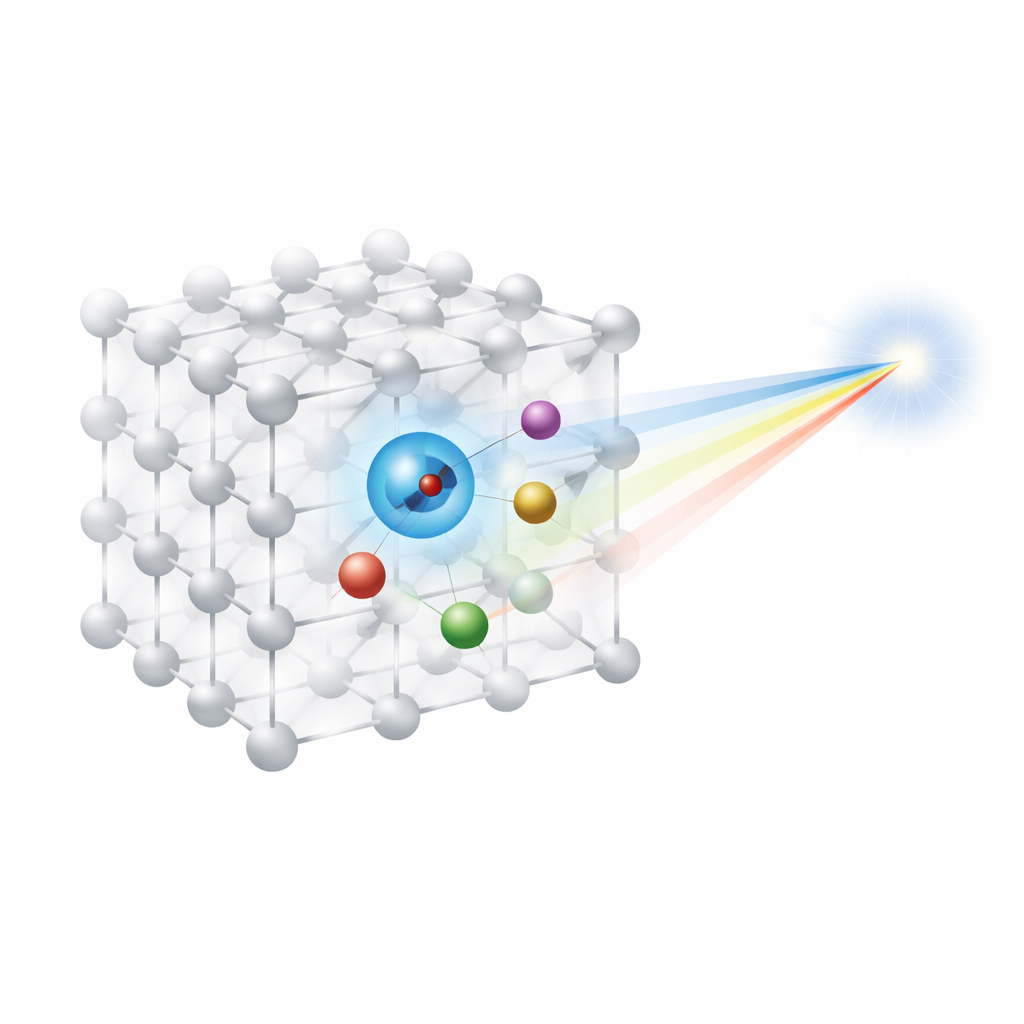
The researchers work with a special defect in diamond called a silicon-vacancy center. At this site, a silicon atom and two empty spots in the carbon lattice trap an extra electron. Because the nanodiamond is under very high mechanical strain, the electron’s motion and its internal magnetism become almost independent, so the electron behaves like a nearly free spin. This “quasi-free” electron spin is easy to control with microwaves and can be connected to light, which makes it an excellent communication qubit—the element that talks to the outside world—while nearby carbon nuclei act as long-lived memory qubits.
Building a small quantum memory from nuclear spins
Surrounding the defect, some carbon atoms are of the rarer type 13C, whose nuclei have a magnetic moment and can store quantum information. The team identifies three strongly coupled nuclear spins that form a fully connected three-qubit register, plus a fourth, more weakly linked spin. They first map out how these nuclei interact with the electron by applying carefully timed microwave pulse sequences and watching how the electron’s coherence decays or revives. Then, by combining continuous protection of the electron against noise with low-power microwave and radio-frequency pulses, they can address each nucleus directly, flip its state, and measure it, turning the cluster into a controllable set of quantum bits.
Keeping quantum information alive
A major challenge in solid-state quantum systems is noise from the environment, which quickly destroys delicate quantum states. Here, the strong strain makes the electron less sensitive to vibrations in the lattice, dramatically increasing its lifetime to hundreds of milliseconds—about a thousand times better than in a related, less-strained device. The team uses methods known as dynamical decoupling and continuous driving to further shelter the electron from fluctuating magnetic fields. At the same time, the nuclear spins themselves exhibit coherence times of several milliseconds and can interact with one another extremely weakly but measurably, with coupling strengths of only a few cycles per second. This combination of a robust “talkative” electron and very stable nuclei is ideal for building a small quantum memory that can be contacted optically.
Linking nuclear spins without wearing out the electron
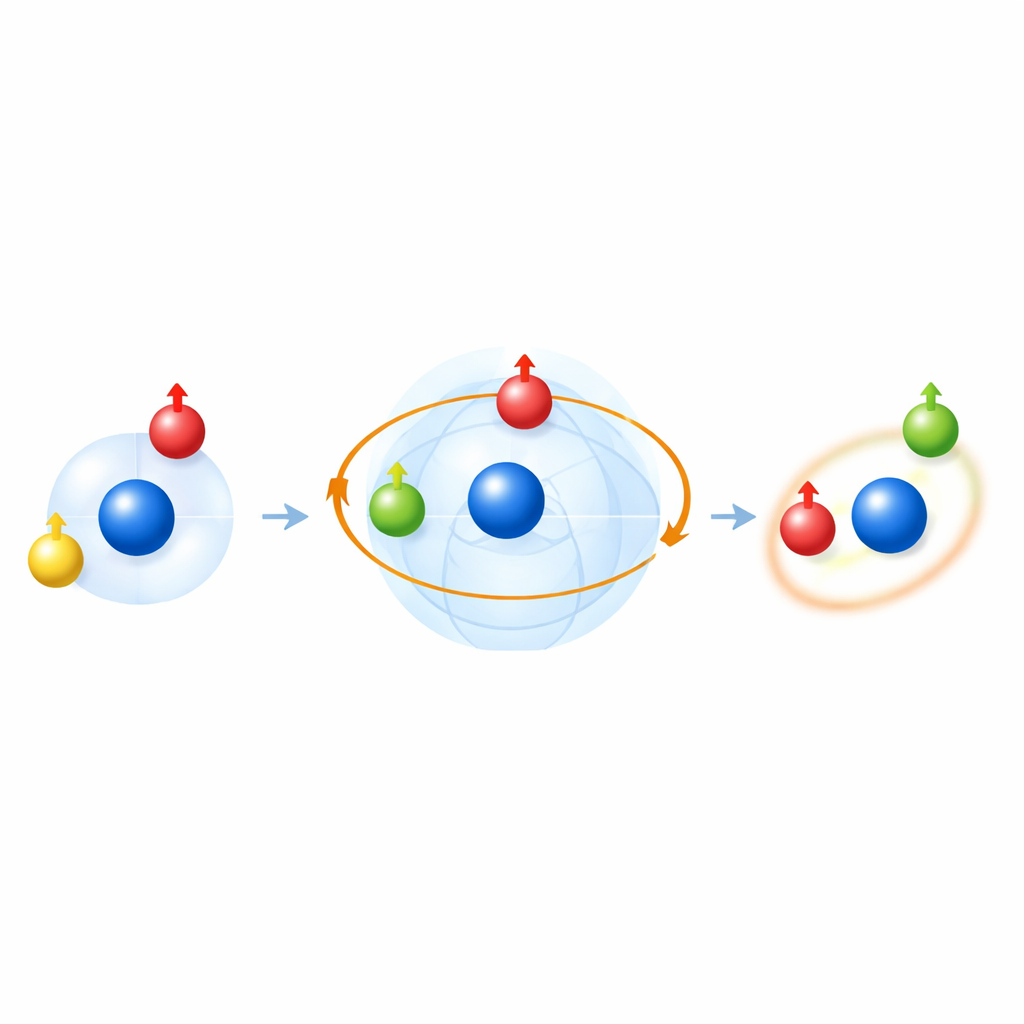
To turn the three-qubit register into a useful quantum resource, at least two of the nuclear spins must be entangled. Standard schemes keep the electron in a delicate superposition while it mediates entanglement, making them vulnerable to electron decoherence and to unwanted couplings. Instead, the authors exploit a geometric trick: when the electron is driven around a full loop in its state space, it accumulates a phase shift that depends only on the path of the loop, not on the timing details. By tuning the drive so that this loop happens only when the nuclei are in a particular joint configuration, they implement a conditional phase gate on the nuclear spins while the electron ends up back in its original state. Combined with simple rotations, this produces a Bell state—an entangled pair—between two nuclei, with a fidelity close to the limit set by technical imperfections in the microwave pulses and readout.
What this means for future quantum networks
The study shows that a spin-1/2 electron defect, long considered less convenient than some alternatives, can in fact host a high-quality multi-qubit nuclear register and mediate entanglement through a robust geometric effect. Because the method relies mainly on the long-lived nuclear spins rather than on keeping the electron perfectly quiet, it can be transferred to other solid-state platforms that couple light to spins. With further improvements in control pulses, photon collection, and device integration, such diamond-based registers could provide the error-corrected quantum memories at the heart of long-distance quantum communication and networked quantum computing.
Citation: Klotz, M., Tangemann, A., Opferkuch, D. et al. Bipartite entanglement in a nuclear spin register mediated by a quasi-free electron spin. Nat Commun 17, 2325 (2026). https://doi.org/10.1038/s41467-026-70154-3
Keywords: quantum networks, spin qubits, diamond color centers, nuclear spin entanglement, quantum memory