Clear Sky Science · en
Stretch-induced reversible self-growth of high aspect ratio microstructures scribed by femtosecond laser
Surfaces That Shape-Shift on Demand
Imagine a sheet of soft rubber that can sprout tiny, orderly spikes in seconds, then flatten back to a smooth surface as if nothing happened. This study introduces exactly that kind of shape-shifting material. It offers a fast, reversible way to make microscopic bumps and pillars that could improve touch-based reading for blind users, hide secret messages, or create smart coatings that change their texture on command.
Learning from Nature’s Moving Skins
In nature, animals use changing skin textures for gripping, clinging, or blending into their surroundings. Scientists have long tried to copy these tricks, but existing methods often rely on slow chemical reactions, toxic ingredients, or one-time-only shape changes. Earlier "self-growing" plastic structures typically rose only a little from the surface and could not be tuned quickly or reversibly. The new approach, called stretch-induced polymer self-growth (SIPS), tackles these limits by replacing slow chemistry with simple mechanics: stretching, cutting, and releasing soft rubbery sheets.
How to Grow and Erase Microscopic Pillars
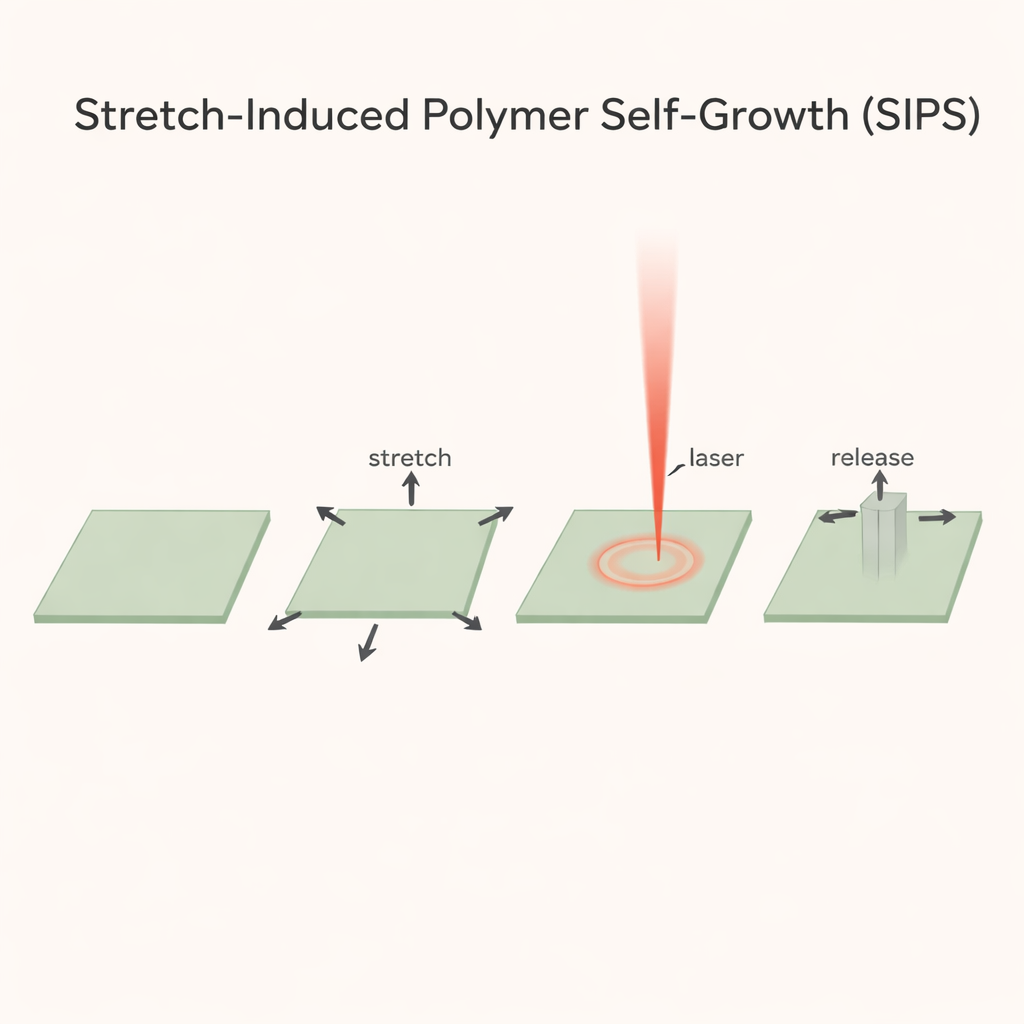
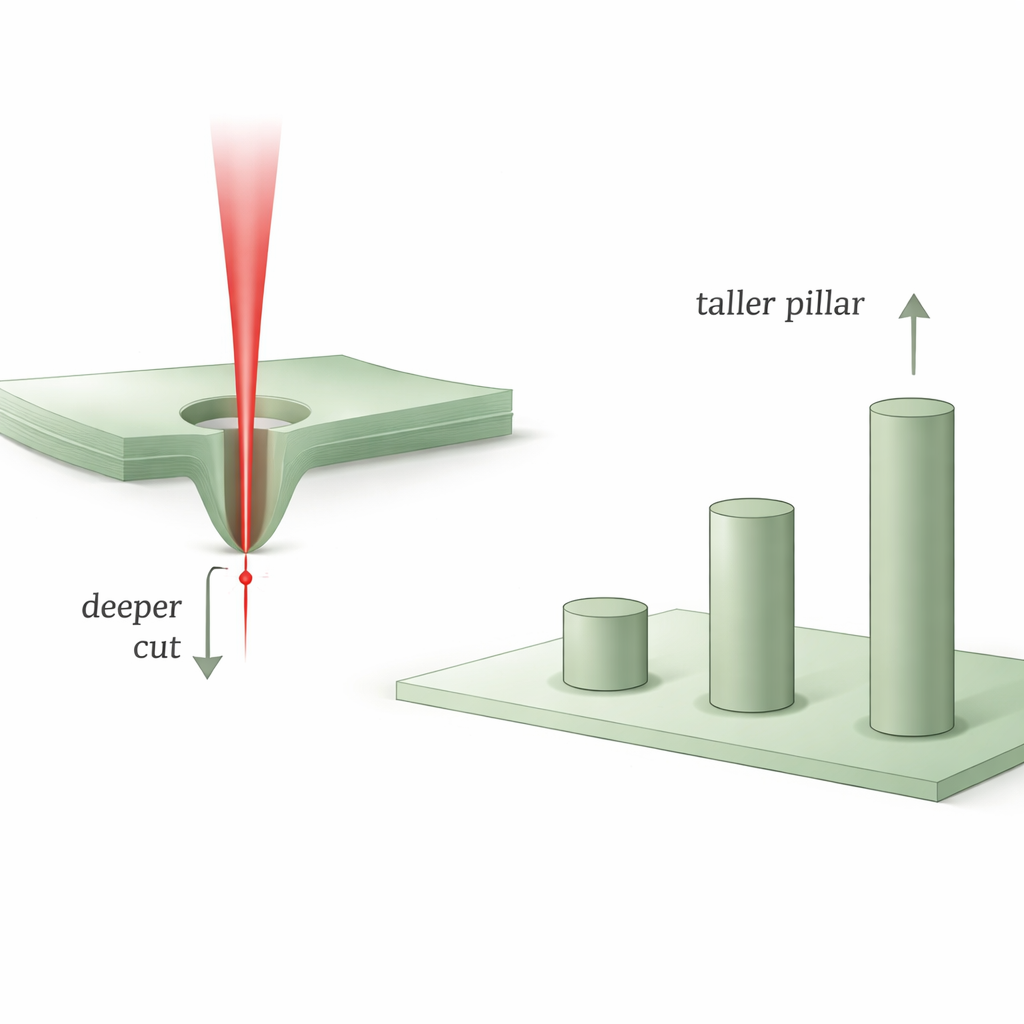
The core idea is straightforward. A thin elastic membrane—such as silicone, polyurethane, or hydrogel—is first pulled tight, like a drumhead, in two directions. While it is stretched, an ultrafast femtosecond laser traces tiny closed shapes (for example, circles or squares) on its surface, cutting partway through the material. These cuts let the stressed material around them relax and pull inward, pushing a small region up into a three-dimensional pillar. As the laser cuts deeper along the same path, more material shrinks toward the center and the pillar grows taller, reaching heights similar to or larger than its width. Computer simulations show that this growth is mainly controlled by two knobs: how much the sheet is stretched, and how deep the laser cuts.
Reversible Shape Control and Bending Pillars
A key feature of SIPS is reversibility. When the tension on the membrane is released, the surrounding material relaxes and thickens again, so the pillar sinks back down and the surface becomes almost flat. Stretching the sheet once more makes the same pillar reappear in seconds. Arrays of these pillars keep their spacing and general shape over many stretch–release cycles, showing that the process is mechanically stable rather than a one-time deformation. By cutting more on one side than the other, the team can also make pillars that lean in a chosen direction instead of standing straight. This bending is caused by uneven stress release on either side of the pillar and can be finely tuned by adjusting how strongly and where the laser scribes.
From Microscopic Claws to Adjustable Braille
Because the pillars are tall and slender, they are especially good at interacting with small objects and with human touch. The researchers built claw-like structures from several inward-bending pillars that can grab and release glass microspheres on demand simply by stretching or relaxing the sheet. They also created Braille characters from pillar arrays. By changing how much the membrane is stretched, both the gap between dots and their height can be adjusted continuously—making the pattern easier or harder to feel. In tests with schoolchildren learning Braille, each learner had a different stretch level at which they could reliably recognize the characters, suggesting this platform could adapt training to a person’s sensitivity and skill. In another demonstration, the directions in which bent pillars pointed were used to encode a phrase like a tactile Morse code: when stretched, the "message" was readable by eye or touch; when released, the pillars vanished into the surface, leaving only faint laser traces.
Why This Matters for Future Smart Surfaces
Overall, this work shows that simply stretching, laser-scribing, and releasing common soft materials can produce precise, high-aspect-ratio microstructures that grow and disappear on command. Unlike chemical growth methods, SIPS is fast, uses widely available elastomers, and avoids complex recipes. Because the technique works with many materials and can in principle be combined with added particles for extra optical, electrical, or magnetic functions, it offers a powerful new route toward adaptive surfaces, tactile displays, and other soft microdevices that physically reconfigure themselves in response to how they are stretched.
Citation: Zhang, Y., Zhang, N., Wu, D. et al. Stretch-induced reversible self-growth of high aspect ratio microstructures scribed by femtosecond laser. Nat Commun 17, 2124 (2026). https://doi.org/10.1038/s41467-026-70098-8
Keywords: smart surfaces, microstructures, tactile display, elastic polymers, laser processing