Clear Sky Science · en
Strong nickel enrichment co-located with redox-organic interactions in Neretva Vallis, Mars
Ancient Clues in a Martian Riverbed
When we send rovers to Mars, we are really asking whether the Red Planet could ever have supported life. This study zooms in on an old river channel called Neretva Vallis, where NASA’s Perseverance rover has found unusually high amounts of the metal nickel locked inside lakebed rocks. Because nickel plays a vital role in some of Earth’s earliest-known microbes, its discovery alongside sulfur-rich minerals and organic material turns this quiet Martian valley into a prime site for probing Mars’s biological potential.
A River That Fed a Long-Gone Lake
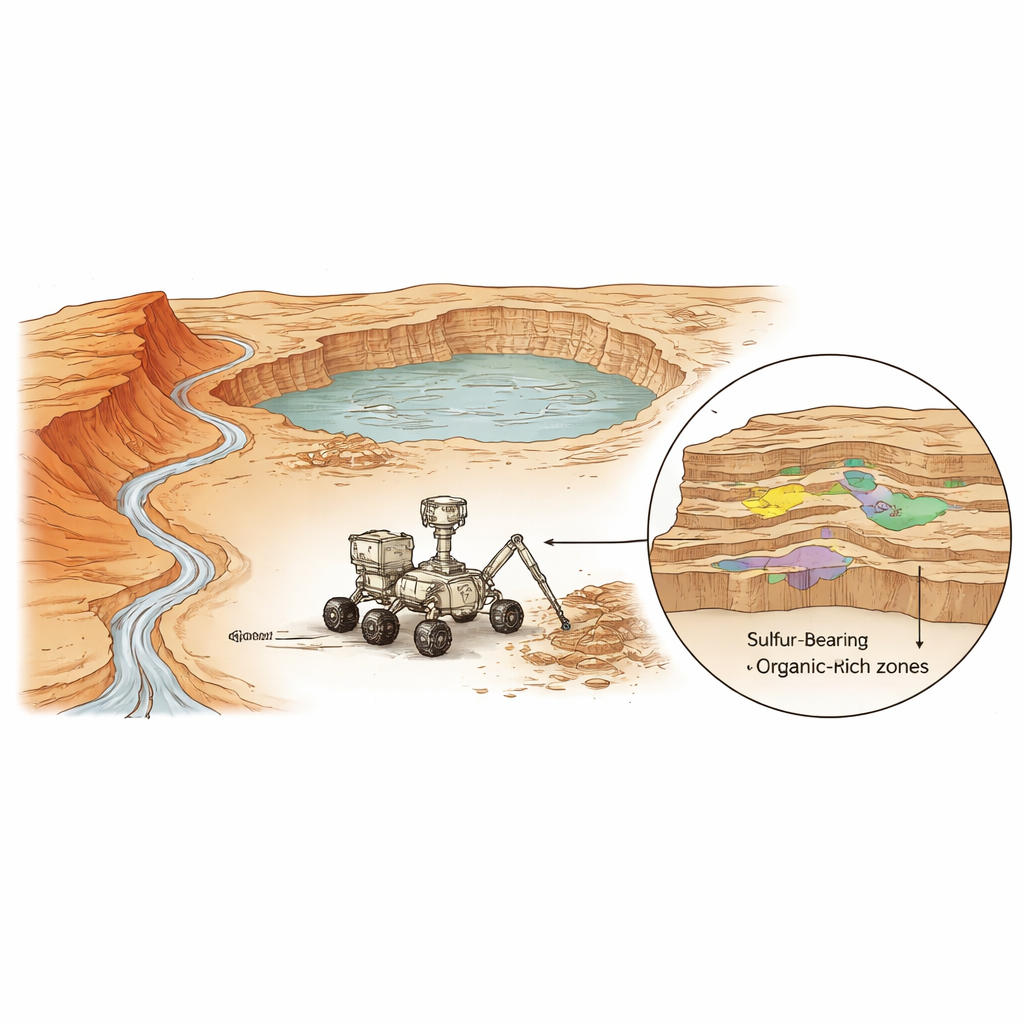
Neretva Vallis once carried water into Jezero crater, which billions of years ago hosted a lake. Along the valley, Perseverance examined light-toned rocks of a unit called the Bright Angel formation and nearby outcrops dubbed Masonic Temple. These rocks are fine-grained mudstones and conglomerates laid down in calm, likely lake-like waters, later overprinted by veins and nodules formed as minerals grew and altered inside the buried sediments. Chemically, they are very different from other rocks in Jezero: they are poor in magnesium but relatively rich in silicon, aluminum, and iron, hinting at a unique origin or an intense history of chemical weathering before they were deposited.
Finding Record-Breaking Nickel on Mars
The rover’s SuperCam instrument uses a laser to vaporize tiny spots on rocks and read the resulting glow to determine their chemistry. In 32 targets along Neretva Vallis, SuperCam detected nickel at levels up to about 1.1 weight percent—by far the highest nickel content ever measured in intact Martian bedrock. These nickel-rich spots cluster in two work areas called Beaver Falls and Wallace Butte. At Beaver Falls, elevated nickel occurs both in the main mudstone and in bright mineral veins that cut across the rock. At Wallace Butte, nickel is abundant in mudstones and in darker, iron-rich rocks that jut above the surface. Overall, the more iron a spot contains, the more nickel it tends to hold, suggesting that nickel is mostly hiding inside iron-bearing minerals.
Peering Inside the Rock with X-Ray Vision
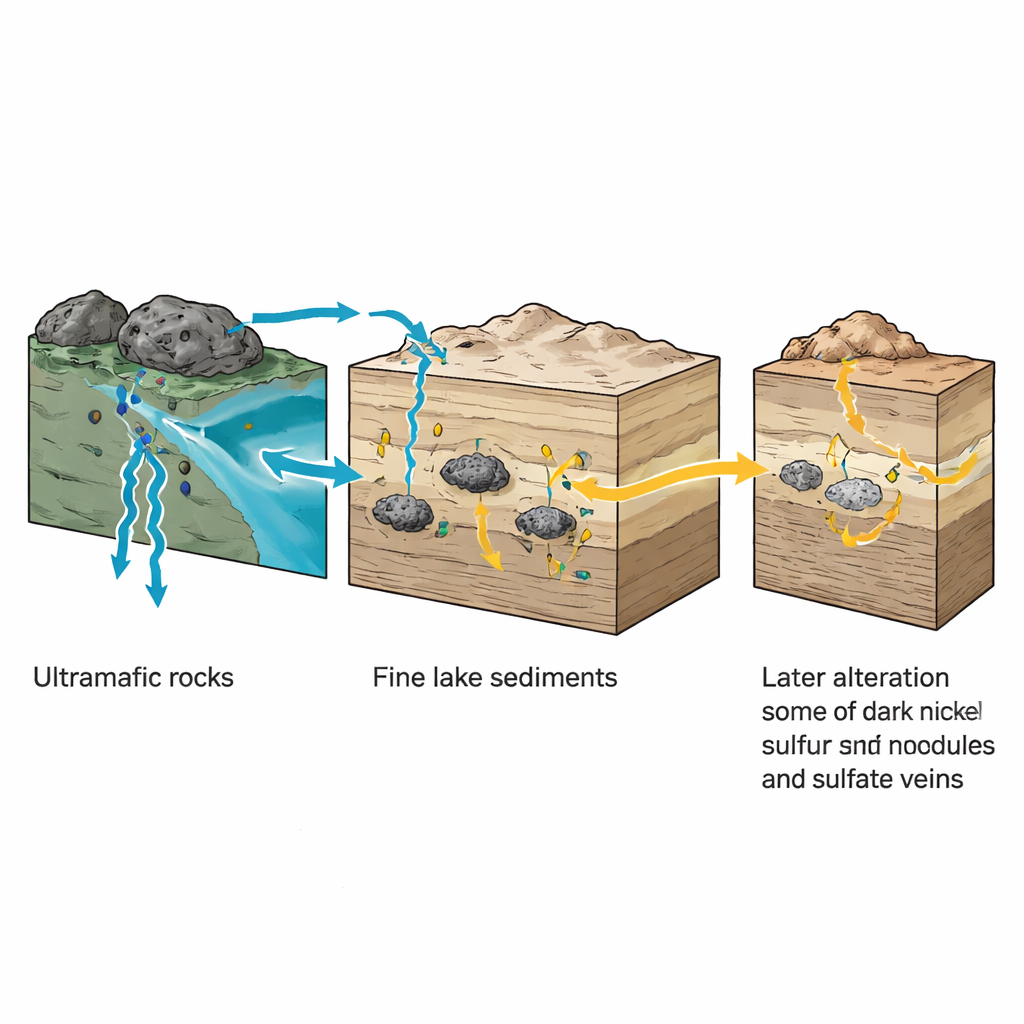
To see exactly where nickel sits at the grain-by-grain level, scientists turned to another rover instrument, PIXL, which builds detailed maps of elements using X-rays. In Bright Angel mudstones, PIXL shows nickel concentrated in tiny, dark domains rich in iron and sulfur—minerals similar to pyrite, also known as fool’s gold, and related sulfides. Lower in the sequence, nickel also appears along the edges of grains of the mineral olivine, while farther south it shows up in bright, magnesium-rich sulfate veins and nodules. Nearby, resistant rocks with chemistry matching weathered iron minerals such as jarosite and akaganeite also carry nickel. Together, these observations point to nickel first being locked into iron sulfides and later partly redistributed into sulfate minerals as fluids moved through the rocks over time.
Tracing Nickel’s Mysterious Journey
Where did all this nickel come from? On rocky planets, most nickel sinks into the core, leaving the crust relatively poor in this element. The extreme enrichments in Neretva Vallis are unusual and require a special explanation. One possibility is that ancient, magnesium-rich volcanic rocks in the region released nickel during intense weathering, and that nickel-bearing fluids then seeped into the lake sediments. Another is that debris from a metal-rich meteorite dissolved in the water, feeding nickel into the mud as iron sulfides formed. Distinguishing between these sources demands precise measurements of trace metals and isotopes that only laboratory instruments on Earth can provide—one reason the team is eager to eventually analyze the cored sample that Perseverance collected from this area.
Why Nickel Matters for Life
On Earth, iron sulfide minerals in fine-grained sediments commonly form with help from microbes that use sulfate as an energy source, and they often trap nickel from the surrounding water in the process. Nickel itself is a key ingredient in enzymes used by methane-producing microbes and in one of the oldest known carbon-fixing pathways. The co-location of strong nickel enrichments, sulfur-bearing minerals, and organic matter in Neretva Vallis therefore hints at a chemically reactive environment where life’s building blocks—and perhaps even simple metabolisms—could have been supported. The study does not claim evidence of life, but it shows that early Mars hosted complex redox chemistry in a setting rich in a scarce, biologically important metal. Bringing these samples back to Earth for high-precision analysis could reveal whether Mars’s ancient river-lake systems ever crossed the threshold from prebiotic chemistry to biology.
Citation: Manelski, H.T., Wiens, R.C., Broz, A. et al. Strong nickel enrichment co-located with redox-organic interactions in Neretva Vallis, Mars. Nat Commun 17, 2705 (2026). https://doi.org/10.1038/s41467-026-70081-3
Keywords: Mars habitability, Perseverance rover, nickel-rich rocks, Jezero crater, Martian river sediments