Clear Sky Science · en
Future scenarios for British biodiversity under climate and land-use change
Why the future of Britain’s wildlife matters
Across Britain, people cherish familiar wildflowers, butterflies, and birds as symbols of place and season. This study asks a simple but urgent question: what will happen to this living tapestry as the climate warms and the countryside changes? Using detailed monitoring data and realistic future scenarios, the researchers explore how British nature could be transformed by 2080—and how today’s choices on emissions and land use may decide which species and landscapes our grandchildren inherit.
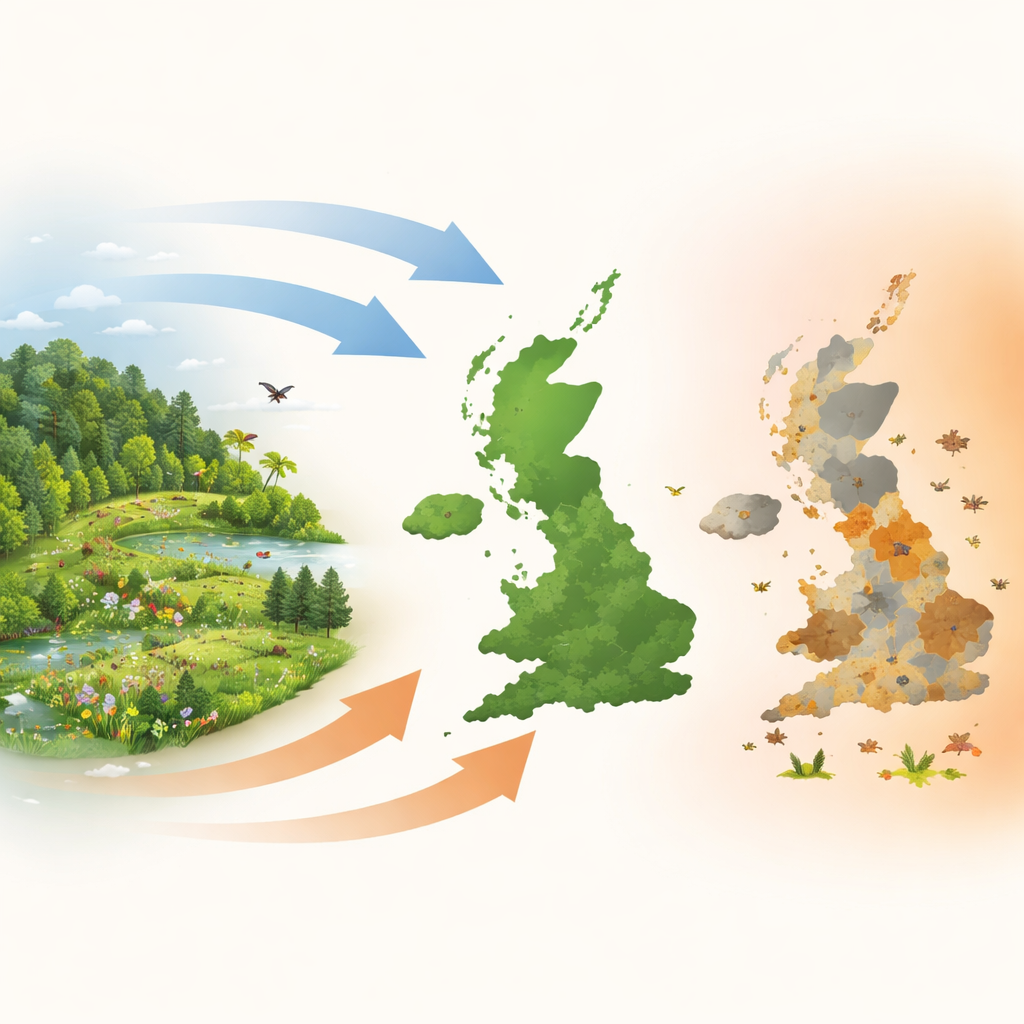
Peering into tomorrow’s countryside
The team combined decades of survey data for more than 1000 wild plants, almost all British butterflies, and nearly all breeding birds with high‑resolution maps of climate, soils, and terrain across Great Britain. Instead of modelling each species alone, they focused on whole communities—asking how the mix of species at one place differs from another, and how those mixes respond to changing conditions. They then projected these community patterns forward under a range of climate pathways (from strong emissions cuts to fossil‑fuel heavy futures) and alternative storylines for how society might use land, from more sustainable farming to intensive agriculture and rapid urban growth.
Familiar communities give way to new mixtures
Even under relatively mild warming, the model suggests widespread reshuffling of species. By the 2070s, plant communities in a typical British square kilometre could share only about half of their current species if emissions follow a high‑end pathway. Butterflies and birds change less dramatically but still noticeably. Many current combinations of climate and species—the “bioclimates” that underpin today’s habitats—are projected to disappear from large areas, especially under strong warming. At the same time, new bioclimates appear that have no present‑day equivalent, particularly for plants across lowland Britain and for birds and butterflies in parts of Scotland and upland national parks. These novel conditions will likely favour some species while disadvantaging others, rewriting food webs and local character.
Winners, losers, and extinction debts
To move from community reshuffling to long‑term survival, the authors also considered how both climate and land use alter the amount and quality of habitat. They used a well‑established relationship between habitat area and species persistence to estimate how many native species are effectively “heading for extinction” in Britain, even if they have not vanished yet—a hidden loss known as extinction debt. Britain already carries such a debt from past changes. Looking ahead, a world of strong climate action and more sustainable land use reduces, but does not erase, future losses. In that best‑case scenario, about 13% of the plant species studied are still on course to disappear nationally, compared with around 20% under a high‑emissions, highly intensive farming and urbanisation future. For butterflies and birds the absolute numbers are smaller, but the proportions are still worrying, and the gap between better and worse futures widens towards the end of the century.
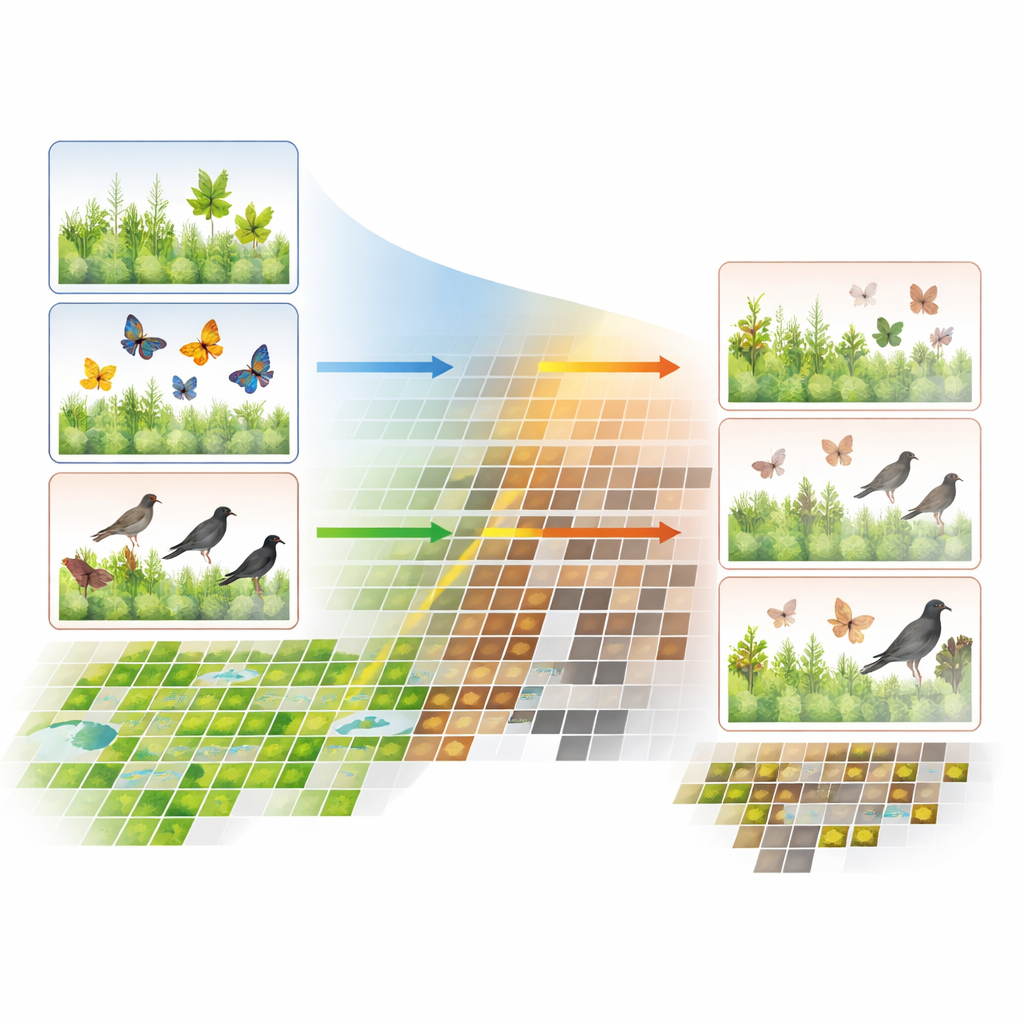
How society’s choices shape nature’s fate
The scenarios reveal that plants are generally more sensitive to environmental change than butterflies or birds, and that different drivers matter for different groups. For plants, the level of greenhouse gas emissions makes a large difference to extinction risk. For butterflies and birds, how society manages land—how much is farmed intensively, how much is wooded, how fragmented habitats become—can be as important as the amount of warming itself. Futures that cut meat and dairy demand, expand mixed woodlands, and avoid extreme intensification tend to slow or partially reverse losses, even if the climate still warms substantially. Conversely, a fossil‑fuelled, consumption‑heavy pathway amplifies both climate and land‑use pressures, creating the worst outcomes across all three groups.
What this means for Britain’s wildlife and people
For non‑specialists, the message is stark but not hopeless: British nature is already committed to substantial change, and many familiar species and communities are at risk over the coming decades. Yet the study also shows that the scale of loss is not fixed. Stronger global action on emissions, combined with smarter national decisions about farming, forestry, and urban growth, could markedly reduce the number of species pushed beyond recovery and soften the shock of disappearing and novel habitats. Because the biggest differences between futures emerge after mid‑century, decisions taken in the next 20 years are critical. In effect, society can choose whether Britain’s future countryside is one of severe biodiversity erosion, or a still‑rich but transformed landscape where more species and the benefits they provide to people are retained.
Citation: Cooke, R., Burton, V.J., Brown, C. et al. Future scenarios for British biodiversity under climate and land-use change. Nat Commun 17, 2704 (2026). https://doi.org/10.1038/s41467-026-70064-4
Keywords: biodiversity futures, climate change, land use change, British wildlife, species extinction