Clear Sky Science · en
Topological metal-insulator transition within the ferromagnetic state
Why this switchable crystal matters
Modern electronics and future quantum technologies both rely on being able to turn electric currents on and off in a controlled way. This study looks at a crystal called K2Cr8O16 that can switch from conducting electricity like a metal to blocking it like an insulator, all while keeping its internal magnetization. The authors show that this switch is not just a simple change in electrical behavior, but also a change in the hidden “shape” of the electrons’ motion, known as band topology. Understanding and controlling such switches could help design new devices that use both magnetism and quantum topology for robust information processing.
A rare magnetic on–off switch
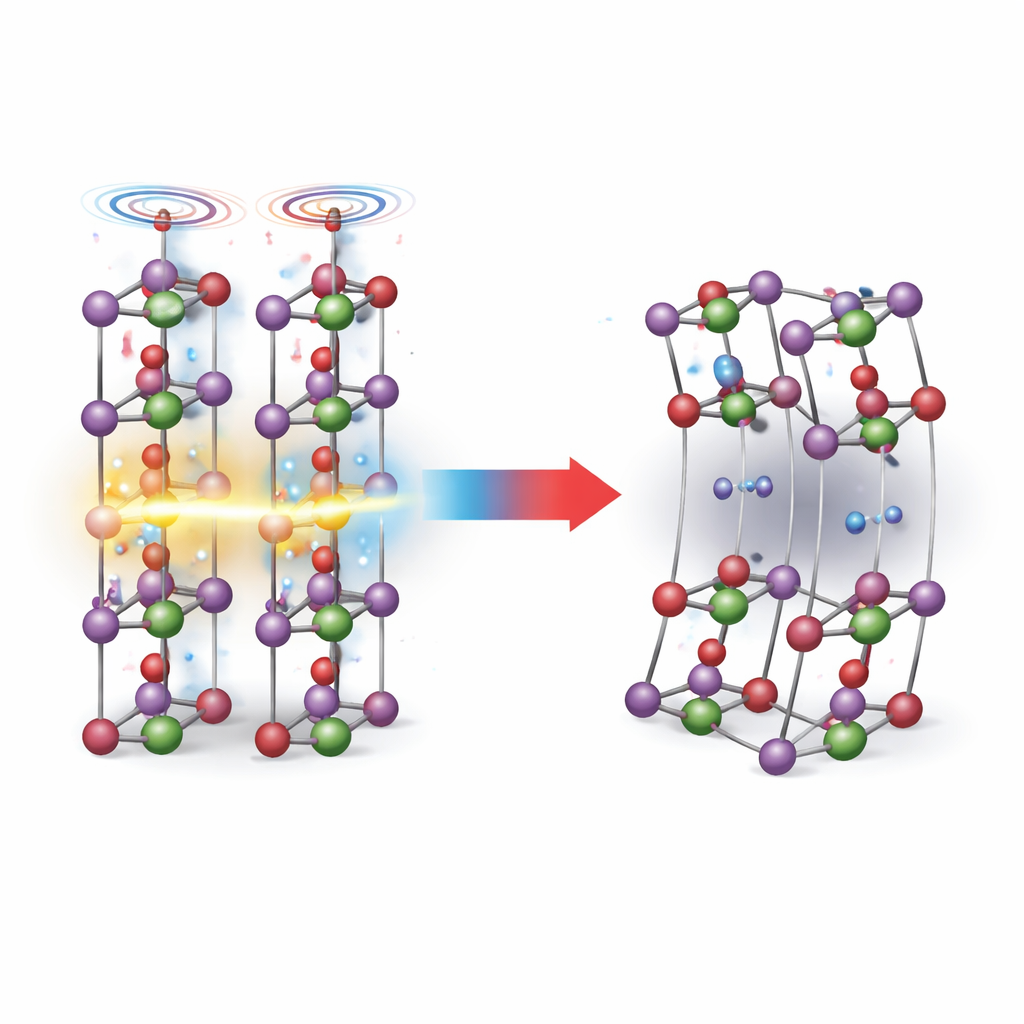
Most materials that flip between metal and insulator do so in states without a net magnetic moment. K2Cr8O16 is unusual because it remains ferromagnetic on both sides of the transition: its atomic magnets stay lined up even as its ability to conduct electricity changes. Earlier work proposed that this change was driven by a classic one-dimensional Peierls mechanism, where a chain of atoms distorts in step with the electrons and certain vibrations of the lattice “soften” as the material cools. At the same time, more recent calculations hinted that in its metallic state this compound might host Weyl fermions—exotic crossing points in its electronic bands associated with topological behavior. The new work asks whether the metal–insulator transition is really just a simple lattice effect, or whether these topological features and strong electron–electron interactions are central to the story.
Probing spins and vibrations
To disentangle these possibilities, the team combined several powerful scattering techniques with advanced calculations. Neutron diffraction established how the magnetic moments are arranged and how this order evolves with temperature. The results show that the crystal stays ferromagnetic through the transition: the spins remain aligned and the key magnetic interaction strengths barely change when the material becomes insulating. Inelastic neutron scattering further mapped out the spin-wave excitations, revealing that the main exchange interactions are consistent with a superexchange mechanism, where electrons virtually hop between chromium ions through oxygen, rather than the double-exchange process expected for a simple Peierls picture. This already suggests that electron correlations, not just lattice distortions, play a major role.
Ruling out the simple lattice scenario
Next, the authors turned to inelastic X-ray scattering to watch how the atomic lattice vibrates. In a textbook Peierls transition, a specific vibration at the wave pattern of the emerging superlattice would gradually lose energy and collapse as the material cools, signaling an instability that drives the structural change. Instead, the measured phonon mode near the relevant wavevector in K2Cr8O16 shows almost no temperature dependence: its energy stays roughly the same above, at, and below the transition. Calculated phonon spectra agree with this picture and reveal only modest changes between the metallic and insulating structures. Together, these findings strongly argue against a phonon-driven Peierls mechanism as the cause of the metal–insulator switch.
Topology reshaped by structure and correlations
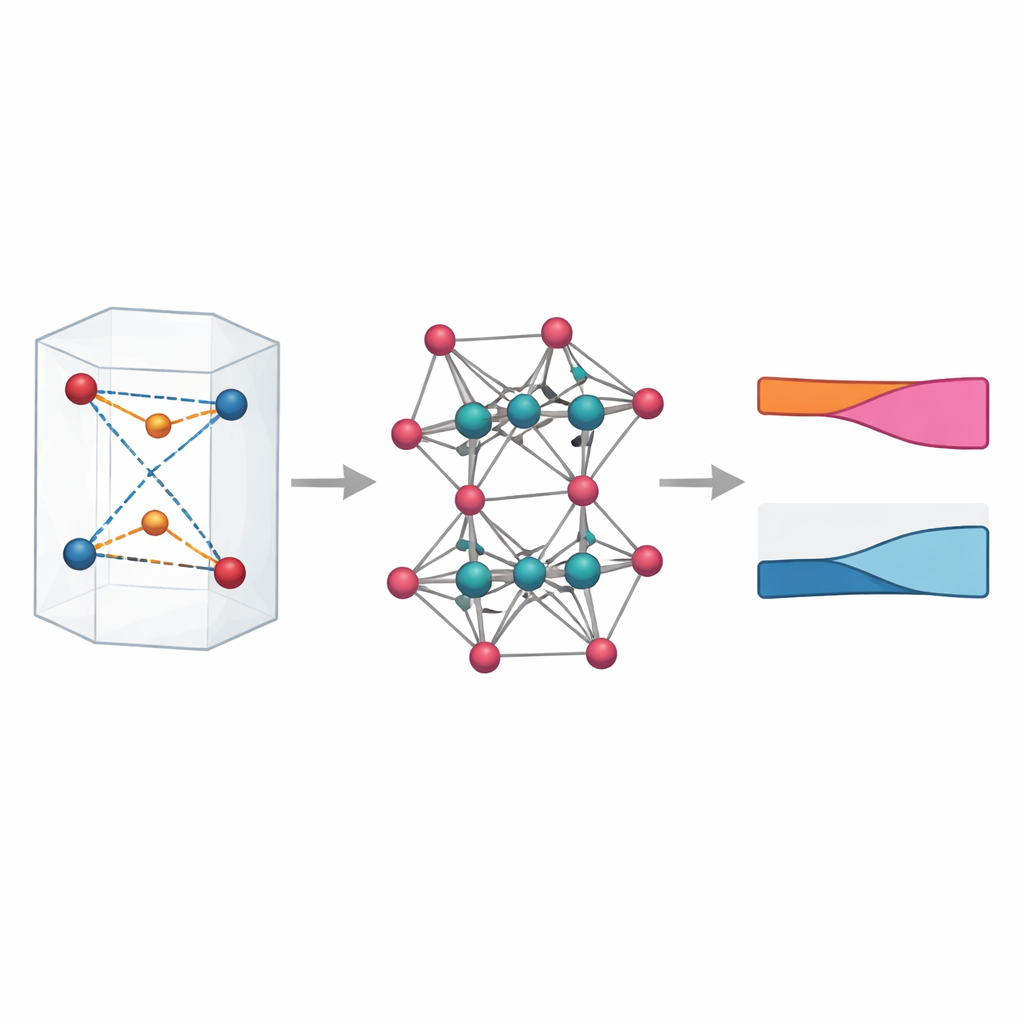
Armed with detailed structural and magnetic information, the researchers performed first-principles electronic-structure calculations. In the higher-temperature metallic phase, they find pairs of Weyl points—special band crossings carrying opposite “handedness”—sitting near certain planes in momentum space. These points are connected by nesting vectors that closely match the observed structural modulation, hinting that the lattice distortion can link Weyl points of opposite type and break their chiral symmetry. When the crystal cools and distorts into its lower-symmetry form, the electronic environment of the chromium ions changes, splitting orbital energies and reducing the symmetry of the bands. The calculations show that this removes the Weyl points and opens a gap, turning the system into a topologically trivial insulator while preserving ferromagnetism.
From exotic crossings to a quiet state
In plain terms, the study reveals that K2Cr8O16 switches from a magnetic metal hosting topological band crossings to a magnetic insulator with no such crossings, and that this happens without the usual lattice vibration “collapse” expected for a Peierls transition. Instead, a subtle interplay between crystal distortion and electron–electron repulsion reshapes the allowed quantum states of the electrons, erasing the Weyl points and opening an energy gap. This kind of topological metal–insulator transition within a ferromagnetic phase offers a new way to link magnetism, correlations, and topology in a single material platform, and points toward future devices where electric and magnetic behavior can be controlled together through such quantum-structural switches.
Citation: Forslund, O.K., Ong, C.S., Hirschmann, M.M. et al. Topological metal-insulator transition within the ferromagnetic state. Nat Commun 17, 2112 (2026). https://doi.org/10.1038/s41467-026-70042-w
Keywords: metal-insulator transition, ferromagnetism, topological materials, Weyl semimetal, electron correlations