Clear Sky Science · en
Photochemical nanomotors reverse anxiety- and depressive-related behaviors in rodents via spatiotemporal polarity dynamics tuning
Shining Light on a New Way to Lift Mood
Many people with anxiety and depression wait weeks for medicines to work, and some never get enough relief. This study explores a radically different idea: using tiny light-responsive machines, called nanomotors, to directly nudge brain cells back into a healthier state. Instead of relying on traditional drugs that act on chemical receptors, these nanomotors change the local electrical environment of neurons with pulses of near-infrared light, rapidly restoring brain activity and mood-related chemistry in mice.
How Brain Balance Goes Wrong in Low Mood
In conditions like major depression, brain cells often become less excitable. This is not only about low levels of serotonin or dopamine; it also involves subtle changes in how charged molecules and fats are arranged in and around nerve cell membranes. When this “polarity” balance is disturbed, ion channels open less often, electrical signals weaken, and communication between neurons falters. Existing antidepressants mostly try to boost chemical messengers in the gaps between neurons, but they do little to repair this basic physical imbalance in the brain’s microenvironment, which may help explain their slow and sometimes incomplete effects.
Tiny Light-Driven Machines Enter the Brain
The researchers designed a nanoscale machine called IC@His-ICG, built from a light-sensitive organic compound coordinated with zinc, wrapped with a stabilizing peptide and a near-infrared dye. When near-infrared light shines on these particles, they undergo a precise chemical change: part of the molecule breaks and twists, dramatically increasing its polarity. At the same time, this change lets the particles move directionally toward the light, even in salty, protein-rich fluids similar to those in the body. In other words, the nanomotors can be steered wirelessly by light toward specific brain regions, such as the hippocampus, a key area for mood and memory. 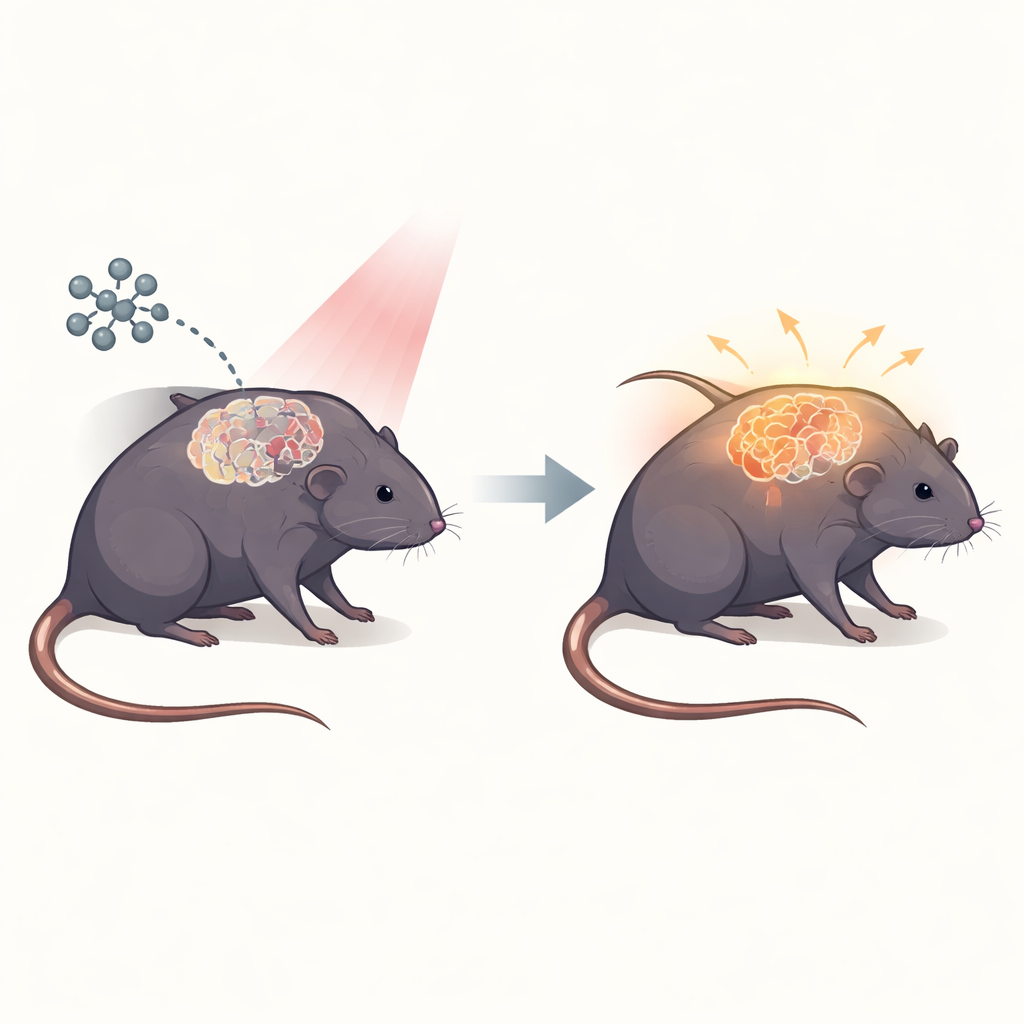
Turning Light Pulses into Neuron Activity
Once the nanomotors reach neurons, their light-triggered polarity shift alters local electrical forces at the cell membrane. In cultured mouse neurons, the team showed that illuminated nanomotors reliably opened calcium channels, allowing calcium ions to rush into the cells. This produced clear waves of calcium signals, a hallmark of neuronal activation, without relying on classic receptor binding or significant production of damaging reactive oxygen species. Gene and protein analyses confirmed that activity-related markers, especially the immediate-early gene c-Fos, were strongly elevated only when nanomotors and light were combined. Large-scale protein profiling further showed that pathways involved in synaptic signaling, calcium handling, and cell-to-cell communication were reshaped by this polarity-based stimulation. 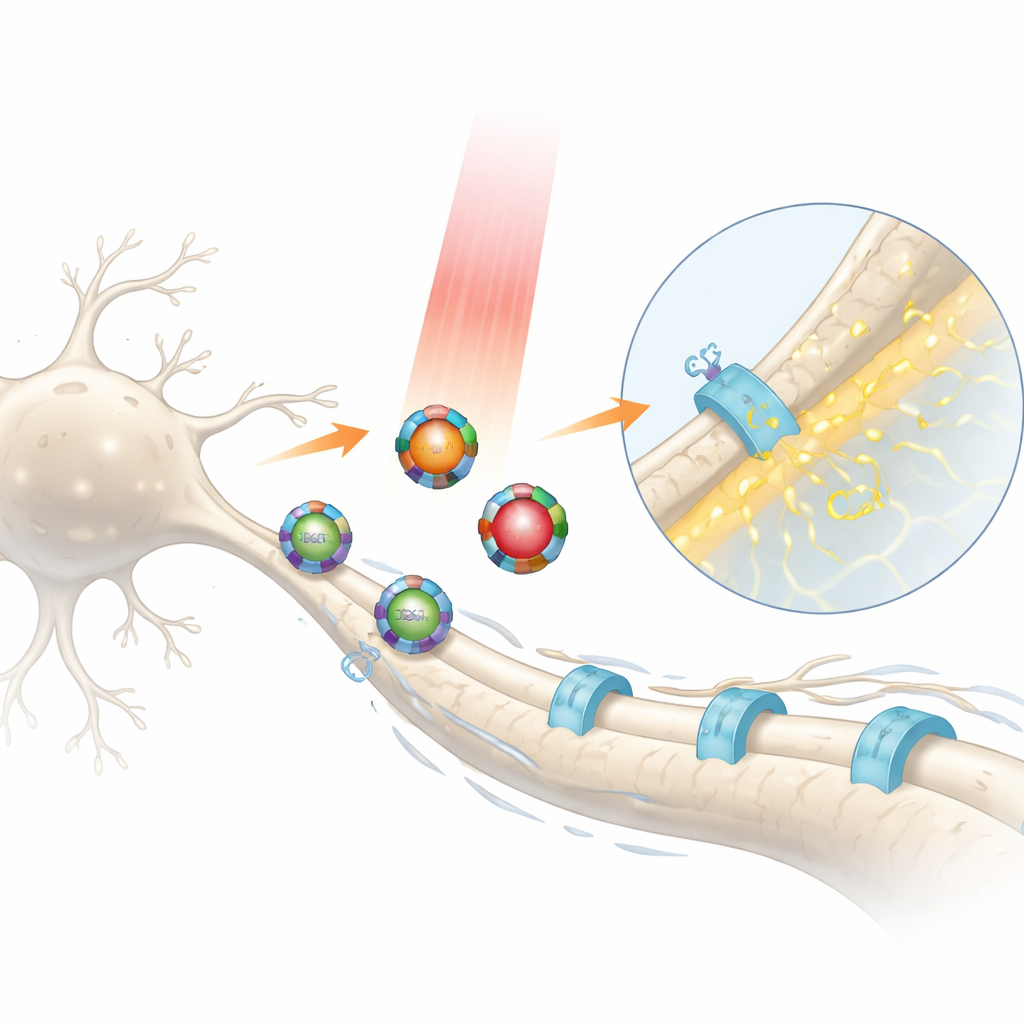
From Cell Signals to Better Behavior in Mice
The scientists then tested whether this physical nudging of neurons could change behavior in live animals. They implanted the nanomotors into the hippocampus of mice with hormone-induced chronic depression-like symptoms and illuminated the region with near-infrared light. Using fast in vivo imaging, they observed propagating calcium waves and strong c-Fos activation deep within the brain. Behaviorally, only the mice receiving both nanomotors and light showed robust improvements: they explored open spaces more, spent more time in less-protected arms of a maze, and struggled longer in standard tests that measure despair-like immobility. At the same time, brain levels of serotonin and dopamine rose toward normal, while stress hormone–related signals dropped, indicating that the polarity-based stimulation reset key mood-related chemical systems.
Safety and Future Possibilities
Because any new brain technology must be safe, the team monitored the nanomotors over time. The particles stayed localized in the brain long enough to act, then gradually cleared through the liver. Detailed tissue, blood, and organ tests revealed no major damage, inflammation, or blood cell disruption at the tested doses. Although the current work uses direct brain injections in mice, the authors suggest that, in the future, similar particles might be delivered through less invasive routes, such as the nose, and targeted to specific regions with carefully patterned light.
A New Direction for Treating Mood Disorders
Overall, this study introduces “polarity therapeutics” as a new way to influence the brain: instead of relying on drugs that fit into receptors, it uses finely tuned physical changes at the nanoscale to switch neurons on and rebalance mood-related chemistry. In mice, light-driven nanomotors rapidly restored brain activity and eased anxiety- and depression-like behaviors while avoiding implanted electrodes or genetic modification. If these concepts can be translated safely to humans, they could inspire future treatments that are faster, more precise, and less dependent on conventional antidepressant drugs.
Citation: Chen, B., Ding, M., Feng, Y. et al. Photochemical nanomotors reverse anxiety- and depressive-related behaviors in rodents via spatiotemporal polarity dynamics tuning. Nat Commun 17, 3237 (2026). https://doi.org/10.1038/s41467-026-70003-3
Keywords: nanomotors, neuromodulation, depression, near-infrared light, calcium signaling