Clear Sky Science · en
Single-photon advantage in quantum cryptography beyond QKD
Flipping a Fair Coin at a Distance
Imagine two people on opposite sides of the world needing to flip a coin to make a fair decision, but neither of them trusts the other. This situation comes up in online gambling, secure auctions, and many other digital interactions. Today’s internet tools cannot guarantee a fair outcome if one side has enough computing power or is willing to cheat. This paper shows how single particles of light – single photons – can be used to make long‑distance "coin flips" more secure than anything possible with classical technology.
Why Ordinary Cryptography Is Not Enough
Modern communication security largely relies on mathematical problems that are hard for current computers to solve. Quantum key distribution (QKD) already goes beyond this by using quantum physics to let two trusted parties share a secret key with security guaranteed by nature itself. But many real‑world applications involve people or companies who do not trust each other. For them, a more basic operation is needed: a digital coin flip whose outcome neither side can unfairly influence. Classical protocols for this task can always, in principle, be broken if someone has enough computational resources. Quantum coin flipping promises to limit how much any cheater can bias the outcome, even if they have unbounded computing power.
Turning Single Photons into a Remote Coin Toss
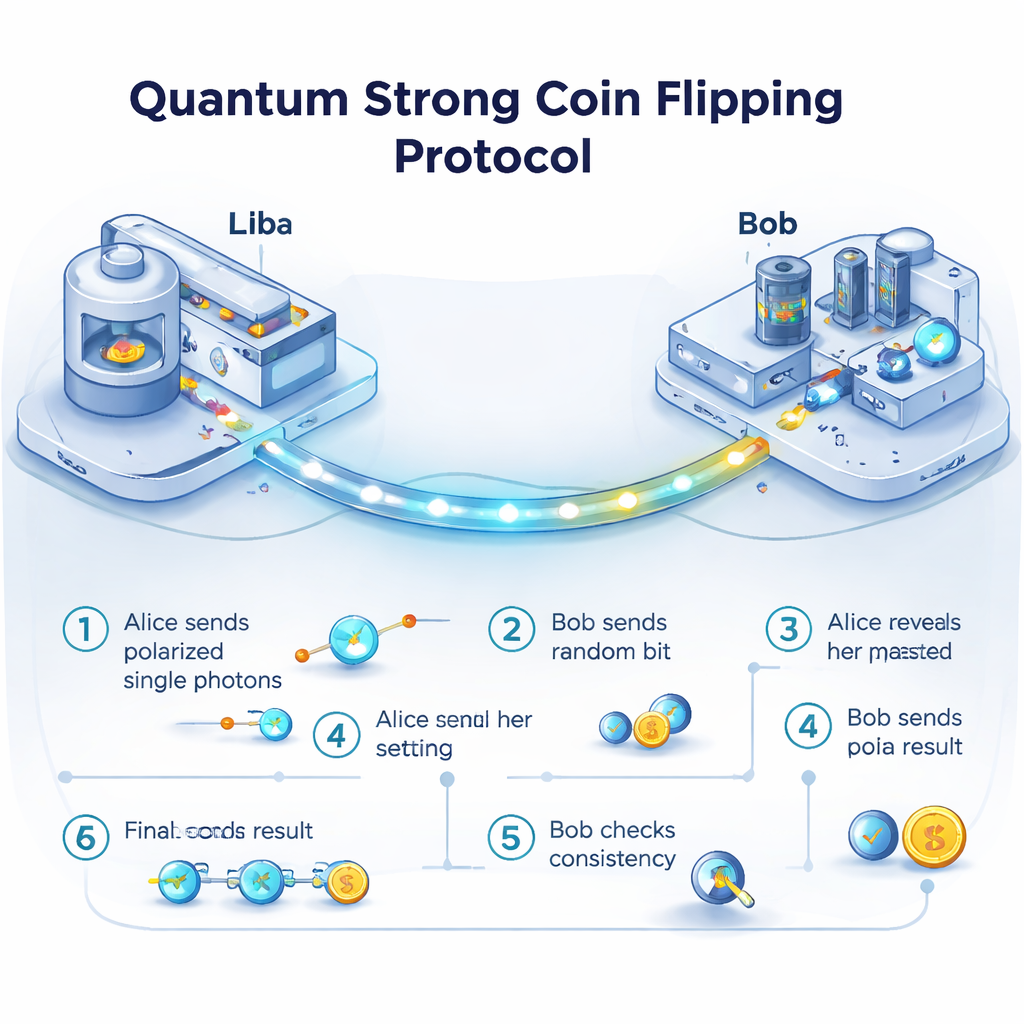
In the "strong" quantum coin flipping protocol studied here, both parties, traditionally called Alice and Bob, want a completely random and unbiased result. The protocol works by encoding bits of information in the polarization – the orientation – of single photons. Alice sends a sequence of photons, each prepared in one of four closely related polarization states. Bob measures each incoming photon in one of two possible bases and keeps track of the first successful detection. After this, Bob sends a random bit and the position of the detected photon to Alice over a normal data link. Alice then reveals how she prepared that particular photon. If Bob’s measurement and Alice’s declaration do not match when they used the same basis, the protocol is aborted. If everything is consistent, combining Alice’s original bit with Bob’s random bit produces the final coin flip result. Because quantum measurements disturb the state, any attempt to cheat leaves statistical traces in the form of errors or inconsistencies.
Why True Single Photons Matter
Previous experimental demonstrations of quantum coin flipping used faint laser pulses or entangled photon sources that probabilistically produced single photons. These sources often emit pulses containing more than one photon, and extra photons open up cheating strategies, especially for Bob, who receives them. In this work, the authors use a state‑of‑the‑art single‑photon source based on a semiconductor quantum dot embedded in a microscopic optical cavity. This device emits one photon at a time with very high purity and at a rapid clock rate of 80 million pulses per second. By carefully shaping and rapidly switching the photons’ polarization, the team keeps the error rate – the fraction of times Alice and Bob disagree when both are honest – below about 3%, which is crucial because even small errors can erode the quantum security advantage.
Measuring the Quantum and Single‑Photon Advantage
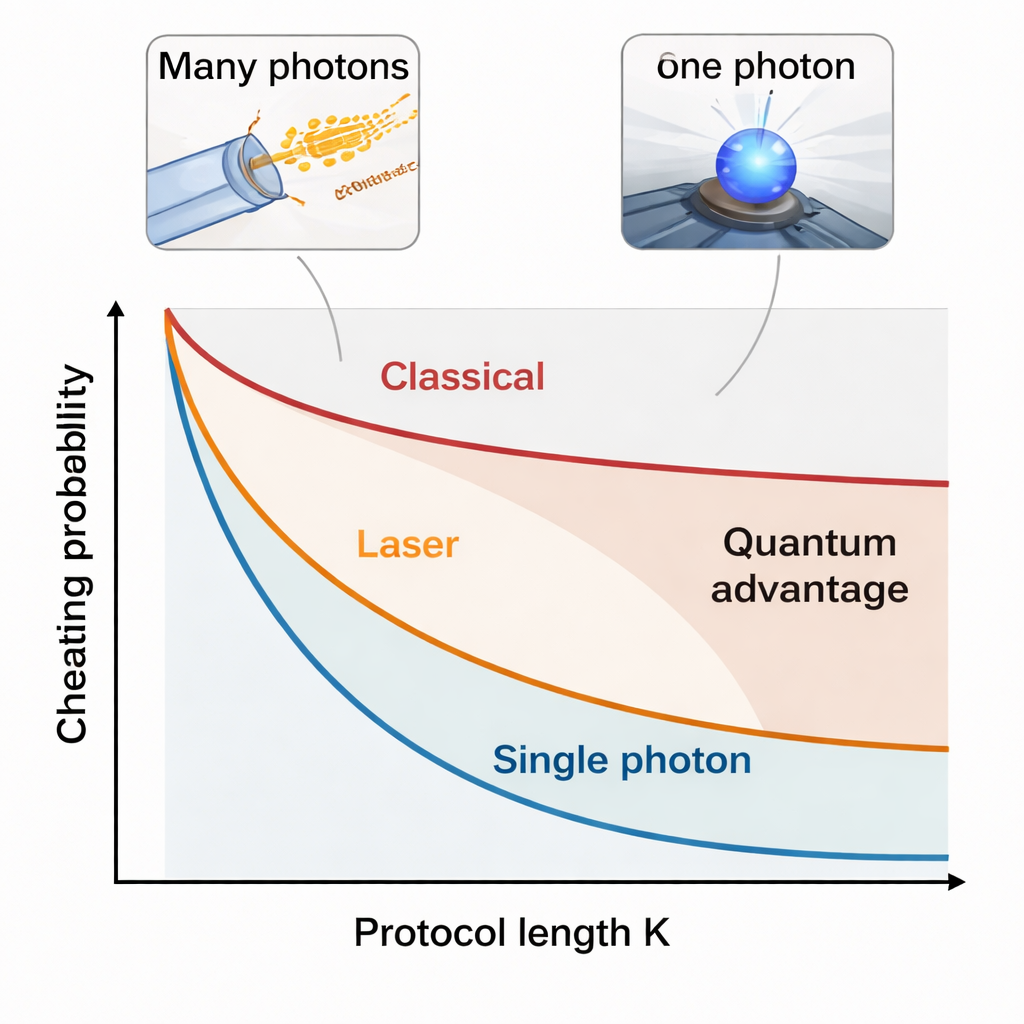
The researchers first perform detailed simulations to understand how different light sources affect the security of the protocol. They compare three cases: a classical protocol with no quantum resources, a quantum protocol using weak laser pulses, and a quantum protocol using a single‑photon source. The key number is the "cheating probability" – the highest chance that a dishonest party can force their preferred outcome. A quantum advantage appears whenever this cheating probability drops below what is achievable classically. The simulations show that the single‑photon source consistently yields lower cheating probabilities than faint laser pulses, especially when many pulses are used per coin flip and when the communication channel has losses, as in realistic networks.
From Laboratory Setup to Real‑World Links
Experimentally, the team implements the protocol using their quantum‑dot single‑photon source, a fast polarization modulator controlled by custom electronics, and highly efficient single‑photon detectors. They achieve around 1,500 secure coin flips per second in a back‑to‑back configuration. In this regime, the maximum cheating probability in their quantum implementation is about 90%, compared with roughly 91.6% for the best equivalent classical protocol – a measurable improvement limited by very general assumptions. Importantly, when they re‑analyze the same setup as if it were driven by a faint laser rather than a true single‑photon source, the cheating probability rises, confirming a clear "single‑photon advantage." They also test the system under increasing channel losses, mimicking several kilometers of fiber, and show that the quantum advantage survives for moderate loss and could, with optimized parameters and improved sources, extend to much longer distances.
What This Means for Future Quantum Networks
To a lay reader, the differences in cheating probability may appear modest, but they demonstrate something fundamental: using genuine single photons, one can outperform not only classical methods but also earlier quantum approaches for a task where the parties do not trust each other. This work shows that advanced quantum light sources can power cryptographic primitives beyond key distribution, serving as building blocks for fair leader election, secure online games, and more complex multi‑party protocols in a future quantum internet. As single‑photon technology improves and moves to telecom wavelengths, these quantum coin flips could become practical tools for ensuring fairness and security in everyday digital interactions.
Citation: Vajner, D.A., Kaymazlar, K., Drauschke, F. et al. Single-photon advantage in quantum cryptography beyond QKD. Nat Commun 17, 2074 (2026). https://doi.org/10.1038/s41467-026-69995-9
Keywords: quantum coin flipping, single-photon source, quantum cryptography, quantum internet, quantum dots