Clear Sky Science · en
Dysregulation of the DNA damage response by phosphorothioate antisense oligonucleotides
When Helpful Gene Therapies Mislead the Cell’s Repair Crew
Antisense oligonucleotides, or ASOs, are a rising class of precision drugs designed to switch individual genes on or off. They are already used to treat some rare genetic disorders and are being tested for many more diseases. This study reveals an unexpected downside of one common chemical tweak used to make these drugs more stable: under the right conditions, it can trick the cell into believing its DNA is damaged, jamming the repair machinery and risking long‑term harm to the genome.
Designer Gene Switches and Their Chemical Upgrade
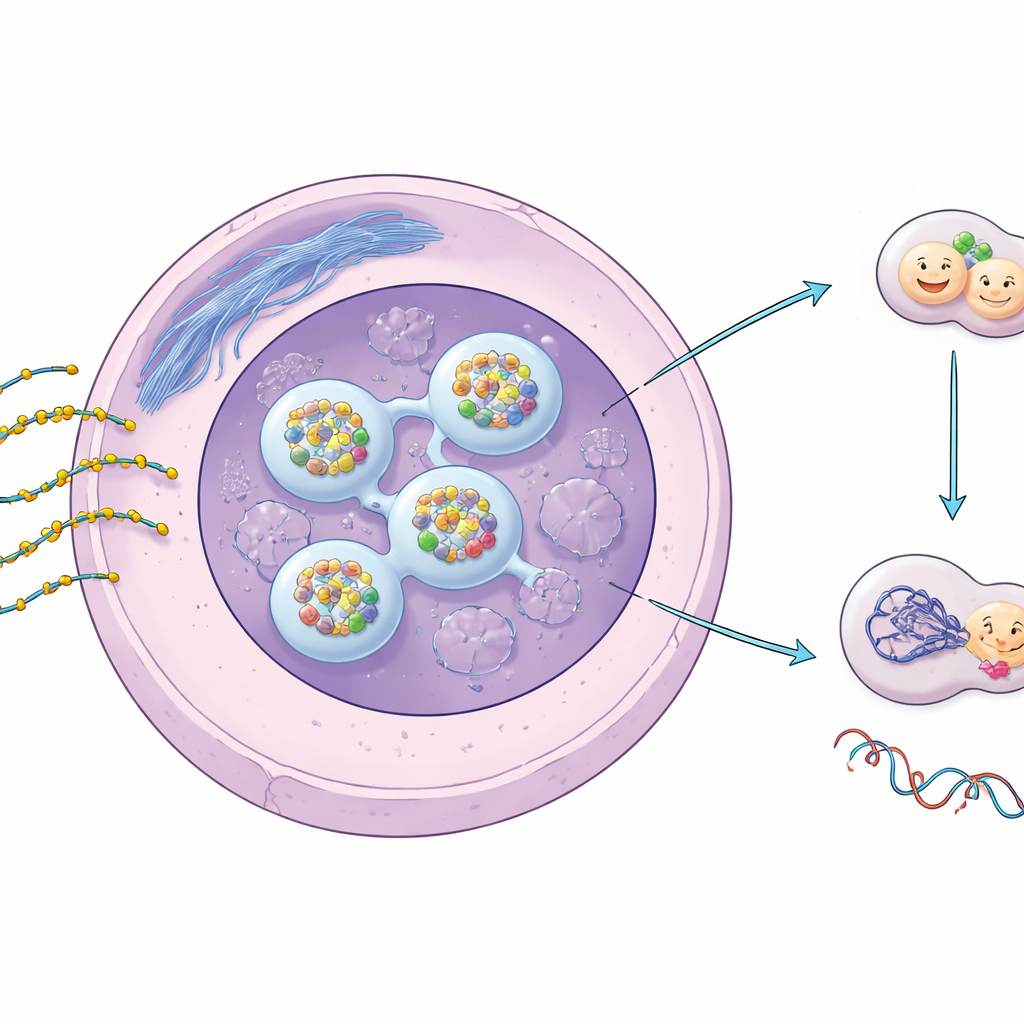
ASOs are short, single strands of genetic material built to recognize and bind specific RNA messages inside our cells, thereby silencing or altering them. To survive in the body and enter cells efficiently, most therapeutic ASOs carry a phosphorothioate (PS) modification, in which a sulfur atom replaces an oxygen atom in the backbone of the strand. This small change dramatically boosts their stability and their tendency to interact with proteins. Previous work showed that PS‑ASOs gather in distinct spots in the cell nucleus and can stress certain nuclear structures, but what this means for DNA repair and long‑term safety had remained unclear.
Artificial Droplets That Mimic True DNA Repair Sites
The authors followed fluorescently labeled PS‑ASOs in human cells and found that, at commonly used experimental doses, they rapidly accumulate in the nucleus and seed new spherical structures called PS bodies. These bodies form in a concentration‑dependent manner and behave like liquid droplets that fuse, dissolve, and depend on weak molecular forces—hallmarks of liquid–liquid phase separation. Crucially, they are not located where actual DNA breaks occur and do not contain the usual markers of broken DNA. Instead, the study shows that key DNA repair enzymes—including DNA‑PKcs, ATM, ATR and PARP1—bind directly to the PS‑ASOs and become highly enriched inside these artificial droplets, even though the underlying DNA is intact.
False Alarms That Activate the Cell’s Damage Signals
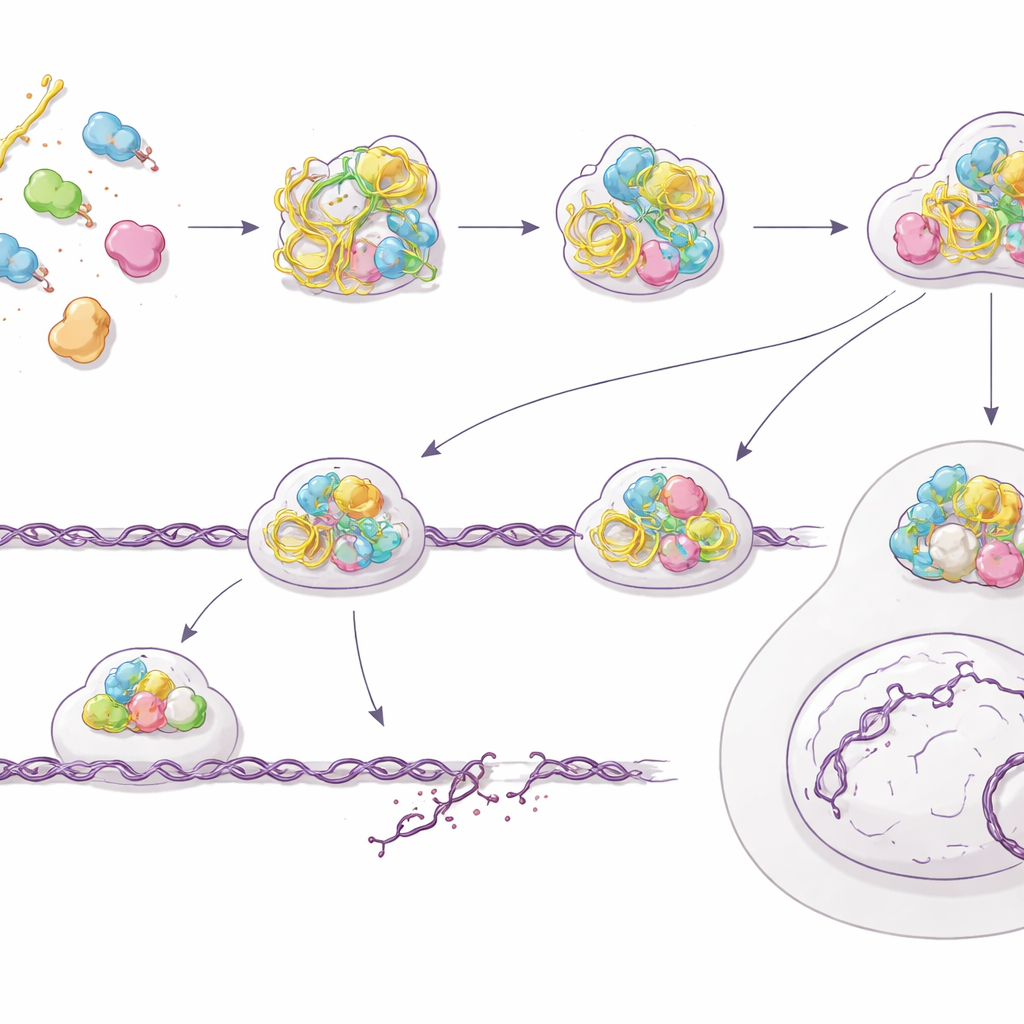
Once assembled, the ASO‑seeded droplets do more than passively trap proteins: they turn the repair enzymes on. Within an hour of ASO entry, the enzymes in these droplets are activated and begin to modify nearby chromatin, decorating histone proteins with chemical marks normally seen after genuine DNA damage. This sets off the full DNA damage response—recruiting additional repair factors, turning on checkpoint signaling, and dialing down the activity of cell‑cycle engines called CDKs. As a result, cells slow or halt their progression through key phases of the cell cycle, particularly at the point where they ordinarily check that their DNA is intact before dividing. In mouse brains exposed to clinically relevant ASO delivery, the researchers also observed heightened DNA damage signaling in regions with higher ASO uptake, indicating that these effects are not limited to cell cultures.
Repair Gone Wrong and a Growing Load of DNA Breaks
Paradoxically, while the cell’s alarm system is blaring, its actual ability to fix dangerous DNA breaks gets worse. The team showed that cells pre‑treated with PS‑ASOs struggle to clear damage after irradiation and even accumulate more spontaneous breaks, as measured by comet assays and persistent repair foci. A closer look at one of the cell’s most accurate repair pathways—homologous recombination—revealed the problem: key players such as BRCA2 and RAD51 fail to assemble properly at broken DNA ends, while earlier markers of processing at those ends still appear. Using a genetic reporter system, the authors quantified a roughly 60% drop in homologous recombination efficiency after PS‑ASO exposure. Cells become less viable overall and markedly more sensitive to radiation, consistent with a repair system that is being signaled but not correctly deployed.
What This Means for the Future of Gene‑Targeting Drugs
Taken together, the study suggests that PS‑modified ASOs can nucleate artificial liquid droplets in the nucleus that concentrate and activate DNA repair enzymes even when there is no damage to fix. This chronic false alarm disrupts normal repair choices, particularly accurate homologous recombination, leading to persistent DNA lesions, checkpoint activation, and cell death. While the strongest effects are seen at high nuclear ASO levels typical of transfection experiments, subtle activation of damage signaling is detectable even at lower, drug‑like doses. For patients and drug developers, the message is clear: the very chemical features that make ASOs effective medicines can, in some contexts, interfere with the cell’s most fundamental safeguard—its ability to maintain a stable genome—underscoring the need to design safer backbones and to monitor DNA repair pathways during therapy.
Citation: Hjelmgren, L., Zhou, Q., Schmidli, S. et al. Dysregulation of the DNA damage response by phosphorothioate antisense oligonucleotides. Nat Commun 17, 2111 (2026). https://doi.org/10.1038/s41467-026-69980-2
Keywords: antisense oligonucleotides, DNA damage response, liquid phase separation, homologous recombination, genome stability