Clear Sky Science · en
Attention-related modulation in the superior colliculus encodes perceptual sensitivity, but not perceptual choice
How the Brain Aims Your Attention
When you focus on a friend’s face in a crowd or track a fast-moving ball, your brain somehow boosts important sights while downplaying the rest. This study asks a surprisingly subtle question about that process: does a small midbrain structure called the superior colliculus mainly help you see better, shift your internal “decision threshold,” or simply bias where your eyes are about to move? By carefully teasing apart these possibilities in monkeys, the authors show that this structure sharpens what is seen and where to look, but does not itself decide what the animal reports seeing.
Where Eye Movements and Attention Meet
The superior colliculus sits deep in the brain and is best known for steering eye movements. Yet decades of work show that its neurons also respond when an animal pays attention to a location without moving its eyes. The challenge has been to sort out what this activity really means. Does it signal better visual sensitivity? A change in the willingness to say that something changed? Or a simple bias to point the eyes toward one spot? This matters because attention is not a single thing; it is built from interacting pieces of perception, decision, and action. Understanding which of those pieces live in the superior colliculus helps map how the brain links what we see to what we do.
A Clever Game to Separate Seeing from Deciding
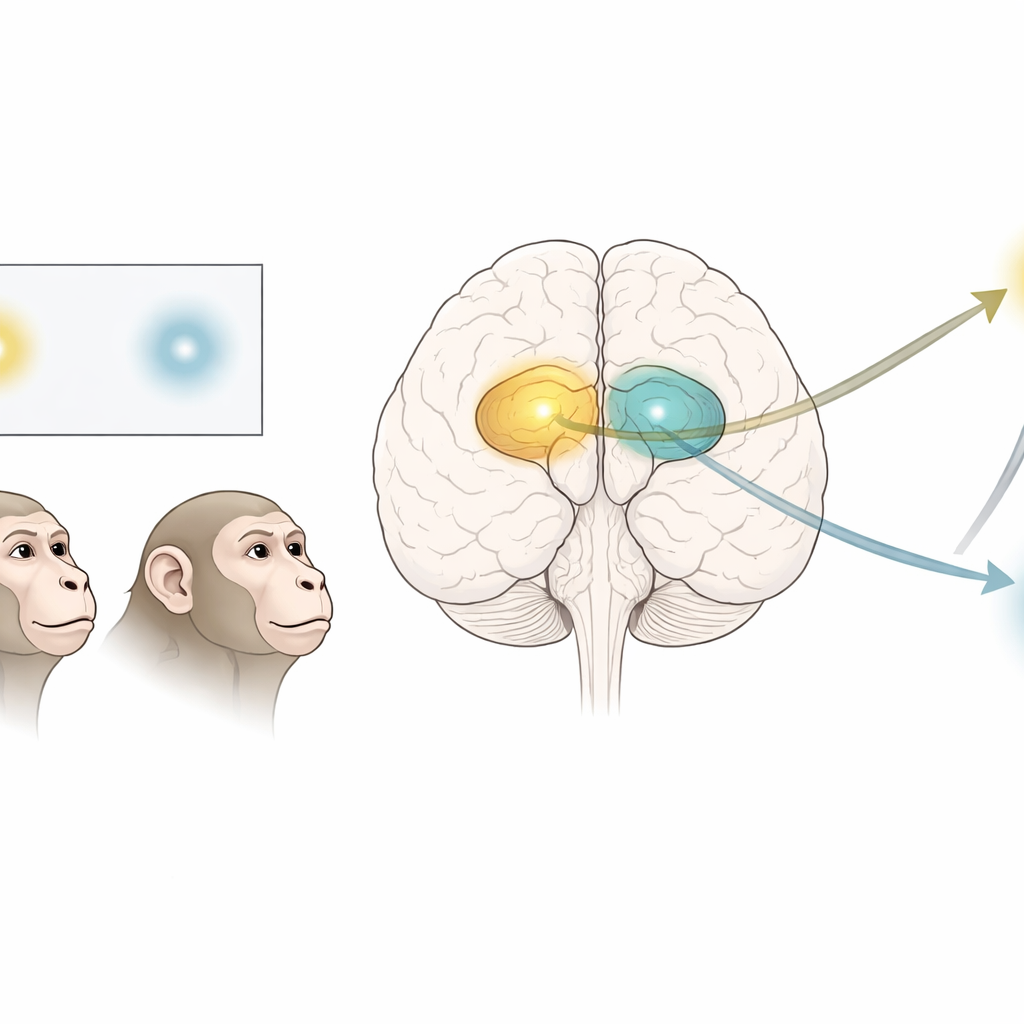
The researchers trained two monkeys to play a visual game. On each trial, the animals fixated a central point while two striped "patches" briefly appeared, one on each side. After a short pause, one patch reappeared, either with the same stripe orientation or slightly rotated. The monkeys reported “same” or “different” by making an eye movement to one of two targets. By adjusting how often rewards were given for different types of correct answers, and by changing how likely each side was to be tested, the team independently tuned three things: how well the animals could tell “same” from “different” (perceptual sensitivity), how biased they were toward reporting a change or no-change (perceptual decision criterion), and how biased they were to move their eyes toward a particular location (motor response criterion). Throughout, they recorded spikes from different types of superior colliculus neurons: those driven mainly by vision, those by movement, and “visuo-motor” cells influenced by both.
Neurons That Track Sensitivity and Motor Bias
The key finding is that activity in visuo-motor neurons closely followed two factors: how sensitive the animal was to changes at a particular location, and how biased it was to choose an eye movement into that neuron’s preferred region of space. When the task and rewards were set so that attention boosted sensitivity at a given spot, visuo-motor neurons representing that spot fired more strongly during the visual sample, and this boost grew when their response field closely aligned with the attended patch. When rewards made it more attractive to choose a saccade into their favored region, these same neurons ramped up after the eye-movement targets appeared, and they tagged the intended direction earlier in time. Importantly, these changes in firing did not simply mirror how fast or slow the actual eye movement was, showing that they reflect an internal bias to select a location, not just the mechanics of the movement.
What the Superior Colliculus Does Not Do
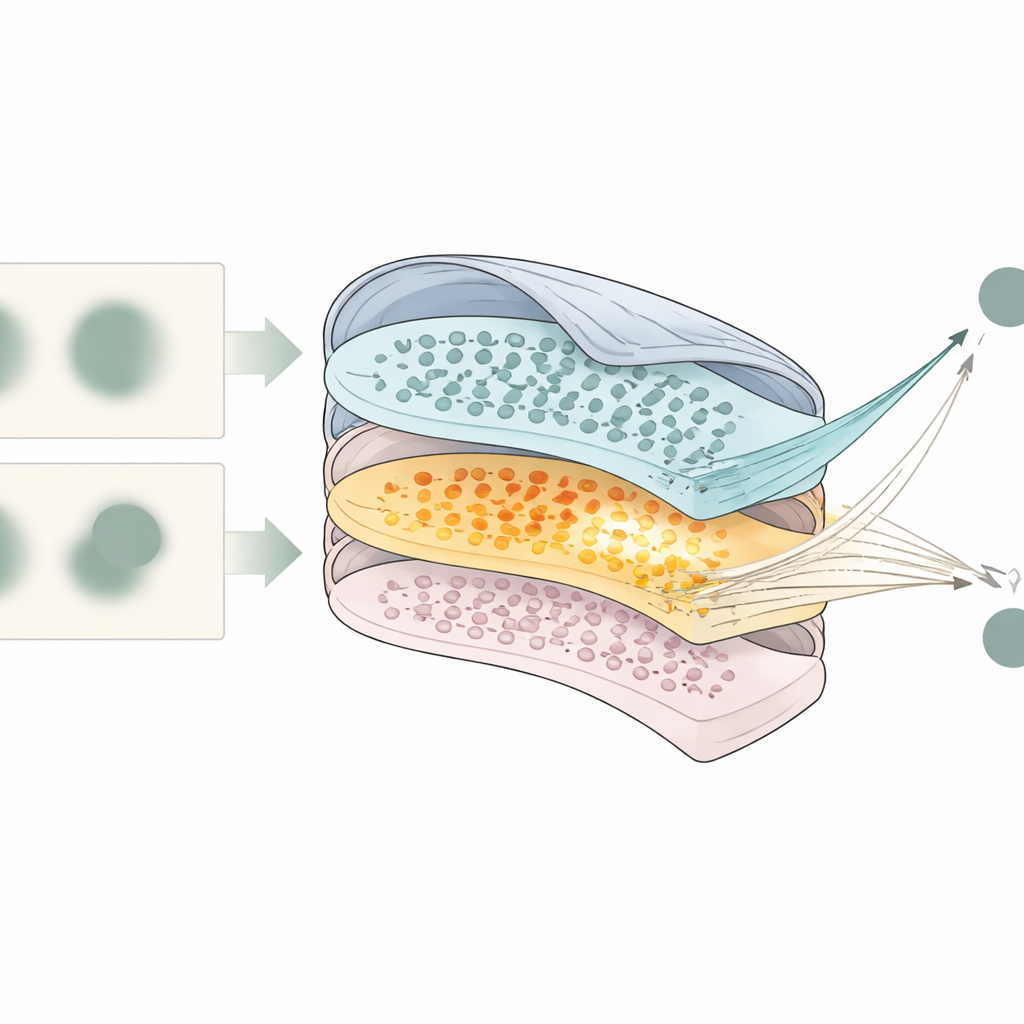
Equally striking is what these neurons did not encode. When the researchers shifted the animals’ perceptual decision criterion—making them more or less willing to call something "different" without changing how well they could actually tell—the superior colliculus showed essentially no change in activity, in any of its cell types. Trial by trial, population activity also failed to predict whether a response would be correct or an error once sensitivity and motor direction were controlled. Advanced analyses that separated signals related to perception, motor planning, and trial outcome confirmed that most of the explainable variation was tied to where the eyes would go and how much attention sharpened vision at that spot, not to the internal yes/no decision rule.
Linking Attention to Action, Not to Choice
To a non-specialist, the takeaway is that this midbrain hub acts like a spatial "spotlight manager" rather than an inner judge. It boosts the clarity of visual information at a chosen location and strengthens the tendency to move the eyes there, but it does not set the internal line between “same” and “different,” nor does it carry a clear signature of being right or wrong on each trial. Those aspects of decision-making likely depend more on higher cortical regions. By cleanly separating perceptual sensitivity, decision bias, and motor bias, this work shows that the superior colliculus mainly links where we focus and where we act, helping attention improve what we see and how quickly we move, while leaving the fine-grained choice of what we report to other parts of the brain.
Citation: Ghosh, S., Maunsell, J.H.R. Attention-related modulation in the superior colliculus encodes perceptual sensitivity, but not perceptual choice. Nat Commun 17, 3323 (2026). https://doi.org/10.1038/s41467-026-69954-4
Keywords: visual attention, superior colliculus, perceptual sensitivity, eye movements, decision making