Why wheat yields still matter for everyone’s plate
Wheat is a cornerstone of the global food supply, providing about one fifth of the calories and protein people eat worldwide. As the world’s population grows and climate change adds new stresses, farmers must harvest more grain from the same land without increasing environmental damage. This study asks a deceptively simple question with big consequences: when wheat yields rise, how much is due to truly better, higher-yielding varieties, and how much is simply breeders working hard to prevent older varieties from sliding backward in the face of new pests, diseases, and shifting climates?
Two different ways to keep harvests high
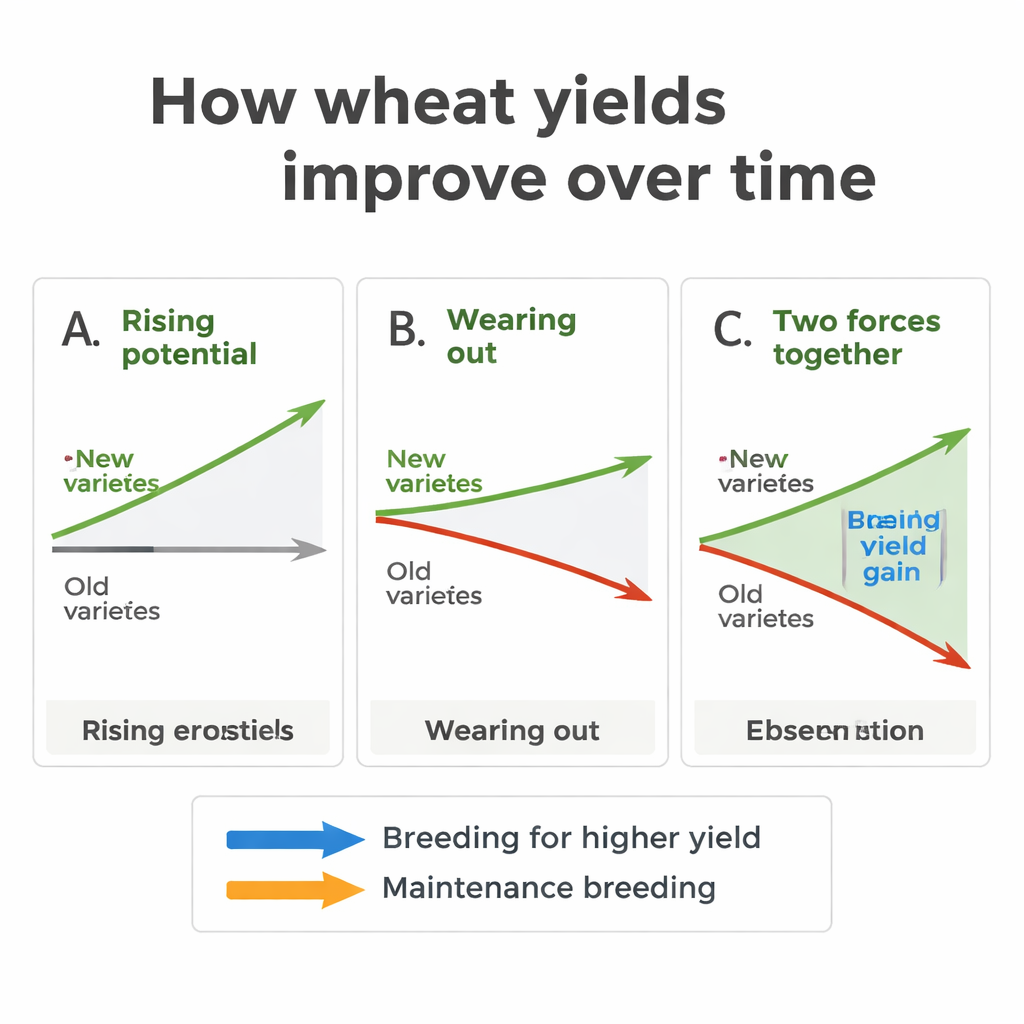
Plant breeders boost food production through two main strategies. One is breeding for higher yield potential: creating new wheat varieties that can turn sunlight, water, and nutrients into grain more efficiently under ideal conditions. The second, often less visible, is maintenance breeding: continually refreshing varieties so they stay well adapted to changing weather, soils, farming practices, and waves of diseases and insects. Most past studies lumped these two effects together, assuming that when new and old varieties are grown side by side today, any advantage of the newer lines must reflect a higher biological ceiling for yield.
Putting long-term trial data under the microscope Figure 1.
To separate these two forces, the researchers assembled a large database from official wheat variety trials in Argentina, France, the United Kingdom, and the United States conducted since 2000. These trials mimic real farming conditions while carefully testing many varieties over many years and locations. The team focused on ten widely grown “check” varieties that remained in the trials for at least a decade, and compared their performance to the top ten yielding varieties present in each year. Importantly, most trials included plots with and without protective fungicide sprays, allowing the scientists to see how vulnerability to leaf diseases changed over time.
What the yield numbers really show
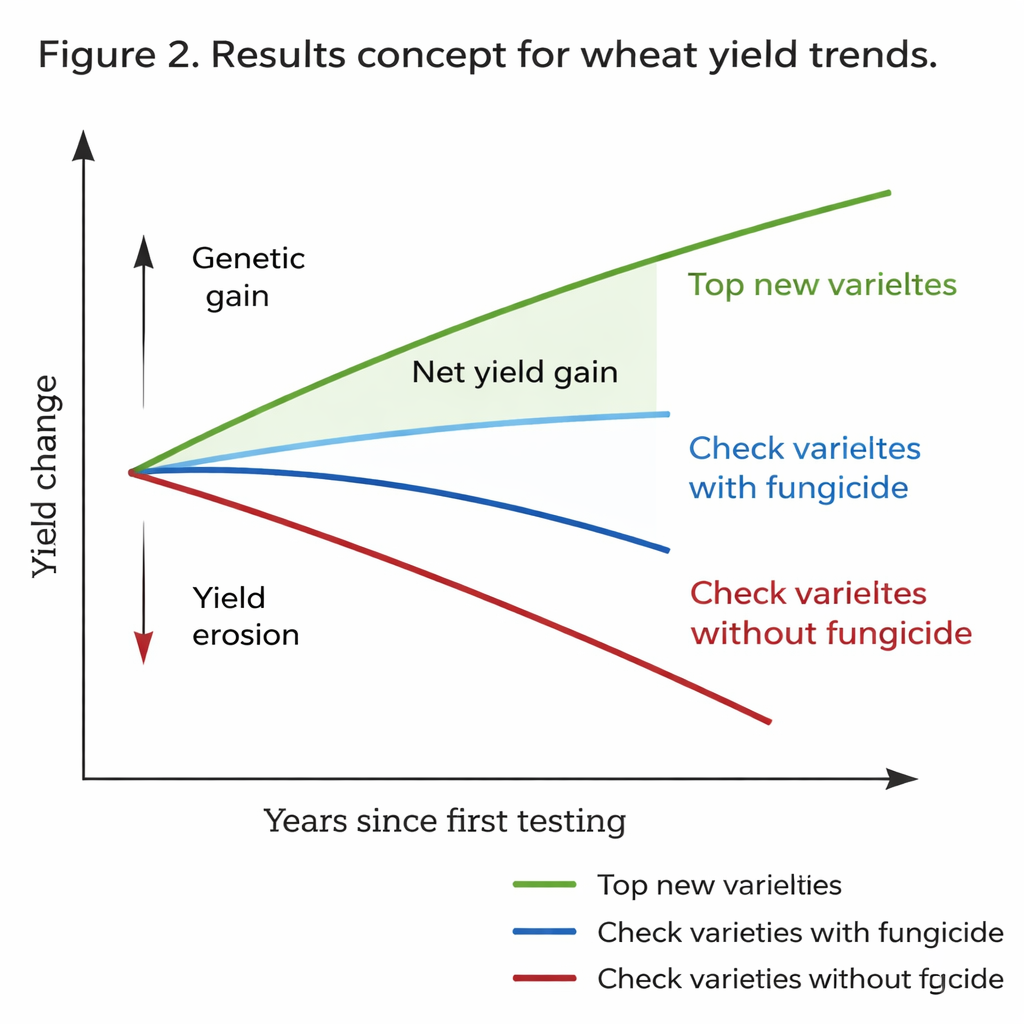
Across all four countries, the gap between modern top-yielding varieties and the older check varieties widened steadily. On average, wheat yields improved by about 73 kilograms per hectare per year when looking at fungicide-treated crops. But when the team disentangled the reasons, they found that nearly half of this apparent progress was not a higher ceiling at all. Instead, about 33 kilograms per hectare per year reflected yield erosion in the check varieties as they gradually lost their fit with evolving local conditions, even when disease pressure was suppressed. The other 40 kilograms per hectare per year represented genuine gains in yield potential of new cultivars. In untreated plots, older checks declined even faster, showing that they had become more susceptible to fungal diseases over time.
Rethinking past optimism about breeding gains Figure 2.
These results reveal an important blind spot in many earlier assessments of crop improvement. Studies that simply grow a few old and new varieties together in today’s fields, and then attribute the entire difference to genetic progress, are likely to overstate how much breeders have raised the biological yield ceiling. The new analysis suggests that, at least for wheat in these major producing regions, maintenance breeding has been just as important as boosting yield potential. Breeders have had to work continuously just to hold back an invisible downhill slide caused by shifting pests, diseases, and environments.
What this means for future food security
For non-specialists, the key takeaway is that rising wheat yields are partly a story of running hard just to stay in place. True breakthroughs that raise the maximum possible yield appear to be coming more slowly than once hoped, in wheat and likely in other staple crops as well. That means future food security will depend not only on smarter genetics but also on better farm management, closing the gap between what fields could produce and what they actually deliver. At the same time, strong breeding programs remain essential—not only to push yields higher, but to keep today’s high-performing varieties from quietly wearing out in tomorrow’s fields.
Citation: Andrade, J.F., Man, J., Monzon, J.P. et al. Maintenance breeding and breeding for yield potential both contribute to genetic improvement in wheat yield.
Nat Commun17, 2078 (2026). https://doi.org/10.1038/s41467-026-69936-6