Clear Sky Science · en
SUPER and femtosecond spin-conserving coherent excitation of a tin-vacancy color center in diamond
A New Way to Talk to Single Atoms of Light
Imagine being able to flip a quantum switch inside a tiny defect in a diamond crystal a trillion times faster than the blink of an eye, and have it spit out single, precisely controlled particles of light. This study shows how researchers do exactly that with a particular defect called a tin-vacancy center. Their methods could make it easier to build quantum networks—future “internets” for securely sending quantum information—by solving a long-standing problem: how to cleanly separate the control laser from the delicate photons that carry the message.
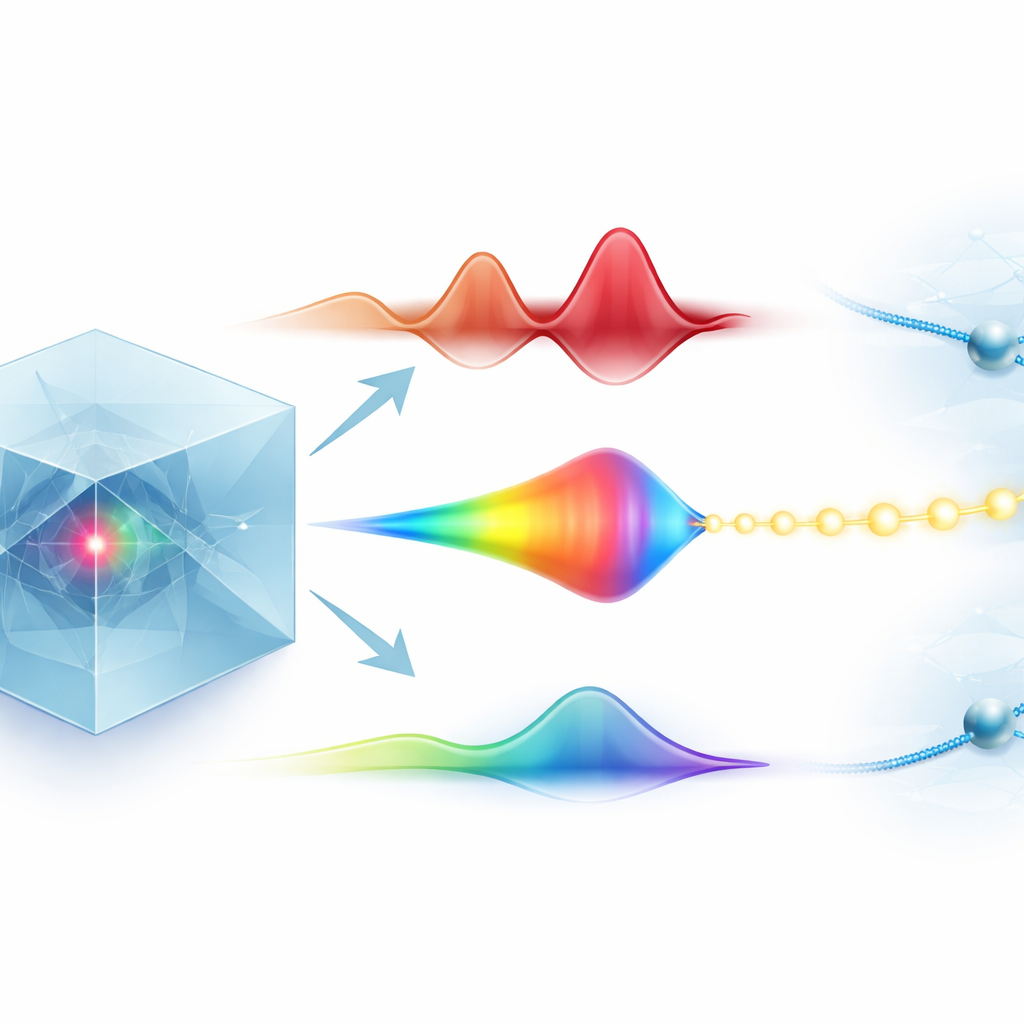
Why Tiny Flaws in Diamond Matter
In an otherwise perfect diamond, a tin-vacancy center is a spot where a tin atom and an empty site replace two carbon atoms. This tiny imperfection behaves like an artificial atom that can store quantum information in the spin of an electron and release it as individual photons. Tin-vacancy centers are particularly attractive because they keep their color stable and can preserve quantum states for surprisingly long times, even at relatively accessible temperatures. That makes them promising building blocks for quantum memories, single-photon sources, and ultimately long-distance quantum links between distant devices.
The Challenge of Clean Quantum Light
To create useful quantum light, scientists must excite the defect with a laser and then collect the photons it emits. Ideally, the laser should put the electron in a well-defined excited state without scrambling its quantum information, so that the emitted photon can become entangled with the electron’s spin. Doing this with a laser tuned exactly to the defect’s main optical transition works well in theory, but in practice it creates a serious headache: the excitation laser and the emitted single photons have almost identical colors. Separating them then requires clever tricks with polarization, timing, or complex optical structures, and those tricks usually throw away a large fraction of the precious photons.
Using Detours in Color to Gain Control
The authors tackle this problem with a strategy called the SUPER scheme, which uses two ultrafast laser pulses whose colors are both slightly red-shifted from the main transition. On their own, each pulse is too far off to excite the defect efficiently. But together, with carefully chosen frequencies, durations, and intensities, they cooperate to “swing up” the electron from its ground state to the excited state in a controlled way. Because the pulses are detuned by hundreds of billions of cycles per second, simple spectral filters can block the laser light while letting the emitted photons through. The team shows experimentally that this nonresonant approach can coherently transfer more than half of the population—already enough for a quantum gate—and simulations indicate that modestly more power would push the fidelity to nearly perfect inversion.
Pushing Quantum Gates into the Femtosecond Regime
Beyond this off-resonant control, the researchers also explore the fastest possible direct driving of the main optical transition. Using a specialized “pulse carver,” they sculpt laser pulses ranging from picoseconds down to femtoseconds—so short that light barely travels the width of a human hair during a pulse. With these shaped pulses they observe Rabi oscillations, a hallmark of coherent control, and demonstrate rotations corresponding to multiple full flips of the optical qubit. Crucially, they verify that the photons produced after such ultrafast control are indeed single photons, and they estimate coherence times that support multiple operations within the natural lifetime of the excited state.
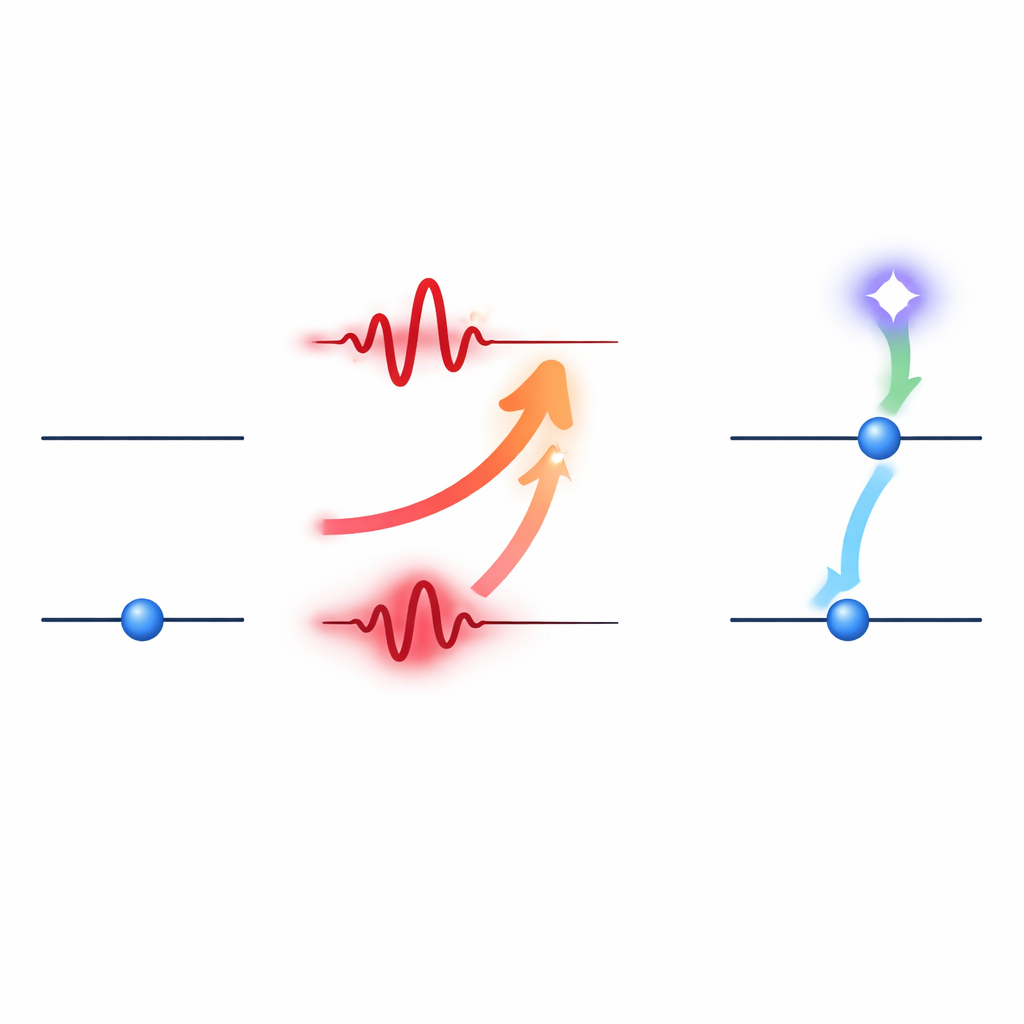
Keeping the Spin Intact and Sharing Entanglement
For quantum networks, the electron’s spin is as important as the light it emits. The team therefore studies how their control pulses affect the spin states in the presence of a magnetic field. Detailed simulations show that SUPER pulses can, in principle, transfer an equal superposition of spin states from the ground to the excited level with very high fidelity, preserving the delicate phase information. Experiments measuring how the spin populations relax over tens of microseconds reveal no detectable extra mixing caused by the SUPER pulses, supporting the idea that the optical control leaves the spin qubit essentially untouched. Building on this, the authors propose an entanglement protocol where two distant diamond defects are excited simultaneously with broadband pulses, then their emitted photons are combined on a beam splitter. When both detectors register a photon, the spins of the two distant defects end up in an entangled state, ready to serve as nodes in a quantum network.
What This Means for Future Quantum Devices
Together, these advances show that it is possible to control a tin-vacancy center’s optical transition on ultrafast timescales while preserving spin information and cleanly separating control light from emitted photons. The SUPER scheme offers a practical way to generate high-quality single photons without elaborate filtering systems, and the femtosecond gates open the door to performing many operations within the brief life of an excited state, even in strongly enhanced optical cavities. As these techniques are refined and extended to other solid-state emitters, they could become key ingredients for scalable quantum repeaters, multi-qubit entanglement protocols, and robust quantum sensors built from tiny, engineered flaws in diamond.
Citation: Torun, C.G., Gökçe, M., Bracht, T.K. et al. SUPER and femtosecond spin-conserving coherent excitation of a tin-vacancy color center in diamond. Nat Commun 17, 2154 (2026). https://doi.org/10.1038/s41467-026-69911-1
Keywords: tin-vacancy center, diamond color centers, ultrafast quantum control, single-photon sources, quantum networking