Clear Sky Science · en
Reconstruction of the lifeways of Central European Late Bronze Age communities using ancient DNA, isotope and osteoarchaeological analyses
Why this ancient story still matters
What did everyday life look like in Central Europe more than 3,000 years ago, when metalwork, long-distance contacts, and new ideas were transforming communities? Archaeologists have long struggled to answer this for the Late Bronze Age because most people were cremated, leaving few traces of their bodies. This study seizes a rare opportunity: intact burials from two sites in Central Germany and a set of comparable graves from nearby regions. By combining ancient DNA, chemical “fingerprints” in teeth and bones, and careful study of skeletons and graves, the authors reconstruct how these communities moved, mingled, ate, and buried their dead.
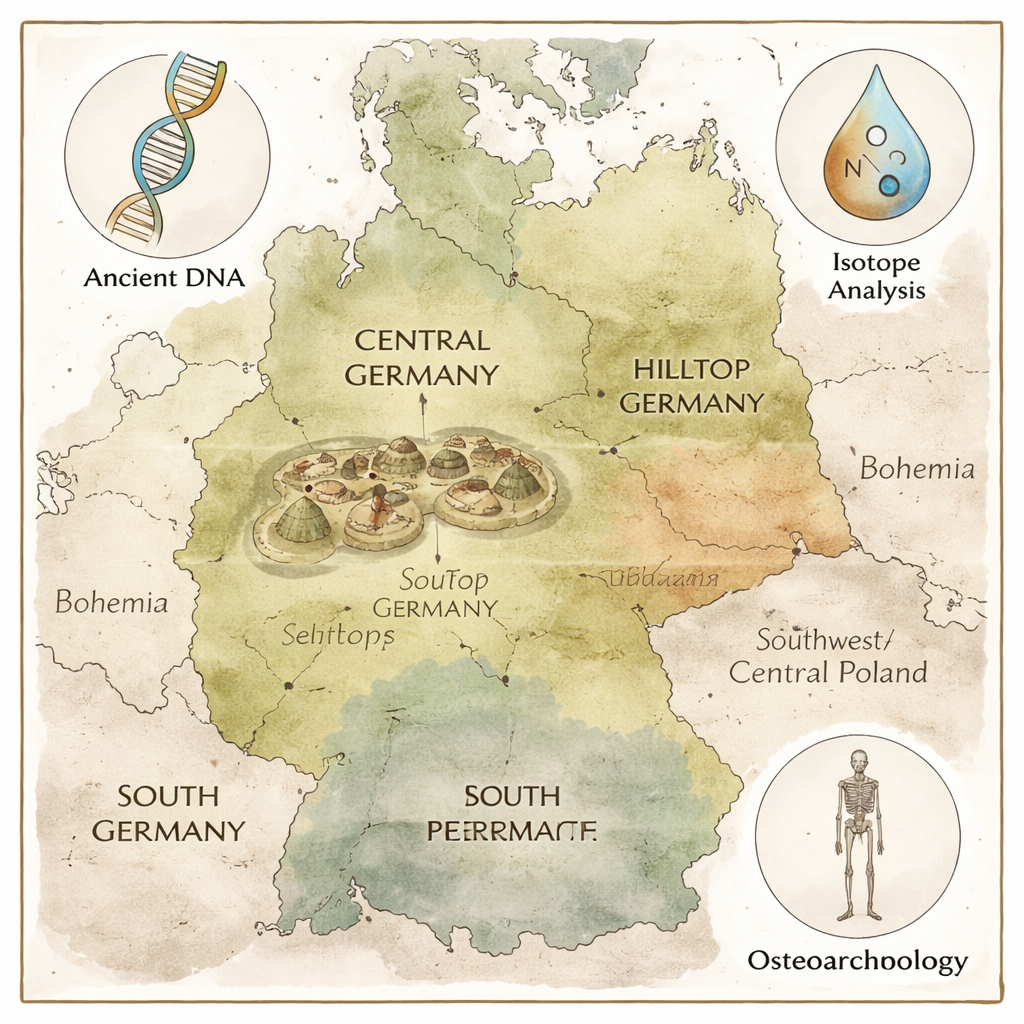
Old landscapes, new connections
The researchers focused on two closely linked settlements at Kuckenburg and Esperstedt in Central Germany, occupied between about 1300 and 800 BCE. These sites belong to a local group that kept burying their dead intact even while many neighboring groups had switched almost entirely to cremation. The team compared 36 inhumation burials from these sites with 33 burials from South Germany, Bohemia (Czechia), and Southwest/Central Poland. Together, these sites sit within the wider “Urnfield” cultural world, famous for urn cemeteries, but here the authors could study the rarer graves where bodies or major body parts survived.
Genetic roots with a twist
Ancient DNA from 69 individuals shows that people in Central Germany’s Late Bronze Age were not newcomers. Their genetic profiles largely continue those of earlier local Bronze Age groups. Over centuries, however, the balance of their ancestry shifted: DNA components linked to early European farmers became gradually more common, while ancestry linked to steppe herders decreased. This same trend—more farmer-related ancestry over time—appears in South Germany, Bohemia, and Poland, but the timing differs. In the south and in Bohemia, the shift happens earlier, during the Early and Middle Bronze Age, while in Central Germany and parts of Poland it becomes more visible around or after 1000 BCE. A few individuals stand out as genetic “outliers,” hinting at connections to southern regions such as Switzerland, northern Italy, or the Carpathian Basin, but these are the exception rather than the rule.
Staying mostly close to home
To track mobility, the team measured strontium and oxygen isotopes in teeth and cremated bones. These chemical signatures reflect the geology and water people grew up with, allowing researchers to distinguish locals from non-locals. Most individuals at Kuckenburg and Esperstedt fall within the local range, and only a handful show clear signs of coming from nearby but geologically different areas. There is no strong difference in mobility between men and women, unlike some earlier Bronze Age communities where women often came from afar. Nor do cremated and buried individuals, or skull-only and whole-body burials, show systematic differences in geographic origin. Chemically, cremation and inhumation appear to have coexisted as alternative practices within the same broadly local population.
Diets, bodies, and ways of burying
Isotope data from bones also reveal changing diets. In the early Late Bronze Age, many people in Central Germany ate significant amounts of millet, a drought-tolerant grain that leaves a distinct chemical trace. By the later phase, diets shifted back toward crops such as wheat and barley. This dietary change does not line up neatly with the arrival of new genetic groups; instead it seems tied to local choices and changing environments. Skeletons show signs of hard physical lives—wear on joints, occasional fractures, and stress markers in children—but overall good dental health and few clear signs of lethal violence. Burial practices, however, are strikingly varied: formal graves, bodies in settlement pits, isolated skulls, and mixed features containing skulls, animal bones, and cremated remains. Genetic and isotopic data show that people buried together were rarely close biological relatives, suggesting that burial groups reflected social, not simply family, ties.
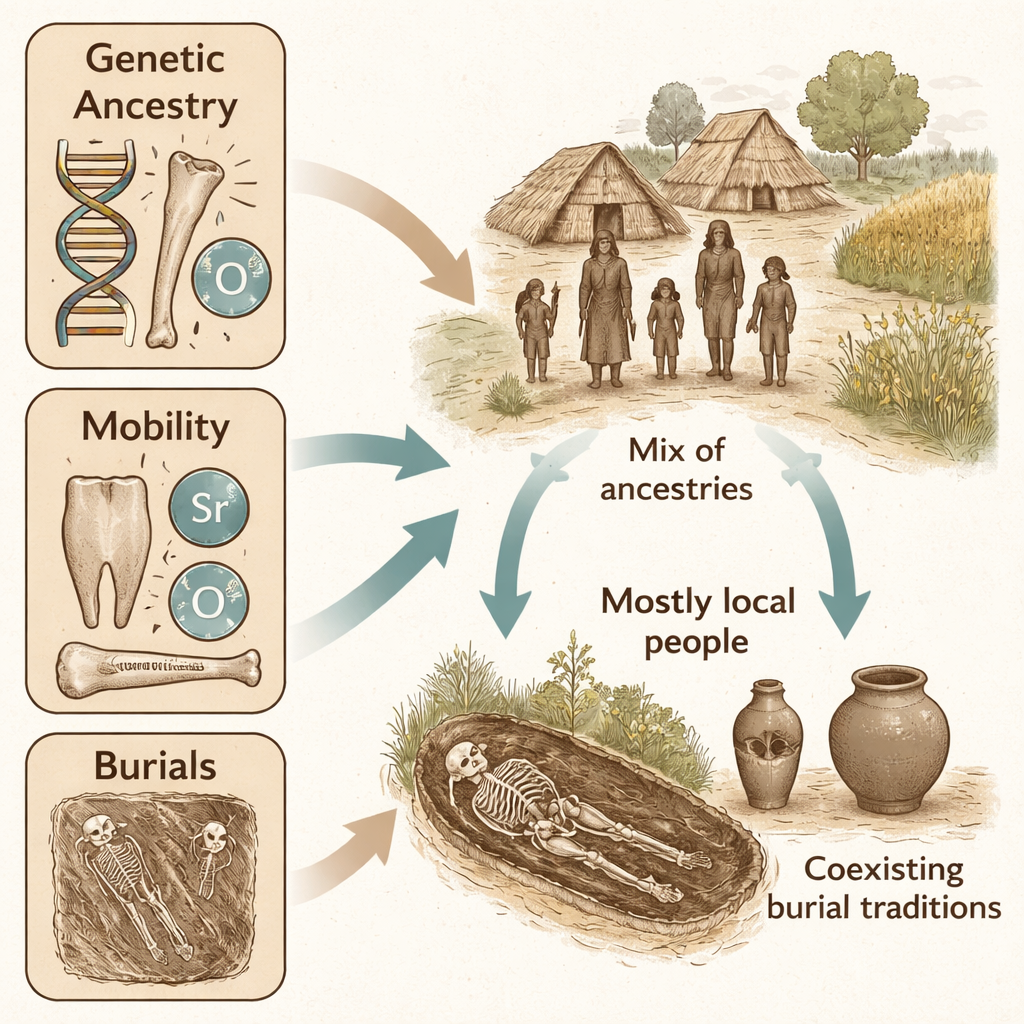
What this reveals about past lives
For a lay reader, the main message is that these Late Bronze Age communities were both stable and connected. Most people were locals with deep roots in the region, yet their genes and customs show ongoing contact with neighboring areas over many generations. Cremation did not simply sweep away older burial traditions; it existed alongside them, as part of flexible, locally meaningful ways of treating the dead. By weaving together DNA, chemistry, and bones, this study shows that identity in the Late Bronze Age was not defined solely by ancestry or birthplace. Instead, it was shaped through shared practices—what people ate, how they worked, and how they chose to remember their dead.
Citation: Orfanou, E., Ghalichi, A., Rohrlach, A.B. et al. Reconstruction of the lifeways of Central European Late Bronze Age communities using ancient DNA, isotope and osteoarchaeological analyses. Nat Commun 17, 1992 (2026). https://doi.org/10.1038/s41467-026-69895-y
Keywords: Late Bronze Age, ancient DNA, burial practices, human mobility, Central Europe archaeology