Clear Sky Science · en
Family imprint reveals basin-wide patterns of Amazon forest embolism resistance
Why the Amazon’s hidden plumbing matters
The Amazon rainforest helps regulate Earth’s climate, storing vast amounts of carbon and recycling moisture back into the atmosphere. But as heatwaves and droughts intensify, scientists worry about how long its trees can keep coping with water stress. This study peers inside the trees’ hidden plumbing to ask a pressing question: which parts of the Amazon are most at risk of hydraulic failure, the kind of internal damage that can kill trees during severe drought?
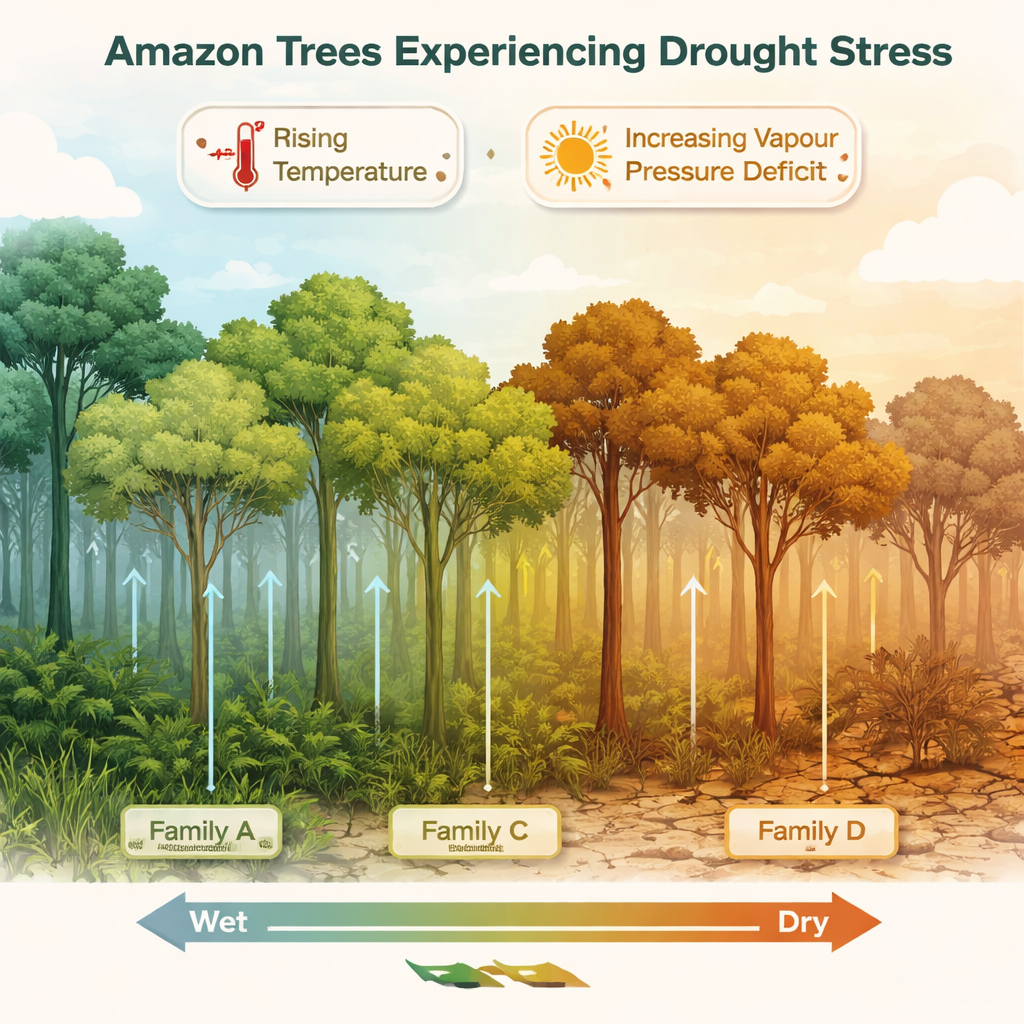
How trees move water—and how that can fail
Trees pull water from the soil up to their leaves through narrow tubes in the wood, a system known as xylem. During drought, the tension in this water column becomes extreme. If it gets too high, air bubbles form and block the tubes, a process called embolism that can permanently cut off water flow. The researchers use a measure called Ψ50: the water tension at which a tree has lost half of its water transport capacity. The more negative this value, the more resistant a tree is to embolism—and the more likely it is to survive intense dry spells.
Reading drought tolerance from the family tree of life
Directly measuring Ψ50 is slow and technically demanding, so only a small fraction of Amazon tree species has ever been tested. However, botanists know a great deal about which species grow where, and how they are related evolutionarily. The team combined a large hydraulic trait database with a modern evolutionary tree of Amazon tree genera to see whether embolism resistance tends to be similar among related groups. They found a clear, though not perfect, “family imprint”: closely related genera and especially families share similar drought resistance. This means that knowing which families dominate a forest can help predict its vulnerability to hydraulic failure, even without measuring every species individually.
The standout survivors: the bean family and its relatives
Among all the major Amazon tree families, one group stood out: Fabaceae, the legume or bean family. On average, their wood could tolerate substantially higher water tension before embolism, making them among the most drought-resistant trees in the basin. This pattern held across different climate zones, from ever-wet forests to regions with marked dry seasons, and even when the authors compared Fabaceae to other families in global datasets. Other families, such as Myristicaceae and Euphorbiaceae, typically showed much weaker resistance. Interestingly, the researchers found that this toughness was a broad feature of Fabaceae rather than being tied to a specific subgroup, leaf type, or their ability to fix nitrogen from the air.
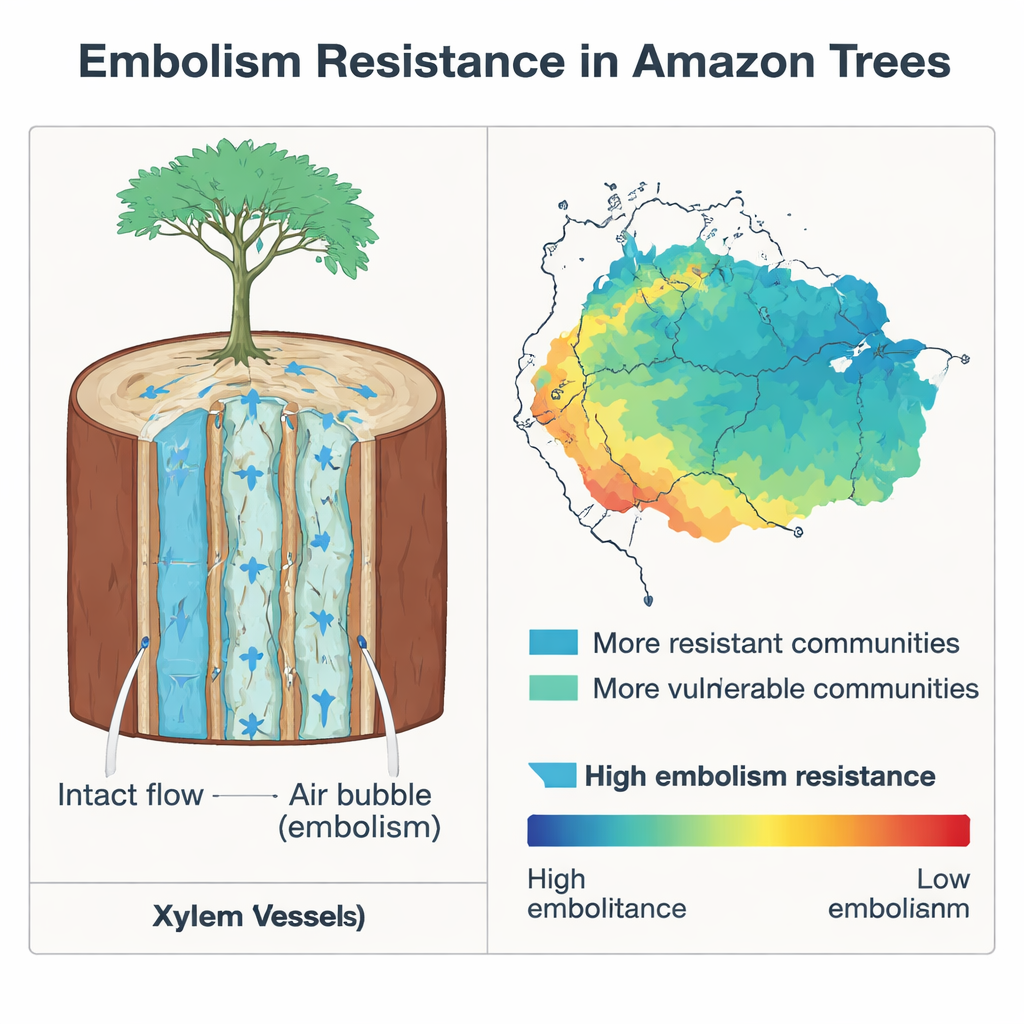
Mapping vulnerability across the whole Amazon
To turn these family-level insights into a big-picture view, the authors combined measurements of Ψ50 with tree inventory data from 448 forest plots spread across Amazonia. For each plot, they estimated a community-level Ψ50 by weighting each species’ trait value by how much space its trunks occupy. Where no direct measurements existed, they filled gaps using averages from the genus or family, leaning on the phylogenetic signal they had uncovered. Interpolating these values across the basin revealed a striking pattern: forests on the Brazilian and Guiana Shields, where Fabaceae are particularly abundant, generally have highly embolism-resistant communities. In contrast, many forests in Western Amazonia appear much more vulnerable, with weaker resistance in their wood even though these areas are famously species-rich.
What this means for the future of the forest
To a non-specialist, the study’s message is both hopeful and sobering. The Amazon’s trees are not all equally fragile: some families, especially the legumes, possess wood that is remarkably resistant to the internal “air locks” caused by drought. Where these families dominate, forests may better withstand episodes of intense water stress. Yet vast areas—especially in the western basin—are built from lineages whose plumbing is more easily damaged. As climate change drives hotter, drier conditions and more frequent extreme droughts, these vulnerable regions could face stronger shifts in tree communities and losses of biodiversity. The work shows that by understanding who the tree “families” are and how their wood works, scientists can map which parts of the Amazon are most at risk, giving policymakers a clearer picture of where conservation and climate action are most urgently needed.
Citation: Tavares, J.V., Gloor, E., Silva, T.S.F. et al. Family imprint reveals basin-wide patterns of Amazon forest embolism resistance. Nat Commun 17, 2073 (2026). https://doi.org/10.1038/s41467-026-69892-1
Keywords: Amazon rainforest, drought, tree hydraulics, embolism resistance, forest resilience