Clear Sky Science · en
Emergent constraints on the hydrological impacts of land use and land cover change
Why changing landscapes matter for water
From farms and forests to expanding cities, people have reshaped most of Earth’s land. These changes do more than alter the view from space: they also influence how water moves between land, air, and rivers. This study asks a deceptively simple question with big consequences for water security and climate policy: when we cut down or plant trees at large scales, do we overall make the land wetter or drier, and are our best climate models getting this right?
How land and water are tied together
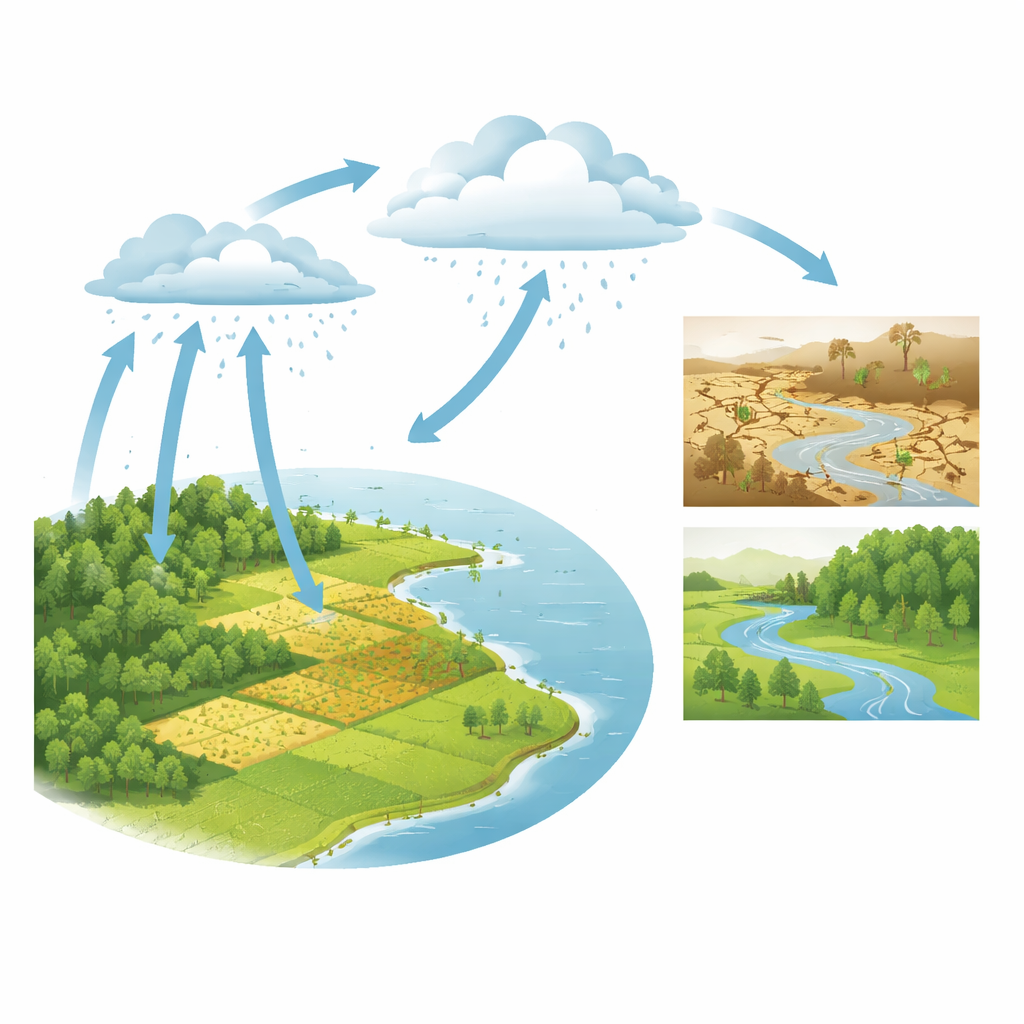
Plants act as living pumps that draw water from the soil and send it back to the atmosphere through evapotranspiration, a combination of evaporation and plant transpiration. Forests, with their deep roots and dense canopies, usually move more water than croplands or grasslands. When forests are replaced by crops, this can shift how much water leaves the land surface and how much stays available in soils, groundwater, and rivers. It can also change where and when rain falls, because water vapor released from vegetation later returns as precipitation, sometimes far downwind. Understanding these links is essential for judging whether large-scale forest loss or new tree planting will threaten or support regional water supplies.
Why climate models disagree
The authors examine an ensemble of state-of-the-art Earth system models used in international climate assessments. These models simulate both historical land use changes since the 1980s—dominated by conversion of forests to croplands—and future scenarios that include extensive afforestation. Surprisingly, in the historical period many models suggest that turning forests into cropland slightly increased global evapotranspiration, which runs against physical intuition and many observational studies. Even worse, the models sharply disagree with one another on both the sign and size of the effect, creating large uncertainty about how much land management has already altered the water cycle.
A new way to correct model bias
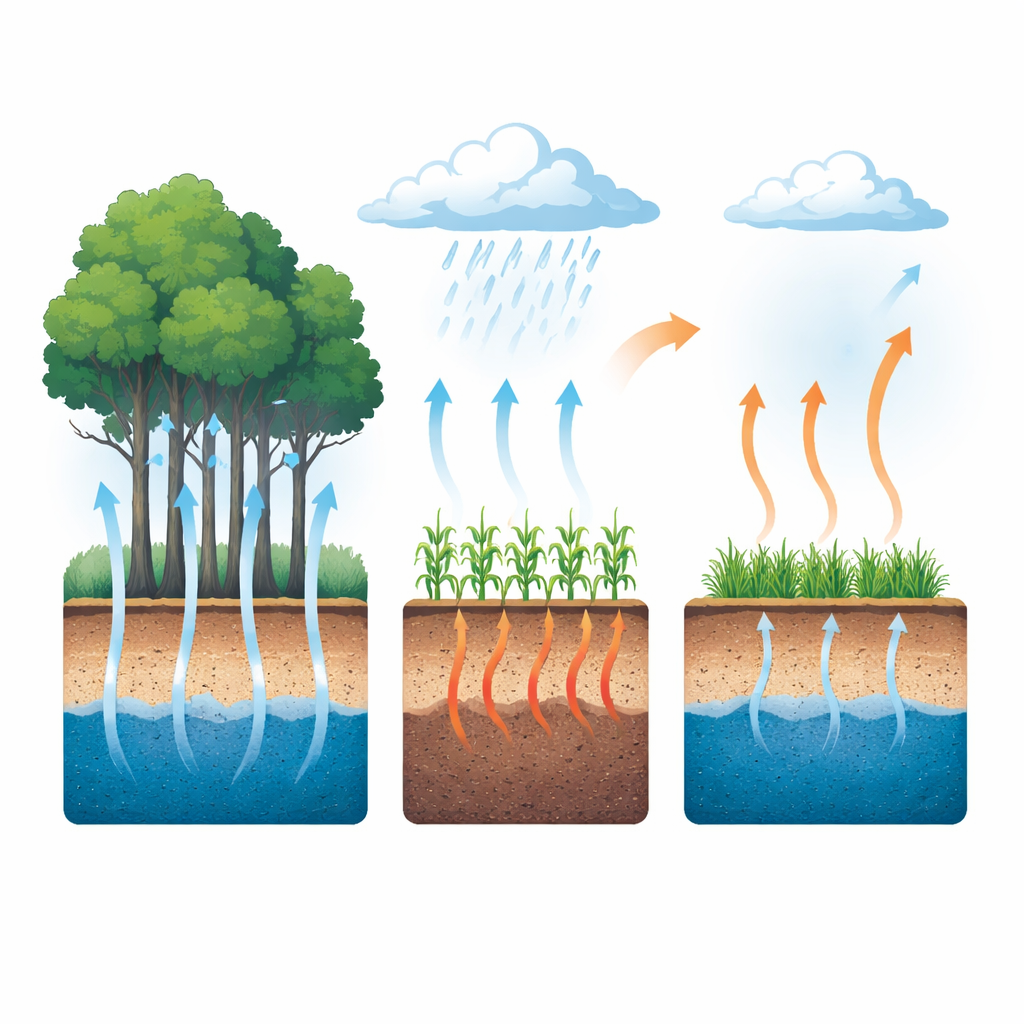
To resolve this, the study applies an “emergent constraint” approach that uses real-world observations to correct model behavior without rebuilding the models themselves. The key diagnostic is a quantity that compares how much incoming energy at the surface becomes heat versus how much becomes water flow through plant transpiration. Across models, there is a tight relationship between this ratio and the simulated impact of land use change on evapotranspiration. Because the ratio can be estimated from satellite and flux-tower data, the authors use the observed value to adjust the model-based estimates. This correction flips the global historical signal: instead of a small increase, worldwide forest loss since the early 1980s has likely caused a modest decrease in evapotranspiration, especially in the tropics and subtropics, and the spread among models is almost halved.
Regional shifts and future forests
Looking region by region, the constrained results show that land use change has strongly influenced local water fluxes in many parts of the world. In Central and South America, Southeast Asia, and parts of Africa, deforestation has likely reduced evapotranspiration much more than models originally indicated. The authors then extend the same framework to a future scenario in which global policy favors afforestation. After correction, planting trees is projected to increase evapotranspiration more strongly than models first suggested. However, in many tropical and subtropical regions the associated increase in rainfall partly or fully offsets the extra water loss from the land surface, so the net decline in water availability is weaker than previously feared, and in some regions water availability may even rise.
What this means for forests and water planning
In plain terms, the study shows that widely used climate models have been misjudging how different kinds of vegetation share incoming energy between heating the air and driving plant water use. That error has skewed their estimates of how deforestation and afforestation alter evapotranspiration and water resources. By anchoring the models to observations, the authors find that past forest loss has probably made many regions drier, while carefully planned future tree planting will still tend to reduce local water but not as severely as once thought, thanks to added rainfall. These improved estimates can help policymakers balance the carbon benefits of restoring forests against the risks and opportunities for regional water supplies.
Citation: Chen, Z., Cescatti, A., Xing, R. et al. Emergent constraints on the hydrological impacts of land use and land cover change. Nat Commun 17, 2908 (2026). https://doi.org/10.1038/s41467-026-69883-2
Keywords: land use change, evapotranspiration, afforestation, water availability, Earth system models