Clear Sky Science · en
CO2 radiative forcing induces summer cooling over India
When Global Warming Brings a Local Cool-Down
As the planet heats up, India has faced deadly heatwaves and record-breaking hot spells. Yet long-term measurements reveal a puzzling twist: during summer, parts of India have warmed far less than the global average, and some areas have even cooled slightly. This study digs into that mystery and finds a surprising culprit. Rather than smoke or ocean currents, the direct effect of carbon dioxide itself can set in motion weather patterns that make Indian summers a little cooler, even as the rest of the world continues to warm.
A Strange Cool Spot in a Hotter World
Most of us think of carbon dioxide purely as a warming gas—it traps heat that would otherwise escape to space. Globally, that picture is correct: Earth’s average surface temperature is now about 1.5 °C higher than before industrial times, largely due to human emissions. But when scientists map this warming, they find patchy regions called “warming holes,” where the trend is much weaker or even reversed. Such holes are already known in the North Atlantic Ocean and the southeastern United States. Recently, researchers noticed a similar feature over India, where observed summer temperatures have risen at only about half the global rate. Until now, explanations focused on man-made air pollution, shifts in large-scale winds, or increased irrigation, with no clear consensus.
Using Climate Models to Isolate CO2’s Fingerprint
The authors used state-of-the-art climate models from the Coupled Model Intercomparison Project (CMIP6) to ask a sharp question: if you increase carbon dioxide and strip away other complications, what happens to India’s summer climate? They compared two kinds of computer experiments. In one, the atmosphere feels higher CO2 but the sea surface is artificially held at today’s temperatures, blocking ocean feedbacks. In the other, the ocean is allowed to respond, but the researchers statistically removed the part of the change that comes from warmer seas. In both approaches, when CO2 levels were suddenly quadrupled, most land areas around the globe heated up strongly. Yet over India, south of the Himalayas, the models consistently showed a pocket of summer cooling near the ground, reaching several degrees in some simulations and amounting to more than 0.1 °C of cooling since the mid‑20th century.
How Extra Clouds Turn Down the Summer Heat
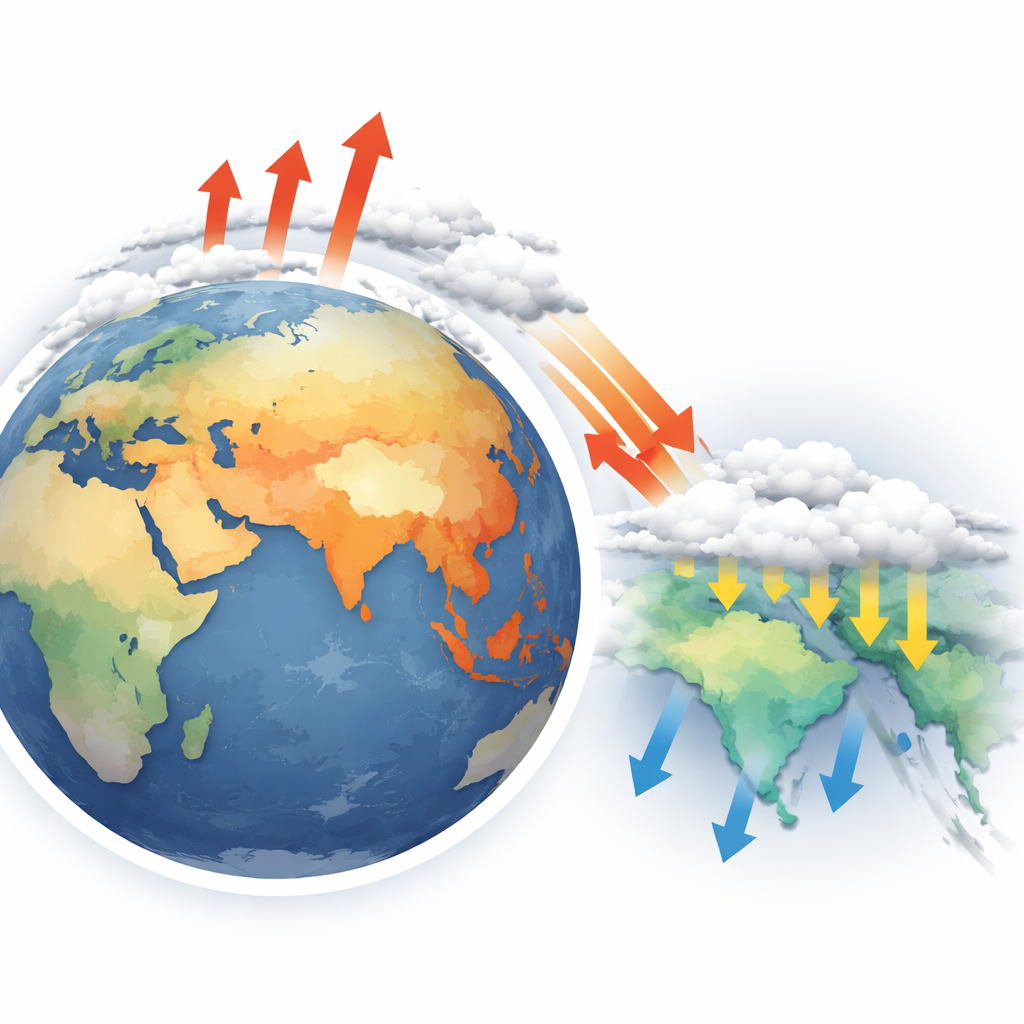
To understand this counterintuitive result, the team examined how energy flows at Earth’s surface. They found that the key is a reduction in sunlight reaching the ground, driven by thicker summer cloud cover. As CO2 rises, the vast Eurasian landmass to India’s north warms faster than the nearby oceans. This sharper land–sea contrast strengthens southwesterly winds that carry moist air from the Arabian Sea toward India. When that moisture hits the towering Himalayas and the Hindu Kush mountains, it is forced upward, feeding stronger rising motion and heavier clouds. These clouds act like a sunshade: they block incoming solar radiation, so the land below receives less direct heating. Near the surface, the cooling remains mostly in the lower troposphere—roughly the lowest few kilometers of the atmosphere—while layers higher up still warm.

Why India Cools but East Asia Does Not
One might expect that other rainy summer regions, such as East Asia, would show the same pattern. However, the models reveal a sharp contrast. Although East Asia is also humid in summer, clouds there tend to decrease under higher CO2, allowing more sunlight to reach the surface and leading to warming. The difference comes down to terrain and wind patterns. Over India, the high mountain arc to the north acts like a wall, focusing incoming moist air and intensifying upward motion and cloud formation. Over East Asia, where no comparable barrier lies directly across the path of the changing winds, this funneling effect is much weaker. As a result, the special combination of strong moisture flow, mountain blocking, and cloud thickening that cools India simply does not take shape farther east.
What This Means for Future Summers
The study shows that carbon dioxide can cool a region, not by cancelling global warming, but by reshaping winds and clouds in a way that locally shades the surface. This cooling is modest—on the order of a few tenths of a degree—and limited mainly to June through August, when moist monsoon air is abundant. Yet it matters. It means that current summer temperature trends over India hide part of the underlying warming that would be present without this cloud-driven offset. It also implies that as humanity eventually reduces CO2 levels to slow climate change, the loss of this cooling influence could allow Indian summers to warm more than expected. In short, the work underscores that global warming does not unfold evenly, and that mountains, monsoon winds, and clouds can all conspire to make one of the world’s hottest regions briefly, and paradoxically, a little cooler.
Citation: Liu, J., Qu, X., Huang, G. et al. CO2 radiative forcing induces summer cooling over India. Nat Commun 17, 2724 (2026). https://doi.org/10.1038/s41467-026-69875-2
Keywords: Indian summer monsoon, regional climate change, CO2 radiative forcing, cloud feedbacks, warming hole